Belgium passes Europe's first ban on wearing burka in public
Parliament hails bill as victory for women, but Amnesty condemns attack on freedom
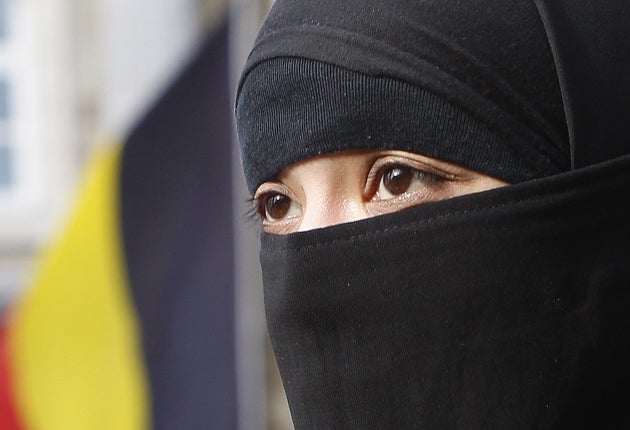
The first European ban on the wearing of the Islamic burka in public is poised to come into force in Belgium. A parliamentary vote on a Bill which bans face coverings has raised fears among Muslim groups and human rights campaigners that other countries could follow suit. France is already considering similar legislation.
"We are the first country to break through the chain that has kept countless women enslaved," said Denis Ducarme, a Belgian Liberal party MP. He said that he hoped other European countries would follow Belgium's example. Members of the Belgian House of Representatives called a truce to weeks of bitter feuding caused by the collapse of the government to push through the vote, giving it almost unanimous, cross-party support. The measure now has to be rubber-stamped by the Senate after June general elections to become law.
Amnesty International condemned the move as "an attack on religious freedom". Philippe Hensmans, of Amnesty Belgium, said it had been pushed through without a proper national debate. He said: "It's also not at all clear that it is in line with the Belgian constitution and with international human rights conventions."
The supposed anxiety of politicians in both Belgium and France about the burka "threat" to female dignity and Western values has its cynical side, say critics. But it also points to a Europe-wide shift in fear of Islam away from standard, right-wing race-baiting towards a more middle-class determination to defend liberal values. The Belgian move was particularly striking in that the country's linguistically divided politicians can agree on almost nothing. Yet they were able to find parliamentary time to ban the full-length veil even as the country teeters on the brink of division.
France too, although facing a multitude of economic and social problems is considering "emergency legislation" to ban the burka and niqab before politicians go on holiday in August. Yet the French security services estimate that only 2,000 out of approximately two million adult Muslim women in France – 0.1 per cent – wear the full-length veil. Edouard Delruelle, co-director of the Belgian Institute for Equal Opportunities said only about 215 women "at most" in Belgium wear the burka.
In neither Belgium nor France, is the burka or niqab a rapidly growing phenonemenon. But in both countries, anti-burka legislation has found support across the usual left-right political divide with opposition to the garment creating unnatural alliances between social conservatives and feminist pressure groups.
In Belgium, the idea was first proposed by the Flemish far right as "a first step against Islamisation". In France, the idea was first raised last summer by a communist mayor and parliamentarian as a necessary defence of the Republican values of "liberty" and "equality". President Nicolas Sarkozy ran with the idea, seemed to lose interest and then insisted earlier this month in pushing ahead before the end of July. His unpopularity and need to prop up his right-wing core support may have influenced his decision.
But the proposed French ban is supported by several senior figures on the French centre-left (and opposed by others). It is strongly supported by the feminist group, Ni putes Ni Soumises, which works for women's rights in the heavily male-dominated, racially-mixed French suburbs. They view it as an important declaration that certain Western values, including female equality, are not consistent with the more extreme forms of Islam.
The draft French anti-burka law will say that "no one can wear a costume in public places intended to hide the face", according to a leaked draft. The fine for a first offence will be €150 (£130). Forcing a woman to wear a full-length veil by "violence or threats" will also be an offence, punishable by a fine of €15,000.
The Belgian Bill outlaws any clothing that partly or fully covers the face and worn in public. Anyone flouting the rule could face a fine of up to €25 and, in theory, up to seven days in prison, though legislators say it is highly unlikely that would be ever be imposed. Builders, nurses or other professionals who might need to cover their faces have been exempted from the Bill.
Local authorities in Belgium have already been allowed to clamp down on head-coverings. Jan Creemers, the Mayor of Maaseik, a small town on the Dutch-German border, said he had used a local ruling to deal with a group of heavily veiled women. "It became a problem in our town because we had about 50 women who walked around like that, which really annoyed many other residents. They kept coming to me to ask me to do something about it," he told Belgian radio. "I spoke to a couple of these ladies to ask them very simply not to wear this kind of clothing. But one in particular refused point-blank so eventually the police opened legal proceedings against her."
Michel Doomst, a Flemish MP, added: "If you have people who cover themselves up entirely, it sends out a very wrong signal to society. And that's why there was so much pressure from parliamentarians and why there's been cross-party support to do something about it."
But it could be many months before the Senate endorses the ruling. The present political upheavals and disputes between the Francophones and Flemish over language and voting rights make it likely that it will slip to the bottom of the agenda, and constitutional experts are likely to refine the legal wording of the text, parliamentarians say.
Join our commenting forum
Join thought-provoking conversations, follow other Independent readers and see their replies
Comments