Briton arrested over 1996 murder of French film-maker
Former journalist in court after Irish bow to French pressure over the killing of woman in Cork
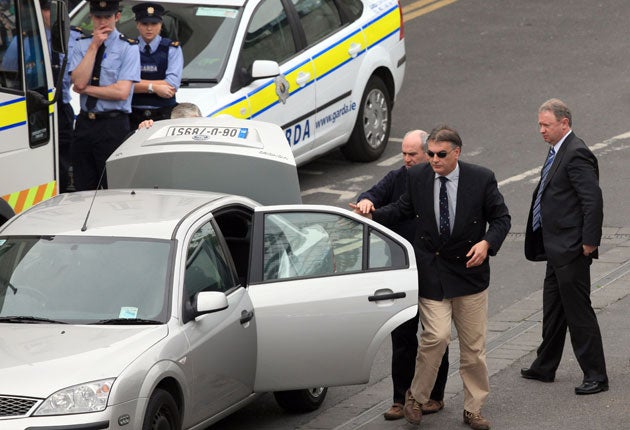
Ian Bailey, a British former journalist suspected in connection with the murder of a French film-maker in Ireland 14 years ago, said he was being unlawfully detained after Irish authorities bowed to a request from France to validate a European Arrest Warrant at Dublin's High Court.
Mr Bailey, 53, was arrested just before midnight on Friday at his home in Schull, West Cork, where he was served with the extradition warrant in connection with the murder case of 39-year-old Sophie Toscan du Plantier, who was found beaten to death outside a holiday home at Toormore, near Schull, in 1996.
"This is an illegal arrest and based on false information," he is alleged to have told officers. Appearing at the High Court after a short hearing yesterday, Mr Bailey was remanded on bail. The court will reconvene on Wednesday.
The decision to arrest Mr Bailey and endorse the warrant marks a new phase in what were increasingly tense relations between Irish and French authorities over the murder case that saw an extensive Irish investigation fail to press any charges.
Mr Bailey, who became the prime suspect during an Irish investigation, denies any involvement in the death, and has vowed to fight "tooth and nail" against any extradition attempts.
But the news was welcomed yesterday by the victim's family. Jean-Pierre Gazeau, the victim's uncle, told the Irish Times: "It is so heartening for Sophie's parents, Georges and Marguerite, because they have been waiting for 14 years for something like this. We fully expect Mr Bailey to fight this in the Irish High Court and the Irish Supreme Court if necessary, so we still have many more steps to travel, but tonight our hope grows a lot stronger."
Mr Bailey, who is studying for the final exams of a law degree at University College Cork, has twice been arrested by Gardai, in 1997 and 1998. No charges were pressed, with the Director of Public Prosecutions in Ireland announcing no one would be charged.
The former freelance journalist, who moved from London to Cork in 1991, is set to fight a protracted legal battle opposing extradition to France.
Mr Bailey's solicitor, Frank Buttimer, suggested earlier this month that his client would appeal to the Irish Supreme Court to fight on the grounds that granting a warrant in such circumstances raised broader constitutional issues, not least that the European warrant does not allow the removal of a suspect from Ireland when the Director of Public Prosecutions has already ruled there is no case to answer.
Yet the decision to endorse a European Arrest Warrant marks the turning point of a case that has intensified an increasingly fractious diplomatic relationship between Ireland and France. The Irish investigation has been fiercely criticised in France, with the decision not to press any charges infuriating Parisian authorities who immediately appointed their own judge, Patrick Gachon, to re-examine the case.
French lawyers argue that they have jurisdiction over the case, citing the French constitution which states that murder cases involving French citizens in any part of the world can be brought in front of French courts.
Judge Gachon's investigation is thought to have fast-tracked the decision to implement a European Arrest Warrant, which came amid increasing pressure from the victim's family. Lawyers from the Irish Chief State Solicitor's Office went before Mr Justice Michael Peart, in the High Court on Friday, who endorsed the warrant.
Mrs Toscan du Plantier's beaten body was discovered outside her holiday home two days before Christmas in 1996. In the house, two wine glasses were found on the kitchen table, and a book of poetry by her bedside was opened at WB Yeats's poem, "Death".
The preliminary inquest revealed that she had suffered severe head and facial injuries caused by a blunt instrument. The murder weapon has never been found. Mrs Toscan du Plantier had been writing documentary film scripts after becoming estranged from her husband, Daniel Toscan du Plantier, who died in 2003.
Lawyer Alain Spilliaert, who advises the Toscan du Plantier family and their supporters, described the decision to grant the warrant as a historic moment in the long and very determined struggle by the family.
Join our commenting forum
Join thought-provoking conversations, follow other Independent readers and see their replies
Comments