Carla caught up in backlash over minister's 'sex tourism'
Sarkozy under fire for letting First Lady persuade him to appoint controversial Mitterrand junior to cabinet
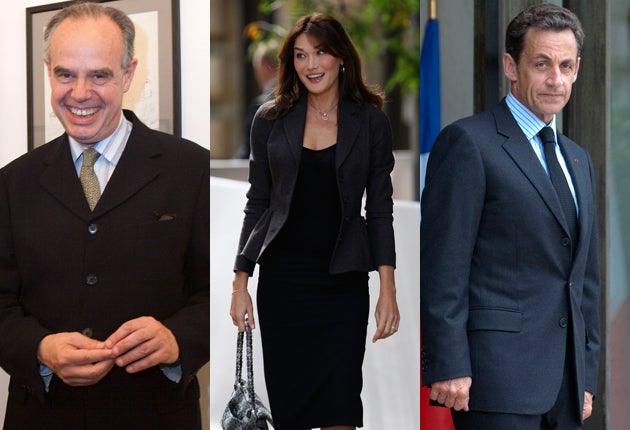
Nicolas Sarkozy's presidency – and especially his relationship with his conservative followers and voters – has been seriously undermined by the "sexual tourism" scandal which has engulfed his Culture Minister, according to centre-right politicians.
Parliamentarians in the President's own party suggest that the "Frédéric Mitterrand affair" – whatever its rights and wrongs – has alienated the older, traditionalist voters who turned out for Mr Sarkozy in 2007 after he promised to roll back the influence of a "left-liberal, post-1968", cultural elite.
Some centre-right parliamentarians blame the scandal on what they call the "bo-bo [bourgeois bohemian] values" brought to the Elysée Palace by the President's wife, Carla Bruni-Sarkozy.
"No one suggests that Carla Bruni is personally to blame but there seems to have been a shift, or a confusion, in the President's values since she appeared on the scene," said a parliamentarian from the President's party, the Union pour un Mouvement Populaire (UMP). "It is generally believed that Frédéric Mitterrand's appointment as Culture Minister was influenced by the first lady."
Mr Mitterrand, 63, France's first openly gay cabinet minister, went on prime-time television on Thursday to deny that he had paid to have sex with under-age boys or defended "sexual tourism". In his best-selling autobiography, Une Mauvaise Vie (A Bad Life), published in 2005, he described his experiences in sex clubs and brothels in Thailand in which he said he "got into the habit of paying for boys".
In an emotional and angry interview on France's most-watched television news programme on Thursday, Mr Mitterrand – formerly a TV presenter – admitted paying for sex but said that what he referred to as "boys" were "men of my own age" including a "40-year-old boxer".
The text in the book is ambiguous. It refers to the "juvenile charms" of some boys in the clubs but also talks of one male prostitute as being "built like a kick-boxer".
The book has come back to haunt Mr Mitterrand since he made an outspoken defence two weeks ago of the film director Roman Polanski, who was arrested in Switzerland for the statutory rape of a 13-year-old girl in California in 1977.
The far-right National Front – followed by some leaders of the main opposition party, the Socialists – has called on Mr Mitterrand to resign.
Mr Sarkozy, without making any public comment on the affair, has let it be known that Mr Mitterrand, the nephew of the late president François Mitterrand, has his full backing. In July, Mr Sarkozy described the book as "brilliant and courageous".
The affair could not have exploded at a worse time for Mr Sarkozy. As he nears the halfway point of his five-year presidency, his opinion poll ratings are slumping and he has quarrelled with his own centre-right parliamentary troops over a range of issues from carbon taxes to local government reform.
A potential row is also brewing – with both right and left – over the alleged "nepotist" influence which has made the President's 23-year- old son, Jean Sarkozy, a leading candidate to become the head of the body which controls La Défense, France's largest office development, just west of Paris.
The Mitterrand affair has crystallised a deep unease within his party about Mr Sarkozy's apparent drift towards a more left-liberal agenda on some – but by no means all – issues. Mr Mitterrand's appointment in June was already seen as deeply controversial among the more traditional UMP deputies and their supporters. "Our electors don't like homosexuals and they don't like culture. If you put them both together, then..." said one UMP deputy, who was only partly joking.
During the 2007 election campaign, Mr Sarkozy made a series of barn-storming speeches in which he promised to repair the moral damage allegedly caused by the May 1968 student revolution in France and pledged to remove the power of an allegedly effete, left-liberal cultural "elite".
To many UMP deputies, the appointment of Mr Mitterrand, even before they were reminded of the contents of his book, flew in the face of this pledge.
Mr Sarkozy's policy of opening his government to racial minorities and figures from the left has always angered UMP politicians. They now regard the Mitterrand scandal with a mixture of horror and schadenfreude. "The [UMP] majority in parliament has been relatively quiet," said one government deputy, Marie-Anne Montchamp. "But you have to pay attention to the little cracks. It is like with porcelain, you can't see them with the naked eye, but if you pour in water which is too hot, or too cold, the cup breaks."
The Paris press was mostly supportive of Mr Mitterrand and Mr Sarkozy yesterday. The centre-left newspapers Le Monde and Libération said that the country should be careful not to put Mr Mitterrand on trial for being a homosexual and that his assurances on television that he had never paid for sex with boys should be accepted.
The alternative was to "pry into his private life", Libération said, which would represent a fundamental shift in French political attitudes.
Provincial newspapers were less accommodating. The République du Centre spoke for many regional titles – and possibly many provincial voters – when it said that "absolving Mr Mitterrand will completely scramble Mr Sarkozy's message that he is leading a pitiless struggle against all types of criminality".
In his words: Extract from A Bad Life
*Obviously, I have read what people write on the trade in the boys here [in Thailand] and seen piles of films and reports. Despite my doubts about the duplicity of the media, I know there is some truth in their quest for sensation... the overwhelming misery... the role of the local mafia and the mountains of dollars it generates, leaving only crumbs for the boys, the drugs which ravage and enchain them, the diseases...
I square all that in my mind with a good dose of ordinary cowardice... I never stop thinking about it but it doesn't stop me from coming back.
All these rituals of a fair for the sale of Adonises, of a slave market, excite me enormously ... the profusion of very attractive and immediately available boys, puts me into a state of desire which I no longer need to restrain or conceal ... I can choose, judge, make up stories about each boy: they are there just for that and me too.
I can choose at last. I have something they have never had: a choice ... Western morality, everlasting guilt, the shame I carry around with me, shatter into fragments. And let the world go to hell, like the man said."
Join our commenting forum
Join thought-provoking conversations, follow other Independent readers and see their replies
Comments