Chariot of ire: museum told to return Etruscan gem to Umbria
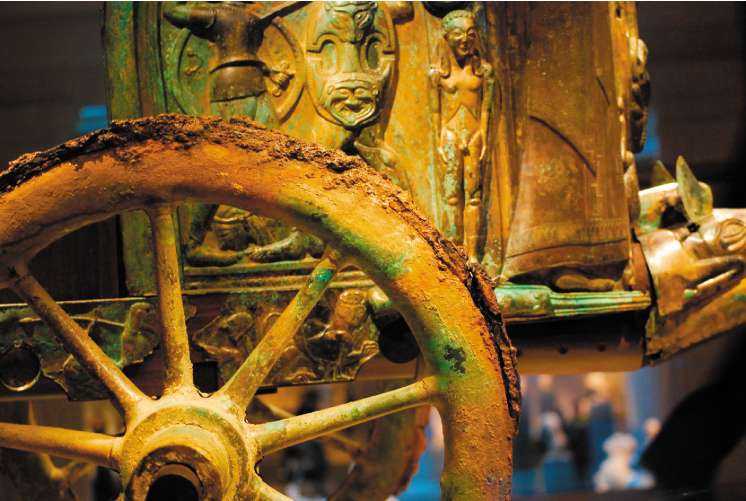
It must have given him a nasty scare, but the day Isidoro Vannozzi fell into a hole in the ground was the luckiest day of his life.
The farmer was digging in front of his half-built house near Monteleone in Umbria when the ground gave way and he tumbled in – to find himself inside a domed, stone structure four and a half feet high. At his feet in the gloom lay two skeletons. Metallic objects glinted around them. Between the two skeletons was a thing with two wheels, a small carriage and a long pole: a chariot.
It was 1902 and Vannozzi had stumbled upon an Etruscan tomb from the 6th century BC; sealed with its aristocratic corpses and their treasures in an Italy about which we know tantalisingly little. The tomb had remained inviolate for 2,500 years and its treasures were in mint condition.
For more than a century the chariot Vannozzi discovered has been one of the glories of the Metropolitan Museum in New York. But if Nando Durastanti, mayor of Monteleone, gets his way, some day soon it will be coming back to the town where it was found.
Since 2004 Mr Durastanti and his supporters have been conducting a noisy campaign to have the chariot returned. They have had the support of a lawyer born in the town but long resident in Atlanta, Georgia, who has bombarded the Met with letters. But as of today the chariot remains grounded in Manhattan.
After Vannozzi's discovery, the pots quickly found a place in their kitchen and the chariot was used in their children's games. Then two months later he took a sample pot to the nearby town of Norcia to see if he could find a buyer. He called in on a man called Benedetto Petrangeli, owner of a trattoria outside the town gate, who did some side business in antiques. "I've got lots of old stuff like this at home," he said, flourishing his pot.
When Petrangeli and his partner dropped by they were astonished to find Vannozzi had unearthed a chariot in extraordinary condition, decorated with scenes from the life of Achilles.
Vannozzi's house was still unfinished. "How much will it cost to put a roof on your house?" Petrangeli asked him. "A thousand lira," was the reply. "Look, for this old stuff I can't go higher than 950 lira." The deal was sealed with a handshake. Petrangeli had struck the bargain of a lifetime. And so "La Biga di Monteleone", "the Golden Chariot" as it is now known in America, began its long journey.
From Monteleone it travelled to Norcia, and from there to Rome, where it was hidden in a chemist's shop, because it was hot property. According to Mario la Ferla, historian of the chariot, the Italian parliament had just passed a law on the conservation of ancient treasures. Italy was awash with souvenir-hunting foreigners, and Italian dealers were happy to keep them supplied. But for the first time the government was at least thinking about taking a stand on the issue.
Petrangeli sold the chariot to Amadeo and Teodoro Riccardi, cousins and notorious forgers, for an unknown sum, and the Riccardis sold it on to the American financier J P Morgan for 250,000 lira. Besides being one of the richest men in the world, Morgan was also a connoisseur of art, and a pillar of the Metropolitan Museum in New York. The chariot was dismantled and taken to Paris by train, hidden inside other merchandise.
At least this is the version of the chariot's departure from Italy credited by Mario la Ferla. The authorised version has the chariot arriving in Paris by mysterious and unknown means, and only then coming to the attention of Morgan – a version which conveniently expunges the financier of any guilt in the chariot's theft. Because although precious antiques were flying out of Italy in those days, the chariot was a special case. When it arrived in New York in November 1903 its theft sparked an outcry in the Italian parliament. Morgan, who had previously been in trouble with the Italians for other acquisitions, needed to be disassociated from the theft. And so he was.
In New York the chariot was re-assembled – wrongly, it was later discovered – and quickly became one of the museum's biggest draws. Today, after a six-year restoration during which it was put together correctly, it is again a star.
Monteleone, meanwhile, is languishing. Crowded around the summit of a steep hill in the pretty Umbrian countryside of Valnerina, the town has been losing people for decades. Today the population is about 650. It has its abandoned Franciscan monastery, a pretty main street, a mood of sleepy languor, a sense of being stuck somewhere in the 1950s, all of which are deeply appreciated by people flashing through from the big city – but not special enough to put the place on the map. Monteleone is famous for what it has not got, what it cannot get back. And that's not enough.
Who were the Etruscans?
The Etruscans were an ancient, seafaring people who flourished in Italy. Although the origins of their civilisation are unclear, experts have found traces of a distinctive culture going back to around the 9th century BC. The Etruscans were skilled craftsmen who created lavish works of art that they traded with the peoples of the eastern Mediterranean. They believed in the supernatural, and several huge necropolises – cities of the dead – have been found in their former territories.
Join our commenting forum
Join thought-provoking conversations, follow other Independent readers and see their replies
Comments