Civil rights lawyer shot dead in Moscow
Champion of Chechen abuse victims is killed near Kremlin in street attack
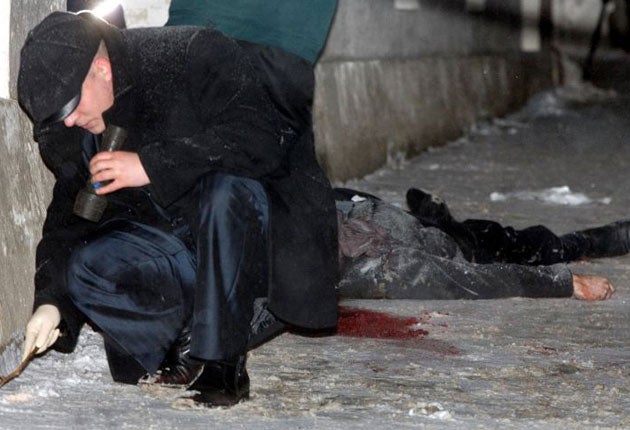
A human rights lawyer who unsuccessfully fought the early release of a Russian colonel convicted of murdering a Chechen woman has been shot dead on a Moscow street. A journalist who tried to intervene was also killed.
The shooting of Stanislav Markelov in broad daylight has angered Russia's beleaguered rights activists and Chechens already upset by the release last week of Colonel Yuri Budanov.
"This is a horrible, frightening crime," said Tatyana Lokshina of Human Rights Watch. She compared it with the murder in 2006 of the investigative journalist Anna Politkovskaya – a client of Mr Markelov's who also fought human rights abuses in Chechnya and around Russia. Mr Markelov, 34, was gunned down after giving a press conference in central Moscow, about half a mile from the Kremlin.
He had told reporters that he was considering filing an appeal to international courts against the early release of Colonel Budanov, who was convicted in 2003 and sentenced to 10 years – including time served – for strangling 18-year-old Heda Kungayeva in 2000. He had admitted killing her, saying he believed she was a Chechen insurgent sniper. Mr Markelov represented her family.
A deputy editor of the Novaya Gazeta newspaper, Andrei Lipsky, said that a freelance journalist Anastasia Baburova, who had written for the paper, was shot when she tried to intervene after Mr Markelov was hit. Ms Baburova, who was in her mid-20s, was taken to a hospital but died on the operating table.
Colonel Budanov was freed last week with more than a year left on his murder sentence. His case was closely watched as a test of the authorities' determination punish rights abuses in Chechnya. The release drew criticism from rights activists and lawyers, who pointed out that inmates convicted of nonviolent crimes but considered Kremlin foes – such as the former oil tycoon Mikhail Khodorkovsky – have been refused early release. Mr Markelov had also represented activists who have campaigned against abuses by Russia's military, and a Chechen woman who was a victim in a 2002 hostage-taking attack on a Moscow theatre. "He was always on the front line," said Alexander Cherkasov of the human rights organisation Memorial.
Mr Cherkasov said Mr Markelov was instrumental in another case involving alleged atrocities by the Russian military in Chechnya – the 2005 conviction of a police officer, Sergei Lapin, who was jailed for 11 years for the torture and "disappearance" of a young Chechen man. Mr Markelov spent months trying to persuade authorities to prosecute Lapin for allegedly threatening Ms Politkovskaya's life.
In April 2004, Mr Markelov was riding home on the Moscow subway when five young men accosted him and beat him unconscious. When he awoke, his mobile phone and papers relating to the Politkovskaya case were gone.
A Chechen MP, Isa Khadzhimuratov, said he believes Mr Markelov's killing was probably connected to the Budanov case. "When one needed a bold journalist, there was Politkovskaya, when one needed a bold lawyer – there was Markelov," said Lev Ponomaryov, a human rights activist.
Join our commenting forum
Join thought-provoking conversations, follow other Independent readers and see their replies
Comments