Costa lot: Expats forced to tighten their belts
Sterling's dramatic fall against the euro has forced British expats who retired to sunny, low-cost Spain to adopt a more frugal lifestyle. Elizabeth Nash reports
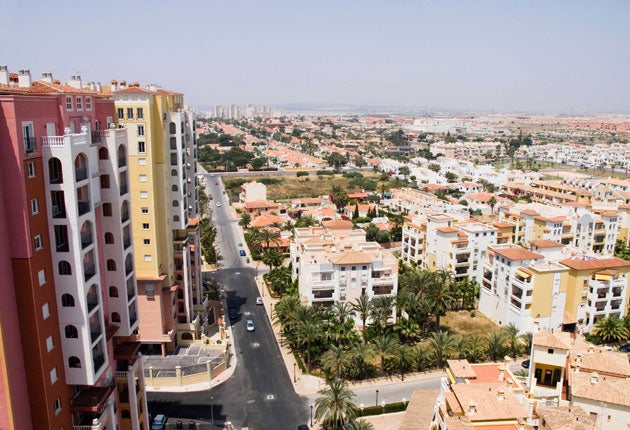
Eugenie Smith, a sprightly 82, still drives her Ford Fiesta to the shops in Torreblanca near Fuengirola, and helps in the charity shop twice a week at the church group, The Ark, run by her son, David, who is pastor there. But the former teacher from Windsor, who moved to the Costa del Sol 26 years ago, struggles to pay her bills since the pound plunged to its lowest level against the euro.
"I've got to keep the car," she says. "I've got spinal trouble so I can't walk up the hill carrying shopping, and there are no buses. And I must keep the gardener; I can't do it myself now, and can't let it run wild. But I don't think I can afford €34 (£29) for my club's Christmas dinner this year. I've got a new great-grandson I want to buy presents for, but I must be much more economical now, when last year I just went out and bought things."
With her teacher's pension supplementing her state pension, Mrs Smith reckons she is luckier than many of the tens of thousands of British pensioners living in Spain whose income has been slashed by more than 20 per cent in a year by the falling pound. But she's cutting back sharply. "My income doesn't cover my outgoings. I must dip into savings for extras, unexpected things. I've just paid €160 at the dentist, and now I need new glasses. It's sunny now, during the day, but it gets cold at night. I wrap a blanket round me rather than put the heat on too early. I'm terrified of my winter heating bills. How long is this going to last? That's what worries me."
The erosion of modest fixed pensions worries many Britons on the Costas, who are experiencing their most difficult financial moment since they started settling here en masse in the 1960s and 1970s, drawn by the sun, and low-cost living. Some 220 miles east on the Costa Blanca, south of Alicante, Torrevieja was purpose-built 20 years ago to attract British incomers, especially retired people, to the sun-drenched, leisurely Mediterranean lifestyle. "It's disastrous for British expatriates on fixed incomes," says Graham Knight, a former policeman who works at Torrevieja town hall representing British residents in the town. "Most of those settled here are on fixed state pensions, and now face costs rising day by day. They've been feeling the pinch for six months or so, since the pound dropped from its January level of around €1.40. Now it's €1.16, and that causes substantial hardship. People are extremely worried."
Judith Ferris, who runs Age Concern in Torrevieja, argues bravely that southern Spain's good health care, gentle climate and a cost of living generally lower than Britain's soften the impact of the plunging pound. But she concedes: "People don't have spare money; those who don't know Spanish must pay translators when they visit the doctor. As they get older, they don't get the benefits, such as attendance allowance, the home care they would in Britain. Some tell me they feel trapped, knowing their money doesn't go as far as it did." This Christmas will be bleak for many, Ms Ferris reckons. "They can't send cards, because post is expensive. We hand out Christmas hampers to those in need: we ask neighbours and friends to let us know, because people are proud and won't tell us themselves they're struggling. Our hampers used to contain little luxuries such as a Christmas pudding or tinned peaches. This year, forget it: they'll contain essentials, washing powder, soup, toilet rolls and the like." And how many will be handed out? "Last year, we distributed some 40 hampers. This year it'll be double that." Dick Conway, active in Torrevieja's ex-service organisations, says: "People are really hurting. They've seen their income fall in value by up to a third in less than a year. Two years ago, those on a basic state pension could get by. Now they're struggling, just as they are getting older and needing more help." Mr Conway is organising Christmas lunches and weekend outings for members. "But this year, people tell me, 'We can't come this time; we're busy doing something else'. The truth is they can't afford it, but they're too proud to say."
Irfon Walters, 75, bought his flat with his wife, Glenis, in Torrevieja eight years ago; they live on a basic state pension whose value has recently dropped €100 a month. "We have to budget a lot more. I'm having to reconsider subscriptions to clubs I've been a member of for 35 years. Luxuries? We've said goodbye to them. Last Christmas, we took a long break to Benidorm. This year, we're chumming up with a couple of friends to cook Christmas dinner together, to make it go further. If the pound drops further, we'll worry. But we hope to sit it out."
Those who can, return to Britain, as their dream of a life in the sun shrivels and dies. Others buckle under the strain. "In the past year, we've helped a lot of families and single people who are going through a hard time," says David Smith, at The Ark in Fuengirola. "Some in real hardship are going back, to stay with family or take up benefits from the British welfare system. We've helped a lot of people with flights. Difficulties often lead to arguments and family break-ups, and some take to alcohol and drugs as a means of escape, and find themselves on the streets. It's a very sorry state of affairs."
For most, returning is not an option. Few admit publicly they want to sell up and go, because, Graham Knight in Torrevieja points out, "that would be an admission of failure". Most share the view of Eugenie Smith. "We've sold our property in Britain, our children are scattered; there's nothing to go back to. Anyway, we like it here, we like the sunshine, we've made friends here, it's our home."
But the sociable, laidback lifestyle that expatriates value so highly is being brutally cut back. "We used to lunch out two or three times a week, at restaurants offering a four course daily menu costing between €8 and €15," says Colin Harlow, 64, from Kent, who took early retirement, sold up and moved to La Mata, outside Torrevieja, nearly five years ago. "Now we eat at home. It's hit local businesses hard. Last year, you'd have to reserve a table in a restaurant. Now they're deserted."
Mr Harlow, unlike many compatriots, makes an effort to learn the language and join in Spanish society. He does confess he misses English church bells, and rain, but he is committed to his adopted homeland. Yet he has been shaken by recent events. "You base your income on the rate of exchange. We always believed the pound would be strong. We expected fluctuations, but not this freefall. We'll have to tighten our belts and battle on. But if the pound hits parity with the euro, that would be a problem."
Join our commenting forum
Join thought-provoking conversations, follow other Independent readers and see their replies
Comments