Czechoslovakia: the unfinished revolution
1989 Europe's Revolution: As Czechs prepare to celebrate 20 years of freedom, they are also reflecting on what has been achieved since the fall of Communism. John Lichfield reports from Prague
The patron saint of the Czechs stares from his plinth in the centre of Prague with a genial, perplexed expression. It is 20 years since Good King Wenceslas last looked out on the frozen and cheerless political landscape of Communism. But each day, he still confronts rival forces contending for the soul of the Czech people. The equestrian statue of the martyred 10th-century King of Bohemia gazes out at well-dressed Czech shoppers – in ranks deep and crisp and even – as they make for Marks & Spencer and Debenhams and the two McDonald's on Wenceslas Square.
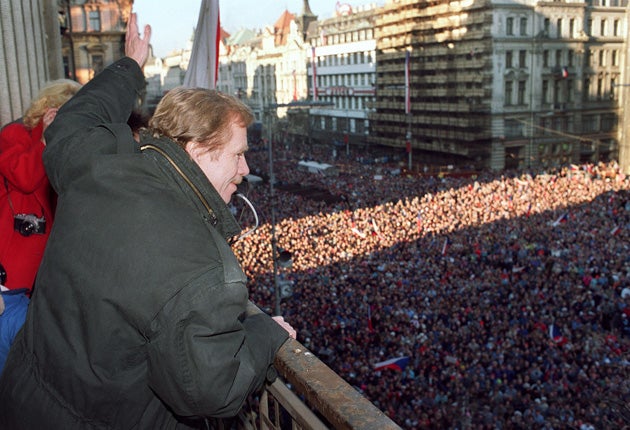
He also faces three lurid, Russian-owned casinos, which are permanently open and frequently empty – beach-heads for the Russian "commercial" interests which are seeking to re-colonise the Czech Republic. Wenceslas Square in Prague is actually an elongated and sloping oblong, more like a boulevard. This was the epicentre of the Velvet Revolution: the protests which dissolved the most rigid, joyless and complacent regime in the Soviet bloc in just over a month in November and December 1989.
The movement began after the brutal repression of a peaceable student march as it tried to reach the king's statue 20 years ago today. Czechoslovakia, as it then was, leapfrogged from being the most reluctant to the most total and pell-mell of Soviet bloc reformers. It was one of the later dominoes to fall but the completeness of Czech Communism's collapse hastened the pace of reform in Poland and Hungary and, some historians argue, ensured the demise of the Soviet Union itself.
All the same, two decades on, there is uncertainty about how the Velvet Revolution should be commemorated. There are doubts about how many Czechs will take part in the celebratory marches planned today. There are persistent, or revived, questions about the revolution itself. How could such an intransigent regime have collapsed so rapidly, without bloodshed?
To mark the anniversary, panels have been erected in Wenceslas Square to celebrate heroes of the pre-1989 Czech resistance. One is dedicated to Stanislav Penc (pronounced "pence"), who was arrested and beaten for, among other things, establishing a cult of Lennon in opposition to the cult of Lenin. The panel shows him 20 years on, driving a tractor and still wearing his hair at protest length. A few yards away, on the terrace of a café, we met Stanislav Penc in person.
He runs a vaguely Green, rural-values pressure group called "friends of goats", which also has a more vulgar meaning. In Czech, the words for goats and tits are similar. He complains that no one has asked his permission to include him in the exhibition of official heroes of the Velvet Revolution. "This is typical of how 1989 is being commemorated in the Czech Republic," he said. "By shoving up people's photos without permission and quoting them as saying things that they never said."
Mr Penc is still a dissident because, he complains, the "moral element" of a revolution partly led by poets and pop singers was rapidly submerged in a rush to make fortunes from flogging off the state.
"Back then, we saw a corrupt, stupid minority were running the country in their own interests. We at least had the satisfaction of getting rid of them. But what do we have now? A corrupt, stupid minority is running the country in its own interests."
This is a cartoon view even if, like all good cartoons, it has some truth to it. The Czech Republic, 20 years on, has much to be proud of. It can look back on its peaceful separation from Slovakia in 1992 (the "Velvet Divorce") and its achievement of a relative, if uneven, prosperity. It can claim to have lived through the longest period of independence in modern Czech history. Czechs themselves tend to dwell on their failings and disappointments. This is, not for nothing, the country of Kafka and the Good Soldier Schweik.
The Czechs, according to themselves, are a nation quick to complain, but slow to protest; they are fundamentally passive but hate to be told what to do. Democracy does not come easily to the Czechs. Corruption is rife. Interest in politics is lamentably low. The Czech Republic even managed to scar its first presidency of the EU earlier this year by stumbling accidentally – or maybe not so accidentally – into a government collapse. Younger Czechs tend to be doubtful about the heroic, and sometimes simplistic, official version of the Velvet Revolution. They point out that it started a week after the fall of the Berlin Wall; and months after the pack ice started melting in Moscow, Budapest and Warsaw.
What, they ask, took our parents so long? Silvie Mitlenerova, 21, complains that the planned march through Prague today has been organised like a "circus parade", with TV-pleasing stunts such as mass balloon releases and people dressed in devil suits to represent the old regime. She said, "Let's celebrate, great, yes, but let's reflect a little as well."
All the same, many intelligent voices, both old and young, are happy to pause and, give thanks – critically – for what the Czechs have achieved. Lubos Dubrowsky was a Communist in his youth and an intellectual dissident in the 1960s. After the suppression of the Prague Spring reforms of 1968, he was forced to work as a window cleaner and boiler stoker. He was a signatory of the Charter 77 demands for human rights in 1977 and part of the Civic Forum, led by the poet and playwright, Vaclav Havel, which negotiated the surrender of Communism at the end of 1989. He was later defence minister for a while and, at 77, still writes on Czech politics and foreign policy.
He is critical of many of the choices made in the past 20 years: especially the hand-brake turn from state control to the extreme and "unethical" market ideology of the early 1990s, which generated widespread corruption. He blames this approach on the influence of Vaclav Klaus – an ultra-liberal economics adviser and prime minister in the 1990s and now the non-executive Czech President.
"There were many chances missed. But who didn't miss these chances?" Mr Dubrowsky said over a glass of beer in his favourite Prague café. "I am satisfied that we have managed to advance. We can live freely now in this country. The quality of life is comparable to not only the other countries of the former Soviet bloc but also – in large areas – to Austria." Lubos Vesely, 33, is a
respected young historian who works for the foreign ministry committee on Polish-Czech relations. In November 1989, he was 13 and his parents advised him to stay away from the anti-regime demonstrations but he went along anyway.
"Imagine if in 1989, or even 1990, you had spoken to an optimistic Czech, if you could find such a thing. You tell him, or her, that in 20 years' time their country will be a member of the EU and Nato and that Czechs will be able to travel to Germany or France, without even showing a passport. You tell them their children will aspire to places in good schools and universities, without holding high rank or pulling strings. He or she would have told you ... that you were completely mad."
What did happen in the Velvet Revolution? Ivan Spirakus, 43, is now chief executive of his own insurance brokerage. He was one of the students who marched into central Prague 20 years ago today. "We had no idea what we were starting," he said. "You have to remember that this started as an authorised demonstration by the Communist party's youth league. We knew a little of what was happening already in East Germany and Poland and Hungary. But we had no expectations of great change in Czechoslavakia. There were a few speeches by students but nothing very radical..." The brutal suppression of the demonstration by riot police, when the students tried to reach Wenceslas Square, caused great popular anger. These were, after all, not long-haired dissidents but ordinary students. Demonstrations began in Wenceslas Square the next day, growing in a week to up to 800,000 or a million strong.
Mr Spirakus said: "I can't describe the feeling in those gatherings, a feeling of warmth, and excitement and fellowship of a kind that I have never felt since." Precisely because Czechoslovakia had seemed so frozen, the demonstrations attracted intense media interest. The waving of keys by hundreds of thousands of people created an eerie whispering sound, like a rising wind of change. Those whispering keys remains one of the most remembered events of 1989.
The movement for reform seemed to come not from the power elite but from the grass roots. "The keys began because no one had bells," said Mr Spirakus. "Bells were the traditional Czech way of saying something is over. Someone produced their keys, and we all had keys, so we waved them to say goodbye to Communism." There are many theories about why the Communist power structure collapsed so rapidly.
The young historian, Lubos Vesely, believes that the rigidity of Czech Communism, its incapacity to consider true reform, and the withdrawal of Moscow's military support, generated a kind of panic. "They tried to fob off the dissidents with cosmetic reforms. When that failed, they had no Plan B. Some of the younger apparatchiks saw a way of saving their own careers by, in effect, swapping sides."
Mr Dubrowsky, the intellectual boiler-stoker who helped to negotiate away Communism in a matter of weeks, says much of the credit should go to Vaclav Havel, the poet and playwright who was in prison in 1989 and President by early 1990.
Rather than accept concessions which would have seemed wonderful a few months earlier, Mr Havel grasped that the power structure was falling apart. "People call it the Velvet Revolution, I call it regime change," Mr Dubrowsky said. "It was Havel who said that we no longer want concessions. We want power."
Mr Penc says the 1989 revolution was "too rapid and came two years too early". As a result, he says, the forces of "moral dissidence" did not have time to create a true democracy, to govern in the interest of the majority of Czechs. Instead, the revolution was confiscated by a rapid deal between some dissidents and moderate, or opportunistic, elements within the old regime. The Czech Republic is, he says, is still paying the price, in widespread public corruption, voter apathy and increasing, dubious Russian investment in its economy. (A much rubbished book by President Vaclav Klaus, denying the evidence for climate change, was subsidised by a Russian oil company. There was little public outrage.)
Ivan Spirakus, the student marcher of 1989 turned insurance chief, says that – fast or slow – the transition from totalitarianism to democracy would always have been a nightmare. "Someone once asked me 'When did the Czechs suddenly decide that it was OK to steal?' I said you have to remember that everything used to belong to the state. It was normal to try to cheat the state before 1989 and some people thought that it was normal to steal afterwards."
The great hope of the Czech Republic, he says, must be the young people born in 1989, or just before, who have no memories of the ancien regime. Silvie Mitlenerova and Jiri Boudal, 23, are the founders of Democracy Czech-Up or Inventura Demokracie, a student movement to encourage young Czechs to take an interest in politics and public life.
Jiri Boudal, a philosophy student at the Charles University in Prague, said: "I have a lot of respect for people who were dissidents before 1989. I have less respect for people who went to the demonstrations in November 1989 waving their keys about, but who had done little before that time. They have retreated into the same passivity since then. They think, 'Great, we did it. We won back democracy. Now we can relax'. They have not accepted that democracy is something fragile that you have to protect, or to nurture, the whole time.
"My fear is that, if presented with some populist politician who promised a short cut to prosperity but a reduction of democratic freedoms, there are many Czechs who would not be strong enough to say 'never again, never that way again'."
There are reasons to be anxious. But so long as the Czech Republic is producing young people like Silvie Mitlenerova and Jiri Boudal, Good King Wenceslas should look out from his plinth with confidence.
Join our commenting forum
Join thought-provoking conversations, follow other Independent readers and see their replies
Comments
Bookmark popover
Removed from bookmarks