Dante's descendants face a new inferno
Poet's family and wine producers are fighting plans for huge incinerator in the heart of the Valpolicella region.
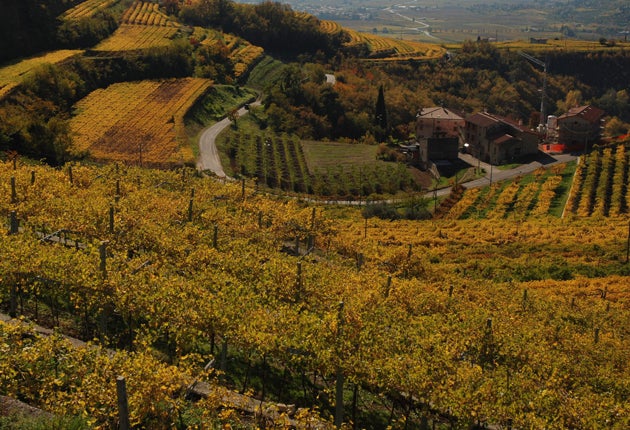
Outraged wine producers led by the poet Dante Alighieri's direct descendant are desperately trying to stop plans to build a huge waste recycling plant with a 310ft-high chimney in the heart of the idyllic Valpolicella vineyards near Verona, northern Italy,where the grapes for hallowed Amarone wine are nurtured.
Dante's son, Pietro, bought the Casal dei Ronchi in Gargano estate at Sant' Ambrogio in Valpolicella in 1353 after his father was exiled to Verona from Florence. The family has cultivated the surrounding vines for 20 generations. Speaking in the courtyard of his sprawling villa above cellars packed with oak and cherry wood barrels of maturing Amarone, Count Pieralvise Serego Alighieri, the current patriarch of Italy's most illustrious genealogical line, said he has no intention of allowing the recycling project planned by owners of a local cement works to upset the delicate ecological balance of the Valpolicella valleys.
"These are activities that have nothing to do with this area," he said. "This is the only area in Italy where local grapes alone are used to produce five different kinds of wine. We are very lucky to be able to create prosperity from an area of great natural beauty. This is a unique zone that deserves to be protected."
The Rossi cement plant in Valpolicella's nearby Fumane valley is something of a historical anomaly, built in the 1960s when governments in Rome were encouraging unbridled industrialisation. The cement is made with marlstone, a lime-rich material dug out of nearby quarries, and stored in grim 90ft-high silos. Pierandrea Fiorentini, Rossi's environmental engineer, insists the company's plans to build a chimney atop a new furnace that will "cook" industrial waste at temperatures of up to 2,000C to create cement will have no adverse ecological impact on the special Valpolicella microclimate. Hundreds of lorries trundle through the countryside each week to deliver waste to the plant.
Mr Fiorentini insists the planned changes will use no more waste than before but will simply be "more efficient" and environmentally even "an improvement". The company has permission from Verona authorities to recycle 122,000 tons of waste a year, though so far it has used no more than 58,000 tons, he says.
Valpolicella's leading wine producers, however, are deeply concerned the new plant could threaten the image of Amarone and other wines in the wake of waste-related scandals in Italy – such as the discovery of dioxin in mozzarella produced near Naples due to dumping of waste by Mafia-linked companies on land used for grazing by buffalos. The related Naples rubbish crisis of a year ago, when the streets of the city were littered with trash for months, has underlined Italy's ecological vulnerability, and there are fears that Rossicimenti may be positioning itself to import more lucrative waste from Naples or Rome, where waste disposal plants have been severely strained recently – something that Mr Fiorentini strongly denies.
Joining Count Alighieri in the fray are many of the biggest and most respected of Valpolicella's wine-makers, including Luca Sartori, the head of the area's wine-growing consortium that groups some 200 Valpolicella Classico producers.
Mr Sartori believes the 100 or so employees at the cement plant, and up to 150 others in related industries such as lorry driving, could easily be absorbed in the wine sector if Rossi's owners in Emilia Romagna and Switzerland could be persuaded to move its activities elsewhere.
Franco Allegrini, a top wine producer credited with making Amarone one of Italy's top exports to the United States and Canada, blames local government in the valleys for failing to stand up to the cement plant. "There is a fundamental hypocrisy here," he said. "These local councils were the first to develop differentiated rubbish collection. Cars in some parts of Valpolicella have to carry certificates that their engines are catalytic. But we don't know what will happen to 120,000 tons of waste being imported and how much damage it could do to any future development of wine tourism in Valpolicella, which has so much potential."
Citizen action groups such as Fumanefuturo, founded in January this year, also are opposing the cement firm's scheme for expansion. Mimi Conti, a Fumanefuturo founder who lives on land in sight of the factory, understandably resents the constant sound of machinery drowning out the natural sounds of the valley. Mr Conti says he received death threats from workers at the plant after he organised a public meeting addressed by a cancer specialist on possible health threats from industrial emissions.
As if the new plant were not enough, Rossicimenti has also applied to the regional government of Veneto to open a fresh marlstone excavation quarry in a new as yet untouched hill that opponents say is part of a protected natural park. Rossi says it holds existing excavation rights to it. The cement company has replanted vines on large swaths of land it no longer needs after exhausting underlying marlstone deposits. But local growers complain that cherry trees, once providing one of the main crops of local farms, no longer bear fruit as before because of omnipresent cement dust.
"We are at a historic turning point," says Daniele Todesco, the head of another citizens' pressure group, Valpolicella 2000, in the adjoining, pristinely beautiful valley of Marano. "Either the cement plant is closed gradually and we relaunch Valpolicella or we relaunch this kind of heavy industrial business."
The centre-left mayor of Marano for his part has accused the action groups of spreading alarm. Many environmentalists accuse local mayors of relying too heavily on tax income from the cement plant. Fumane's centre-right mayor declined a request to discuss the issue with a foreign reporter, saying it would be "inappropriate while studies of the project are ongoing."
Franco Allegrini, however, believes many local people have become too used to living with the cement works, engendering complacency. "What attracts tourists here is the Amarone. I want to leave my children this land as I found it – or better. I don't want it to be a land of conquest, for speculation of different kinds."
Join our commenting forum
Join thought-provoking conversations, follow other Independent readers and see their replies
Comments