World

2° London Hi 4°C / Lo -2°C

Dictator's wife defiant over forced adoptions

Margot Honecker, a Communist-era minister now living in exile in Chile, left a cruel legacy of separated families

By Tony Paterson

Margot Honecker

AFP/GETTY

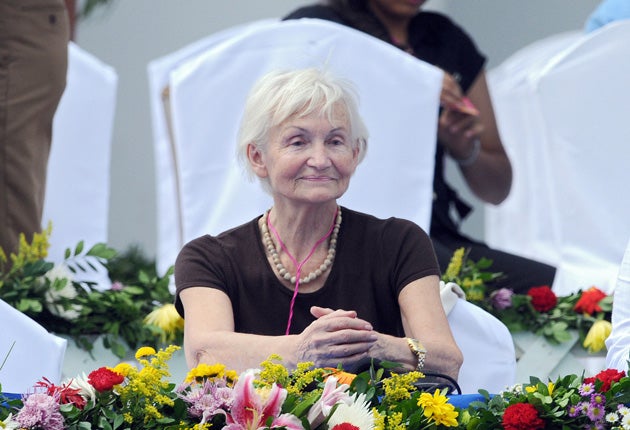
Margot Honecker, wife of the former East German leader Erich Honecker, was People's Education Minister. 'We lived good lives in our GDR,' she says

More than 2,000 Germans are still searching for family members lost as a result of the forced adoption policies instigated by Margot Honecker. The widow of Erich Honecker, the East German dictator who ordered the building of the Berlin Wall, lives in exile in South America on a German state pension. And 20 years after the collapse of the Iron Curtain she remains unrepentant. In a rare interview recently the 82-year-old insisted that people "lived good lives" under the regime headed by her husband.

The families torn apart by Mrs Honecker's children's policy would not agree. Under the policy, the children of dissidents and East Germans who attempted to flee to the West were forcibly and permanently separated from their parents. Many were placed in foster homes or state adoption institutions, or with the families of childless Communist party activists.

Many affected children and parents never saw each other again, but a search pool has been set up and is attempting to bring families back together. It has identified more than 2,000 individuals still suffering a family loss thanks to Mrs Honecker's legacy.

Eva Siebernherz, director of the programme, told The Independent: "This was one of the gravest human rights abuses perpetrated by East Germany's Communist regime. The state simply took away people's children. Parents and the children themselves are still suffering from the consequences 20 years after the fall of the Wall," she added.

Petra Hoffman lost two children to the "Youth Welfare" department. In 1971, as a 17-year-old government canteen worker, she had her first child, Mandy. The baby's father was a dissident, so Petra was forced to give up the child for adoption. "I tried to fight them but I was young. And all that happened was that they put me in jail as an enemy of the state," she told Bild newspaper. The judge at her trial called her "a rat gnawing away at the magnificent pillars of Socialism". A son she bore in 1974 was also taken from her and adopted without her consent. "They came to the door at night, pushed me aside, and stole him from his bed," she said. Petra and Mandy were reunited last month. She has still not traced her son.

Mrs Honecker was East Germany's People's Education Minister and was even more hardline about Communism than her husband. As well as forced adoptions, she introduced military and weapons training in schools. She fled to Chile in 1993 after the government in Santiago decided to reciprocate the sanctuary provided to its members by East Germany when they had fled the Pinochet regime. Her husband, in power between 1971 and 1989, joined her the same year, but died of cancer in 1994. He had initially fled to the Soviet Union, but was extradited back to Germany and tried for treason. His wife was investigated for her role in the child adoptions scandal, but never stood trial.

"I have had enough of the persecution that is inflicted on former citizens of the German Democratic Republic [GDR]," Mrs Honecker said in the interview. "In today's Germany ... there is hardly a television talk show, film or news programme that does not defame the GDR. But they haven't succeeded. Fifty per cent of East Germans say we are worse off under capitalism. We lived good lives in our GDR. You can say what you like, but the facts can't be ignored; more and more people are reminding themselves nowadays of what they had in the GDR. We can be sure that things are going to get worse in Germany, not for industry but for the working classes. But socialism will return – even in Germany."

At her home in Santiago, Mrs Honecker, once mocked for her blue rinsed hair, lives a life shielded from the press and rarely gives interviews. She is still celebrated however by left-wing South American activists. Last year she was lauded as a "Heroine of Socialism" in Nicaragua and decorated by President Daniel Ortega for her contributions to the cause of Revolutionary Socialism. She raised a clenched fist to show her appreciation.

Post a Comment

View all comments that have been posted about this article.

Offensive or abusive comments will be removed and your IP logged and may be used to prevent further submission. In submitting a comment to the site, you agree to be bound by the Independent Minds Terms of Service.

Comments

Stolen children
[info]wild_worm wrote:
Tuesday, 10 November 2009 at 01:48 am (UTC)
Horrible.
Before we feel too smugly superior to Margot Honecker, keep in mind that at least until the 1970s Canada and Australia had similar policies on a much larger scale towards aboriginal families, though the motivation was cultural genocide instead of political repression. As a Canadian, I can't say I'm proud of that history.
Re: Stolen children
[info]nightside242 wrote:
Tuesday, 10 November 2009 at 04:31 pm (UTC)
Was going to comment saying exactly the same thing, great post.
leopards and spots
[info]wernersliver wrote:
Tuesday, 10 November 2009 at 04:34 pm (UTC)
She was always a heartless bitch, nicknamed "the purple witch".
if their life was so bad why so many germans feel nostalgia for GDR?
[info]rex123 wrote:
Friday, 13 November 2009 at 11:40 pm (UTC)

That is the question which hardly is easy to answer...Their life was not free, but it was good, that is a fact - the most striking evidence that every person at the age of 18 was given apartment from the state in GDR...For a housewife who was not interested in politics - life was good, but for an intellectual who wanted to express his ideas inconsistant to commie ideology- it was ofcource not good at all...But how many people in Africa and Asia now would be happy to change their current life in their respective countries for that "bad" life in GDR of 1970-1980-s...!!!
Re: if their life was so bad why so many germans feel nostalgia for GDR?
[info]jari_zeglaz wrote:
Monday, 16 November 2009 at 05:00 am (UTC)
Here you are again rex123

Sure, the life of 200 000 political prisoners in "Gelbe Elend" (Bautzen), Cottbus, Berlinie-Rummelsburg, or specific women prison Hoheneck, and other 17 "detentions centers" that were run by Staatssicherheit, in addition to 1000 people shot at the borders, their life "was not good at all". Neither was for their families since the DDR used the collective punishment.

On the other hand the life of people where 1 in 10 adults was informant of STASI the life was just peachy.

Where you get your information from!? I would love to see the source of your quote about the apartments: if it is true it would be unique in the communist block, for example in Poland which was relatively well off (sic) you had to wait 10-20 years as a member of a housing coo-op before you were eligible to get one, and only if your parents had the money to sign you up when you were a small kid. You also had to pay for it or have your payment deducted from your salary. Furthermore, only maybe 20% of them were owned, the rest were rented from the co-op. So do not be surprised that I will not take your word for it. Even if it was true, which I doubt, in a normal country you just get a job and pay for it. Interestingly enough in the West Germany in case you could not find the job you could qualify for cheep social housing and get social assistance to pay for it.

I do not believe you stated the truth. This link will provide you with somewhat different view of housing in DDR
http://www.foothill.edu/divisions/unification/housing.html
Here is some quote from it (you can't just make stuff up, you know):
"The persistence of a housing shortage meant that allocation of housing created a measure of discontent. Housing, particularly in the large urban areas, was difficult to obtain, and young couples looking for their first home were often forced to wait two or three years before a unit became available. ... Housing, however, has been used to ... reward loyal service to the state; therefore, highly skilled workers and members of the technical intelligentsia and political elite have been given preference in assignments and receive the choicest housing".

Perhaps then, the person that gave you this information about "once 18 you get your apartment" was a party hack. If it is YOUR personal experience, well, then you were that Party hack! sorry you didn't know it.

Many people from Africa or Asia would happily change their life for the one of east Germans, perhaps because it is better live like this then to starve for sure. After all DDR was build upon well developed, industrialized, and educated nation. But you are framing the question wrong. You should have asked that having all relevant information, how many would choose East German "life style" over the one of West German, Dutch, or French
etc. ?

Close to 2 600 000 people managed to run away from that paradise before the "Wall" was build in 1961, thousand died trying afterward, another 85 000 were arrested for trying.

You should visit once the Stasi Hohenschönhausen Muzeum and see for yourself before you write such nonsense.

Jari

Article Archive

Day In a Page

Sun | Mon | Tue | Wed | Thu | Fri | Sat

Select date