Drive-in sex plan to curb prostitutes in Europe's playground
A public backlash is forcing a rethink of Switzerland's liberal laws on sex workers

For free real time breaking news alerts sent straight to your inbox sign up to our breaking news emails
Sign up to our free breaking news emails
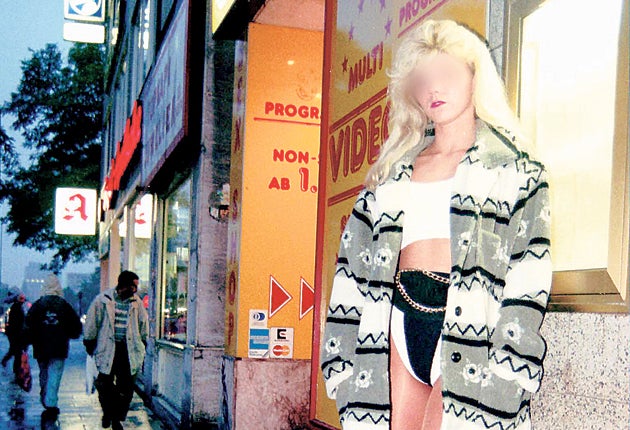
A fine drizzle falls on the Sihlquai red-light area along Zurich's Limmat River, and the rain appears to have scattered all but a solitary prostitute, who teeters in her heels and tiny green dress under an enormous red umbrella. Then there is a rustle, and more young women emerge from the overgrown river bank, smoothing their mini-skirts and brushing away the bracken and long grass from their bare legs. "We're hiding from the police," one whispers conspiratorially.
There is a tension on the quay. This is one of about a dozen areas in the Swiss financial capital where sex workers are permitted to ply their trade, and most of these women have their papers in order, pay their taxes, and travelled from eastern Europe legally to sell their bodies in one of the richest cities in the world. But a backlash is brewing as Switzerland opens its borders to more foreign workers – which in turn brings more sex workers – forcing a radical re-think of some of the most liberal prostitution laws in Europe.
By early next year, these women may be forced from the Sihlquai and relocated to Switzerland's first drive-through red light district in an industrial area on the fringes of the city. Based on a similar model in Germany, customers will pull off the road and into a meticulously organised compound, cruise by women standing in a designated area displaying their bodies, before picking one up and backing into one of about 10 "sex boxes" complete with privacy walls and a security alarm.
It is part of an overhaul that includes reducing the number of areas in the city where prostitutes can legally work from 11 to three and introducing police interviews for migrants hoping to get permits to work as prostitutes in the city.
While advocacy groups working with the prostitutes fear that the policies may drive more women underground, the city insists they are necessary to both protect the women and calm public anger over the social annoyances that curb crawlers bring.
"We're just trying to find a way to live with the phenomenon without having too much harm done," says Claudia Nielsen, the Zurich city councillor for health and environment. "We have no certainty that it will work out. What we know is we can't continue the way it worked up until now, and we also know we can't forbid it."
Ms Nielsen's office overlooks the pleasant stretch of riverside greenery that was once better known as Needle Park, the product of another radical policy by the city of Zurich, which allowed heroin users to congregate to buy and inject drugs without police intervention. Although the policy sparked outcry across Europe and Needle Park was closed in 1992, it led to the sterile "shooting galleries" and methadone substitution programmes which have pushed addiction down to record lows and been replicated across much of Europe.
Ms Nielsen says she often glances out of her window across the Limmat to remind herself of how things have changed.
"In both of these topics is the principle that what can't be forbidden should be made feasible or not harmful to the population or to people in that situation. It is very pragmatic: what we can't change we have to live with," she tells The Independent.
But there is a crucial difference: while drug dealing remains illegal in Switzerland, prostitution has been legal and regulated since 1942. Men and women can work in the sex industry as long as they are deemed to be doing so of their own free will. Trafficking, forcing people into the trade and most forms of pimping are illegal.
Switzerland also has pacts with other European countries allowing people to enter the country on temporary work visas. Signatories to the Free Movement of Persons Agreement broadly mirror member states in the European Union, and in Zurich, a foreigner from such a country need only present themselves to the city authorities, undergo a brief interview with police, and provide proof of a health insurance plan before being given permission to work for 90 days as a prostitute, either on the streets or in the discreet brothels and massage parlours found throughout the city.
It is the addition of poorer east European countries – in particular Hungary and Romania – to the agreement that has brought a flood of new sex workers to the city. Authorities are reluctant to speculate on figures, given that many migrants stay in Zurich after their papers expire and there are also a significant number of women trafficked illegally into the country. Some say there are up to 5,000 street sex workers in Zurich. Ms Nielsen says her figures show that 229 women applied to work as prostitutes from January to April this year, up from 153 in the same period last year. And accompanying the increasing number of sex workers are a slew of negative stories in the Swiss papers and grumbles from residents about the noise and disruption.
The council's proposals for the drive-through sex park are currently before the city parliament, and Ms Nielsen says she is confident that they will be passed and enacted by January. One plank of the plan – the police interviews for prospective sex workers – has already been rushed through and came into effect in June.
City authorities have even found an area where the residents are unlikely to complain – the drive-through brothel backs directly on to a temporary housing block where asylum-seekers live as they wait to have their applications processed.
But on the Sihlquai, the women are on edge. Ever since the new policies were announced, they say more police have been prowling the area demanding to see papers.
Critics of the plan are concerned that the new policies have been rushed through to try to reduce the number of sex workers, without adequate discussions about the possible negatives. Doro Winkler, who works for FIZ, an advocacy group for migrant women, worries that some sex workers may be forced into the hands of exploitative pimps if they do not pass the police interview. Women without all their papers in order, meanwhile, may not be allowed to work in the drive-through compound, leaving them out of the reach of social services vital for keeping them healthy and safe.
The women working on the Sihlquai are generally happy about any proposals that will protect them from violent clients. "Very often, when we have to sit in a car and go with the clients somewhere, even if we have a clear agreement they will go to another place and change the agreement," says one Hungarian woman with bottle-blonde hair. "It's a big problem that there are many aggressive clients."
Her friend, also Hungarian, shrugs before heading back to the rain-sodden streets: "It's got to be better than them killing us here on the Sihlquai."
Prostitution in Europe
39 – the percentage of Spanish men who admit to having used a prostitute's services, according to a UN report. In the Netherlands the figure is 14 per cent, and in the UK it is between five and 10 per cent.
400,000 – the number of sex workersin Germany, where prostitution was legalised in 2001.
200,000 – the estimated number of women trafficked out of central and eastern Europe and the former Soviet republics every year, most of whom are thought to be sold into prostitution in western Europe.
Enjoli Liston
Subscribe to Independent Premium to bookmark this article
Want to bookmark your favourite articles and stories to read or reference later? Start your Independent Premium subscription today.
Join our commenting forum
Join thought-provoking conversations, follow other Independent readers and see their replies