Eating with the enemy: why Russia loves Georgian food
Despite diplomatic strains, Muscovites can't get enough of their neighbour's cuisine. Shaun Walker reports

For free real time breaking news alerts sent straight to your inbox sign up to our breaking news emails
Sign up to our free breaking news emails
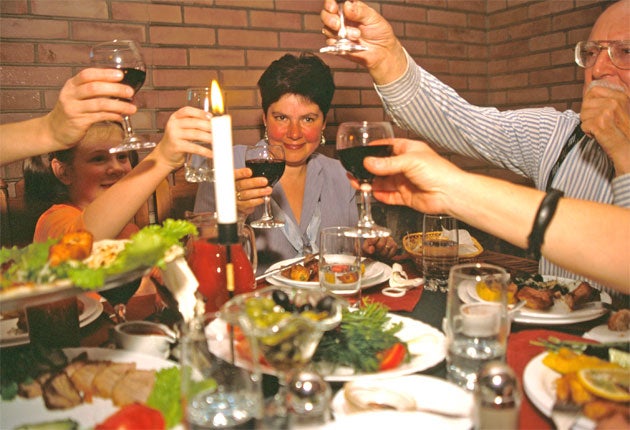
At the newly opened Café Khachapuri, just off Pushkin Square right in the heart of Moscow, young Muscovites tuck into plates of coriander-infused chakhokhbili chicken stew, spicy lobio beans and the eponymous khachapuri – gooey cheesy bread.
None of these exotic Georgian dishes tastes like the bland indigenous Russian food, and nor do their consonant-heavy names roll off the Slavic tongue easily. But everyone knows exactly what they're ordering. Georgian food, perhaps the tastiest and most exciting of cuisines in all the former Soviet countries, has long been popular in Russia, and as new restaurants spring up across the capital, its popularity is going from strength to strength.
In these cheerful surroundings there are only small hints as to the bitterness of relations between Russia and its small neighbour to the south, which led to the two countries fighting a bitter war in the summer of 2008. The first is the wine list. Going for a Georgian meal is somewhat equivalent in the Russian popular psyche to "going for an Indian" in Britain, except that instead of washing the food down with five pints of Cobra, the standard etiquette is to knock back glasses of sweet Georgian wine. Georgia prides itself as being the birthplace of wine, and in Soviet times citizens from Vilnius to Vladivostok would enjoy the luxury of uncorking a bottle of sweet Georgian red.
But on Café Khachapuri's menu there is no mention of Tsinandali, Mukuzani, or any of the other tasty Georgian wine varieties that diners might order if they were eating the same food at one of Tbilisi's outdoor cafés. There's not even Kvanchkara, the sickly sweet red that brings back memories of the Soviet times for Russians. Ever since 2006, Georgian wine and mineral water has been banned in Russia, ostensibly due to safety regulations, but in reality due to thinly disguised political concerns.
But the ban on Georgian wine, which had a devastating effect on the Georgian economy, has not stopped Russians' love for the country's cuisine, even if they have to settle for French or Chilean wine to go with it.
"Everybody in Moscow loves Georgian food," says Tina Kandelaki, a Georgian who is one of Russia's leading television presenters and a strong critic of Georgia's government. "All the best parties in Moscow these days end with Georgian dancing and Georgian food."
Part of this is down to the continued presence of a huge Georgian diaspora in Russia. A spokeswoman for the Union of Georgians in Russia estimated that there are between 1 million and 1.5 million ethnic Georgians living in the country. Many of these are well-settled professionals – the chief cardiologist of Moscow, the city's most famous sculptor and a whole host of media personalities are all Georgian – while others are part of the legion of migrant labourers from former Soviet lands who come to Russia because salaries are higher than in their home countries.
In 2006, during a crisis between the two countries that preceded the war, Russian authorities were accused of organising a modern-day pogrom against Georgians and Georgian interests. Georgian restaurants were raided, schools were told to check for pupils with Georgian surnames, and many Georgians living in the Russian capital were deported. Now, however, the Union of Georgians in Russia claim there are "no problems at all" for Georgians in the country. "The number of Georgian restaurants is a good sign of how Georgians in Russia are thriving. There are so many in Moscow it's impossible to count them," said the Union's spokeswoman. One Moscow listings website has details of 261 Georgian restaurants in the capital.
Governmental relations between Russia and Georgia have never recovered from the 2008 war, which saw a Georgian incursion into a breakaway zone repulsed by a Russian counter-offensive. As a result of the conflict, Russia recognised South Ossetia, and Georgia's other breakaway state of Abkhazia, as independent nations. Meanwhile, the Russian leadership has declared the Georgian President, Mikheil Saakashvili, a "political corpse", and has said there will be no contact between the two governments while he remains in power.
In recent weeks, two prominent Georgian opposition leaders have travelled to Moscow for talks aimed at improving the climate of vitriol between the two countries. Nino Burjanadze, formerly one of Mr Saakashvili's closest allies but now a bitter opponent, was in the Russian capital last week, and even held a televised meeting with Russian leader Vladimir Putin.
Zurab Nogaideli, a former prime minister who is also now in opposition to the government, arrived in Moscow last night for a second visit in the space of a few months, saying that he wanted to resolve trade issues with the Russian authorities.
Supporters of Mr Saakashvili, who is due to remain in power until 2013, say that this is little short of a deliberate attempt by Russia to destabilise the political situation in Georgia.
"How you can talk to Putin when his forces are occupying parts of our country?" asked Alexander Rondeli, a leading Georgian political analyst. "It's a very clever idea from the Russians but I don't think the population will buy it; they will see them as traitors."
The vitriol continues to fly from both sides, with Georgians accusing Mr Putin of being a bully and a war criminal, and Russians accusing Mr Saakashvili of being an unstable madman who started the 2008 war due to his own recklessness.
But with all trade and air links between Russia and Georgia cut, no contact except insults between the governments, and the television channels in each country churning out propaganda about the other, Georgian restaurants in Russia go from strength to strength.
"The terrible relations between Russia and Georgia haven't affected Russians' love for Georgian food," says Ms Kandelaki. "In fact, since the war, people are eating it more and more. You can love Georgian food without loving Saakashvili. It's too tasty to give up just because of one person."
Recipe: Georgian chicken stew
Chakhokhbili, a Georgian chicken stew, is increasingly popular in Moscow. To make it for a hungry group of six:
*Take 1kg of diced chicken. Dry it with paper towels, and fry it with 2-3 sliced onions for about ten minutes on a medium heat.
*Add 4-5 chopped tomatoes, bay leaves, whole black pepper, lemon juice, garlic and dry chilli. Cover the pan and simmer for 20 to 30 minutes.
*Add 2-3 teaspoons of khmeli suneli, a Georgian spice mix available in speciality shops. Stir and leave on a low heat for five minutes.
*Stir and remove from heat. Add coriander, basil and tarragon. Leave for 5-10 minutes and serve with soft cheese, flat bread and red wine.
Subscribe to Independent Premium to bookmark this article
Want to bookmark your favourite articles and stories to read or reference later? Start your Independent Premium subscription today.
Join our commenting forum
Join thought-provoking conversations, follow other Independent readers and see their replies