EU sets up crisis fund to protect euro from market 'wolves'
Finance ministers hammer out historic deal worth €500bn in bid to end market turmoil
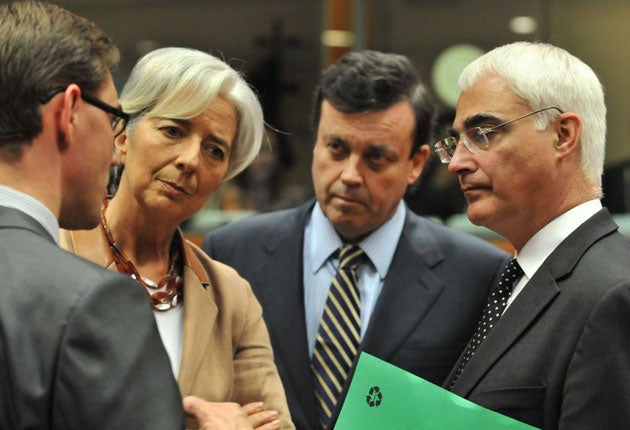
The EU faced the biggest test in its history last night as it launched a last-ditch effort to save the Euro, amid acute fears that markets could unleash a fresh attack on the currency today.
EU finance ministers set up an emergency fund worth a staggering 500 billion euros during frantic talks in Brussels, rewriting the EU rule book in the space of a few hours.
The unprecedented, mammoth bail-out scheme would provide a safety net for highly-indebted countries such as Portugal, Spain and Ireland and is meant to shore up confidence in the battered currency. The International Monetary Fund was also set to contribute an extra 250 billion euros.
“All the actions taken today prove that we shall defend the euro whatever it takes,” said EU Monetary Affairs Commissioner, Olli Rehn.
Ahead of the announcement at 2.35am, there was a mood of febrile anxiety in the European Council corridors. Diplomats could barely keep up with the fresh billions that were being pledged as EU member states raced to hammer out a deal before 2am, when the Tokyo stock exchange would open.
“It’s make-or-break time,” said one diplomat. “Throughout this crisis we have been behind the curve. Everyone now realises we have to get ahead of it and pre-empt the markets. And we have to do it tonight.”
This collective effort is a breathtaking departure from the past three months, when eurozone countries dithered and bickered over whether or not to bail out Greece. Their indecision fuelled investors’ fears about the euro and the risk of ‘contagion’, and it set the scene for last week’s market turmoil.
The Euro slid by four per cent against the dollar on Friday as market jitters ricocheted from New York to Tokyo. The Bank of Japan forced to pump billions into Asian markets and world leaders berated the EU for its belated response to the Greek meltdown.
Sweden’s finance minister, Anders Borg, coined the phrase of the night when he said it was a case of building rapid defences against the “wolf-pack” of financial markets. “If we do not stop these packs they will tear the weaker countries apart,” he told reporters.
At the European Council building, the tension was heightened when the German Finance Minister, Wolfgang Schäuble, was rushed to hospital. Interior Minister Thomas de Maizière was parachuted into Brussels, with ministers scrambling to reach a deal. The ticking of the clock was almost audible as they added the jigsaw pieces to their gigantic rescue scheme, keenly aware that the EU’s credibility - and even its long-term survival – was on the line. “The future of Europe….is at stake,” Ms Merkel said last week in her stark warning.
In the first part of the plan, an extra €60 billion will be pumped into a European stabilisation mechanism, an existing facility that already holds €50 billion and which was used to issue rescue loans to Hungary and Latvia when their economies collapsed last year.
The loan could be activated within 48 hours as it comes under Article 122, which shields member states against “exceptional circumstances”. However the loan, which would be underwritten by all 27 member states, would be just a drop in the ocean. Greece’s tiny economy was thrown a lifeline of €110 billion to guarantee its debts over the next three years on Friday night, but conservative estimates suggest that a combined bailout for Portugal, Spain and Ireland would amount to at least €500 billion.
The second line of defence, though, foresees the creation of a new body known as a Special Purpose Vehicle. Eurozone countries agreed to an inter-governmental system, whereby they would guarantee joint loans of up €440 billion, with the IMF providing half of that sum again. “This will be based on rigorous conditionality, and would be guaranteed by member states,” Commissioner Rehn explained, explaining that the loans would depend the beneficiary undertaking a programme of drastic budget reforms and cuts, such as those being carried out by Greece at the moment.
At the same time, the EU is planning to speed through reforms to stabilise the framework that underpins the single currency, and had forced Portugal and Spain to clean up their finances in a bid to deter market predators.
No one expected yesterday night to end on such a major raft measure and mind-boggling sums. It now remains to be seen whether the markets will believe in them.
“It’s the big, bold move we needed to make,” said one EU diplomat. All 27 European governments will be praying he is right.
Join our commenting forum
Join thought-provoking conversations, follow other Independent readers and see their replies
Comments