Euro 2008: Poland and Germany go to war again (but this time the Poles started it)
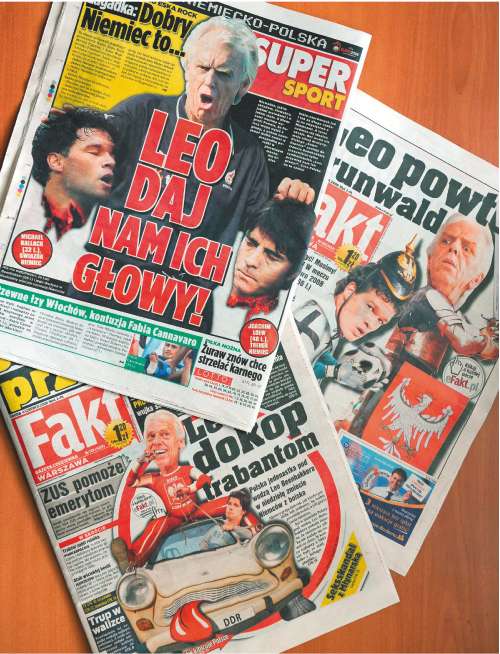
The picture managed to top even the worst excesses of British soccer-related Hun bashing: the sports section of the Warsaw daily tabloid Super Express depicted Poland's national football coach, Leo Beenhakker, with a warlike scowl. In each hand was a recently severed head, both dripping blood on to the foot of the page.
The heads belonged to Michael Ballack, Germany's team captain and Joachim Löw, the side's trainer. In the middle of the photomontage a giant headline etched out in the Polish national colours of red and white urged Beenhakker, who happens to be Dutch, to " Give us their heads!"
The gory image, published in Poland on Wednesday, was merely the latest round in a protracted tabloid war that has been raging in Polish and German mass-circulation papers for more than a week. The mud-slinging reaches a climax tomorrow when Poland meets Germany in the Euro 2008 football championships in the Austrian city of Klagenfurt.
The German media has been tormenting the Poles with football jibes. It has featured items such as a joke anti-Polish video clip which shows German fans stepping out of a bus to relieve themselves during a long trip on the autobahn, only to find that their vehicle has been stolen by Polish thieves while they were having a pee.
But the war really started in earnest when Poland's biggest-selling daily newspaper, Fakt, retaliated on Tuesday with a picture of Ballack wearing a Prussian spiked helmet, waiting to be decapitated by Beenhakker wielding a massive battle sword. This time the paper implored the Dutch trainer to "Repeat Grunwald", which was a reference to the 15th-century battle of the same name in which a combined force of Poles and Lithuanians inflicted an ignominious defeat on the German order of Teutonic knights. The victory is almost the Polish equivalent of the Battle of Trafalgar.
The Germans are used to being insulted in the British press, especially over football. For decades, Germany's teams have not walked but "marched" on to the pitch in the pages of London tabloids. The Germans have not been amused by this sort of ritual ribbing. Successive German ambassadors to London have made it their business to complain about such treatment. In 1996, Piers Morgan, then editor of the Daily Mirror, was even forced to apologise after his paper ran the headline "Achtung Surrender!" and declared a "Football war on Germany".
But Germany's sporting elite is clearly not used to being treated by their next-door neighbour Poland in this way. Peter Danckert, the chairman of the German parliament's sports commission, called the severed head picture an "absolute scandal"and "absolutely below the belt". He added: " I hope that the Polish government will react to it in an appropriate manner."
The Polish government's reaction was mute, but Beenhakker swiftly delivered an apology to the Germans, describing the newspaper's antics as "mad, dirty and sick". He added: "We want to say sorry to the German people."
For a Dutchman this was perhaps no small gesture. The Dutch love to make fun of the Germans, especially when it comes to football. During the 2006 World Cup, a Dutch company hit the headlines after it manufactured thousands of mock Second World War German helmets made from orange plastic. The hats were eagerly snapped up by Dutch fans who wore them at the tournament to taunt German supporters.
Yet so far nobody has offered a plausible explanation for the sudden upsurge in Polish-German football animosity. Hopes that it would subside after Wednesday's severed heads incident were scotched yesterday after Fakt came out with a fresh story which accused the Germans and the Austrians of conspiring to fix the results of matches and force the Poles out of the tournament. Bild complained to its readers: "Will this never stop? Why is the atmosphere being poisoned before our Euro debut?"
One of the reasons may be linked to the ownership of the papers blamed for starting the war. Bild and its Polish counterpart Fakt are owned by Germany's Axel Springer publishing house. Fakt was set up by Springer after the collapse of Communism and was specifically designed to become the Polish equivalent of Bild. It has since become the country's biggest-selling daily. There has been intense speculation in Germany that the tabloid football war is simply a Springer-orchestrated spat to boost sales in both countries. Of course, no editor would admit to such tactics. Hence the response by Alfred Draxler, Bild's deputy editor, who insisted on Wednesday that his paper was "journalistically completely independent" and therefore had no difficulty attacking its Polish sister paper for its anti-German stance.
The other reasons are manifold and in today's post-Iron Curtain Europe, they still remain largely unaddressed. Perhaps only the Israelis have more justification than the Poles to dislike and mistrust the Germans.
The relationship between the two countries has been likened to that of England and Ireland. It has its roots in Protestant Prussia's partitioning and subjugation of Catholic Poland in the 18th century, the enforced teaching of German in Polish schools and presence of powerful German landowners presiding over workforces of Polish peasant farmers.
No other European Union state suffered as much as Poland at the hands of the Germans during the Second World War. Hitler's annexation of the country in 1939 was followed by the Warsaw ghetto, Auschwitz and the razing of Warsaw during the closing stages of the conflict to avenge the Warsaw uprising. Millions of Poles were slave labourers for the Nazis.
The relationship between both sides hardly recovered during the Cold War after tracts of eastern Germany were annexed to Poland on Stalin's orders and Poland was forced to cede vast areas of its eastern territories to Russia. A pseudo-friendship between the Communist governments of Poland and East Germany existed during this period, but the peoples of each country treated each other with suspicion. The East Germans blamed the Poles for buying up their hard-won provisions when they visited. The East Germans were not allowed to visit Poland during the 1980s because their government was worried that its citizens would be infected by the values of the free trade union movement, Solidarity.
West Germany's citizens may have deluged Poles with care packets at this time, but its government was nervous that the Solidarity uprising would destabilise the post-war status quo in Europe and remained reluctant to back the movement to the hilt. Many Poles have not forgotten this.
Attempts to normalise relations between the two countries have been badly hampered since the collapse of communism in 1990, by German expellee organisations trying to reclaim their former properties in old eastern German territories that now belong to Poland. Germany's Expellee Association has more than two million members whose support is crucial to Chancellor Angela Merkel's conservative Christian Democrats. As a result, her party, while not supporting claims for property restitution, has been sympathetic to many of the expellees' concerns.
In 2003, the issue boiled over, when proposals for a permanent exhibition explaining the plight of Germany's expellees were unveiled by Erika Steinbach, a German conservative MP who is head of the Expellees Association. Poland accused the Germans of trying to whitewash its Second World War crimes. The Polish magazine Wprost produced a front cover which depicted Mrs Steinbach in Gestapo uniform riding on the back of the then German Chancellor Gerhard Schröder. "The German Trojan Horse" was the headline.
Mr Schröder, who had no sympathy for the expellees, annoyed Poland by insisting that a moratorium should be imposed on Poles who wished to live and work in Germany, although their country had been declared a full EU member. One of the consequences has been that Poles have chosen to flock to Britain instead.
Polish-German animosity deepened in 2005 when the right-wing conservative Polish twin brothers Lech and Jaroslav Kaczynski were elected to become their country's president and prime minister respectively. Both disliked the Germans and elevated Hun-bashing to national politics.
Mercifully for the Germans, Poland ousted the Kaczynski government in a general election last year. Although Lech remains President, his popularity rating is below 30 per cent. Donald Tusk, Poland's liberal-minded Prime Minister, has declared that one of his main priorities is the normalisation of Polish-German relations.
He will meet Ms Merkel in the Polish seaport of Gdansk this month. The city was once called by the German name of Danzig and was shared by Germans and Poles. Hitler's seizure of the "Polish corridor" near Danzig in 1930 started the Second World War.
With a history like that, it is not surprising that many Germans and Poles have found it hard to make fun of each other in public ever since. The outbreak of a cross-border tabloid football war is perhaps a step towards some badly needed normality.
Join our commenting forum
Join thought-provoking conversations, follow other Independent readers and see their replies
Comments