World

Rain (AM and PM) 4° London Hi 10°C / Lo 3°C

€400bn energy plan to harness African sun

It's decision day on a chain of solar generators across the desert that could supply a quarter of Europe's power
By Tony Paterson in Berlin

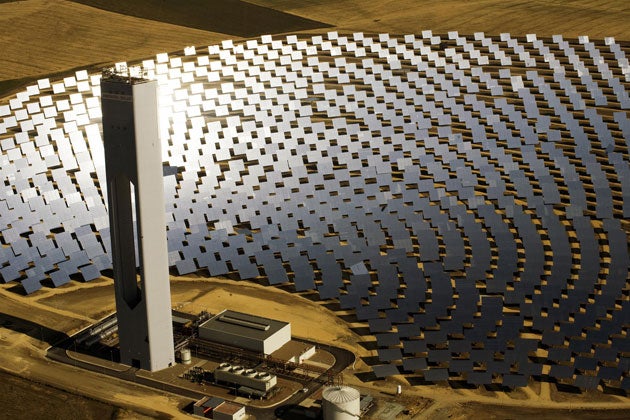
Concentrating solar thermal plants use an array of mirrors to capture and focus sunlight, which can then heat water and power turbines

Greenpeace

Concentrating solar thermal plants use an array of mirrors to capture and focus sunlight, which can then heat water and power turbines

The world's most ambitious green energy project is about to take shape. It is a plan for a chain of mammoth sun-powered energy plants in the deserts of North Africa to supply power to Europe's homes and factories by the end of the next decade.

In a few days' time a consortium of 20 German firms will meet in Munich to hammer out plans for funding the giant €400bn (£343bn) project, named Desertec. The scheme is being backed by Chancellor Angela Merkel's government and several German industry household names including Siemens, Deutsche Bank, and the energy companies RWE and E.ON. The Munich meeting will also involve Italian and Spanish energy concerns, as well as representatives from the Arab League and the Club of Rome think-tank.

Energy experts have calculated that Desertec could meet at least 15 per cent of Europe's needs, and be up and running by 2019. By 2050, they estimate the contribution could be between 20 and 25 per cent. Although no host countries have been named, Desertec envisages a string of solar-thermal plants across North Africa's desert. The plants would use mirrors to focus the sun's rays, which would be used to heat water to power steam turbines. The process is cheaper and more efficient than the usual form of solar power, which uses photovoltaic cells to convert the sun's rays into electricity.

The project also envisages setting up a new super grid of high-voltage transmission lines from the Mahgreb desert to Europe. Hans Müller-Steinhagen, of German Aerospace, has researched the project for the German government. He said that although the idea behind the scheme had been around for several years, investors had been deterred by the high costs of setting up the infrastructure.

Professor Müller-Steinhagen said that similar projects have been operating in the American West for years, but these had failed to gain the appropriate recognition. "Solar thermal power plants were built in California and Nevada, but people lost interest in them because fossil fuels became unbeatably cheap," he said.

Until now, projects of Desertec's scale have failed to get off the ground because of the huge problems involved in delivering electricity to consumers hundreds of miles away. The main stumbling block is that the further electricity is transported, the more is lost. However, Siemens claims that it has come up with a solution. Alfons Benziger, a spokesman for the engineering giant which has been involved in the construction of major hydro-power plants in India and China, said: "We have developed so-called high-voltage direct current energy transmission. This can transport energy over long distances without heavy losses. We use the process at the power plants in India and China."

Andree Böhling, an energy expert for Greenpeace Germany, has heaped praise on Desertec: "The initiative is one of the most intelligent answers to the world's environmental and industrial problems," he said. Munich Re, meanwhile, which insures major insurance companies across the globe, was persuaded to invest in the project after seeing a steady rise in the number of claims the company had to meet as a result of climate-change-induced damage.

Yet Germany's largest solar energy company, SolarWorld, argues that North Africa is too risky a location. "Building solar power plants in politically unstable countries opens you to the same kind of dependency as the situation with oil," said Frank Asbeck, the firm's managing director.

Other critics claim that by singling out comparatively poor North African countries as a location for a sophisticated European solar energy project amounts to a form of "solar imperialism". Lars Josefsson, the head of the Swedish energy giant Vattenfall, has also rejected the idea because of a potential risk of terrorist attacks. However Desertec supporters, including the German conservative politician Friedbert Pflüger, argue that a far greater threat is posed by the prospect of nuclear power plants being subjected to such attacks. He points out that a number of nuclear reactors are scheduled to be built in North Africa – Egypt alone plans to build five. Mr Pflüger claims that the risk of politically motivated Russian-style energy stoppages by host countries could be avoided if the solar grid has enough supply channels.

But he warns that politics is likely to be the main stumbling block. "It's not Europe that will decide whether the desert can be used as an energy resource, but the countries of North Africa," he said last week. "So far these countries have either not been involved in the dialogue at all or only at a very limited level."

Post a Comment

View all comments that have been posted about this article.

Offensive or abusive comments will be removed and your IP logged and may be used to prevent further submission. In submitting a comment to the site, you agree to be bound by the Independent Minds Terms of Service.

Comments

True green leadership
[info]ftgt wrote:
Sunday, 12 July 2009 at 01:33 am (UTC)
Trust the Germans to put their money where their mouth is. Truely enlightened government action to pull together and back this green initiative. Well done!

Btw, why is the UK not involved?
Re: True green leadership
[info]corporeal_v001 wrote:
Sunday, 12 July 2009 at 06:26 pm (UTC)

UK will plan, plan and then plan some more.
We need action...
Sounds like eco-imperialism to me
[info]shegelu wrote:
Sunday, 12 July 2009 at 02:23 am (UTC)
So, now Africa will supply Europe with energy, after centuries of exploitation of other natural resources. Why can't the plants be used to supply African countries with energy? God knows, they need it more! The countries concerned should make a deal that they have to get a percentage of the energy generated.

"Although no host countries have been named, Desertec envisages a string of solar-thermal plants across North Africa's desert." This sentence suggests a smack of arrogance - have they even asked any countries yet if they are willing to host plants? If so, why are they coy to name them?

No coyness at all
[info]ottorino wrote:
Sunday, 12 July 2009 at 07:27 am (UTC)
There have been literally dozens of sites identified for SCP across the Sahara desert and the Saudian Arabian peninsular. These have a star grading, much like hotels, and more than enough 5-star locations exist to satisfy all Europe's energy needs.

It's in the public domain and has been for some years. I'm sure the governments of these countries are perfectly well aware of the value of their land assets, and where they are.
Too costly and vulnerable
[info]under_hog wrote:
Sunday, 12 July 2009 at 04:14 am (UTC)
Europeans should consider harvesting heat from the waters of the Mediterranean, Aegean, Black and Adriatic Seas as well as the Gulf of Taranto by using the Atmospheric Vortex Engine technology.

By combining this with CSP on the European side, great economies in transmission can be achieved, as well as having a system not dependent on sovereign foreign governments.

This decision is irresponsible, IMO, and smells of political pressure from large corporations.

You miss the point
[info]ottorino wrote:
Sunday, 12 July 2009 at 07:20 am (UTC)
I must claim an interest having been a supporter of Desertec for some years. The Deserctec proposal is not solely about SCP, into looks to source 'green energy' from wherever it can be produced, and ship it around Europe using HVDC. So that can include wind, wave, geothermal, biomass and so on. The problem with AVE associated with seas (as with wave and tidal) is that it's an incredibly hostile environment and prototypes get destroyed in weeks by the conditions. Building something to last decades will be the real challenge.

The reporter indicates that HVDC is somehow 'new'. It isn't. I was a junior electrical engineer on the Nelson river project in Canada in 1969 where the first HVDC went in - that's 40 years ago! There's no point in arguing about the technology - it's long been sorted. Siemens just has to make it sound as if it's new. It's not.

The point with SCP (and I reckon the Fresnel option has the rosiest future) is that it can be turned on and off almost instantaneously, and can provide 24 hour electricity with heat storage. there's no limit to the amount of land you can cover with mirrors to generate electricity (half a percent of all deserts the world over is enough to satisfy ALL mankind's energy needs), and much redundancy can be built into the grid. If one country decides to withold its energy producing capability, then others will readily step up to the late.

The only snag with all this is that Gordon Brown thinks it's a jolly good idea (which it is), so that'll be the kiss of death in this country.
Re: You miss the point
[info]colinru wrote:
Sunday, 12 July 2009 at 10:29 am (UTC)
Whilst I agree with the majority of your post, I point out that SCP is a little more expensive, at present, than Fission with U3O8 at less than $100 a lb. This excludes the cost of a Fission Waste Depository, assuming Laser Inertial Fission/FusionEnergy does not allow us to burn the Waste economically, but also excludes most of the cost of building the HVDC grid. I do not think that this negates the idea but it needs to be made clear because, when you inlude the cost of SCP heat storage, the cost of SCP rises dramatically according to a recent article in The Economist.

There is also the security of supply risk which will have to be addressed by building in massive redundancy which also increases the cost of SCP.

This may well be a good idea but there are still many uncertainties to consider before we can be sure that this is a winner.
Dirty sideshow
[info]ottorino wrote:
Sunday, 12 July 2009 at 11:53 am (UTC)
There's actually only enough U238/235 (no atomic weight's yet got to 300!) to last around 14 percent of the world's energy for 30 years or so. If you're prepared to go down the fast breeder reactor route which creates vast amount of plutonium, then the figure changes significantly. But that's the stuff of nuclear bombs (first was Nagasaki bomb - 'Fat Man'). And we still don't know what to do with the waste.

There are all sorts of costs bandied about, and they are much manipulated to suit the argument in question. Basically SCP power stations costs the same as any other power station. The furnace that provides the heat is cheap to manufacture for fossil fuels, but expensive for SCP as acres of mirrors don't come with a wave of the fairy godmother's wand. Against that you have to reckon with the extraction of a fossil fuel and its transportation to the power station, and of course the attendant CO2 emissions. For SCP the energy is free, and transports itself there unasked, courtesy of the Sun.

Don't believe all the costings you see. there's a lot of skulduggery going on with many multinationals trying to protect their vesetd interests.
Re: Dirty sideshow
[info]colinru wrote:
Sunday, 12 July 2009 at 12:18 pm (UTC)
I do not agree with your first paragraph as the figures that I have seen range from 100 to 300 years supply of U3O8 (Uranium Oxide or "Yellowcake") fuel available based on the present, planned and likely future Plants. Hopefully, we can use the Fission Waste in LIF-FE but, if that does not work, then we have to use a Waste Depository system. Some people find this worrying although I do not (perhaps because I have used Fission Products in my work so I have the comfort of familiarity). Nevertheless, Fission is only a stopgap until Fusion, CSP, Geothermal and other Renewables can be proved/scaled-up to Industrial size. We will have to go Renewable eventually as Fossil Fuel and Fission sources are depleted so we may as well get started even if AGW turned out to be wholly untrue.

Whilst I agree that Costings can be distorted, The Economist did an article a few weeks back and, in summary from memory, thought that SCP was slightly more expensive than Fission (U3O8 at $100 per lb, presently $50 per lb) and thus a fair bit more than Gas (including, I assume, transport costs etc.). This does not mean that we do not use SCP - it would be a useful addition to the mix and the HVDC network would have external benefits for making other types of Renewables more economically viable than they are at present. But it does mean that we are in the early stages of this Project and need to see the full HVDC costs and an estimate of the external benefits of same. This is especially so since The Economist was very clear that Heat Storage dramatically increase the cost of SCP Plant - but it MAY still be of benefit because of the externalities even if the Plant only produced 50% of the time in any particular time-zone.
Re: You miss the point
[info]sanemind wrote:
Sunday, 12 July 2009 at 03:37 pm (UTC)
"If one country decides to withold its energy producing capability, then others will readily step up to the late."

Yeah just like what happens with the oil producing countries now, I mean, it's not like they could form a cartel or anything (OSEC anyone).

If they go ahead and do this then they need to think very carefully.

As clearly shown with OPEC, it is not enough to assume that if they diversify into multiple countries that that will protect them from blackmail.

Obviously, some kind of ongoing payment (in money or energy or both) would be required for the use of the land. However, they would be wise to set clear terms whereby the facilities are owned by the countries and/or corporations that build them and that they have exclusive rights to the land for an agreed period of time.

If a country agreeing to these terms attempted to renegotiate the price AFTER the plant was built therefore when they think they have the west by the short and curlies the demand should simply be ignored. If this lead to an attempt to nationalize or subvert the energy supply then the west would be well within its moral rights to consider it an act of war and treat it accordingly.

That might sound harsh but western corporations and governments are not charities and no one would force any country to agree to these terms.

if african nations don't like the terms then they are welcome to build their own solar plants (and therefore take all the risk and cost involved onto themselves) and try sell to the west directly.


Re: You miss the point
[info]colinru wrote:
Sunday, 12 July 2009 at 04:56 pm (UTC)
Well put but the reality is that the Polity will not do as you say so we could well finish up in an OPEC type of situation.
Solar Energy from Africa
[info]alexweir1949 wrote:
Sunday, 12 July 2009 at 06:11 am (UTC)
Solar Energy from Africa

Better to move factories to Africa - next to the power source. Whichever method is used, the outcome will be that the existing tyrannical dictatorships of North Africa will be even more bolstered and buttressed by the European Countries and consumers - and the man and woman in the street in these countries will not benefit in any way, least of all regarding freedom and justice.

Apart from that - it is a great idea. And it could be done in Botswana to feed the South African demand also.

Mr Alex Weir
Gaborone and Harare
Move factories to Africa
[info]ottorino wrote:
Sunday, 12 July 2009 at 07:37 am (UTC)
I couldn't agree more.

One product that springs to mind is aluminium. Providing electricity for a plant is an electrical engineer's nightmare as it's load is very 'unbalanced' as the phase angle is so high. To get round this many plants have their own power generation. Putting it near the coast on the edge of the Sahara would make an enormous amount of sense.

Presumably one could persuade Pilkington to do the same with its glass, and then you could make all the mirrors (uses aluminium for the silvering) and aluminium supports locally for the SCP plants.

One other point people seem to have missed, is that if a better technology is found in future years, then the SCP plants can be switched to atmospheric CO2 scrubbers (see article in New Scientist) or dismantled completely. It would leave no residual problems as do most other power stations.
More information about DESERTEC
[info]gerrywolff wrote:
Sunday, 12 July 2009 at 07:12 am (UTC)
There is more information about the DESERTEC concept at http://www.desertec.org/ and at http://www.trec-uk.org.uk/ .

This was possible 20 years ago
[info]old_green wrote:
Sunday, 12 July 2009 at 08:40 am (UTC)
Many, such as Prof Bob Hil, advocated this a long time ago. The only obstacle was investment. Mass production was needed to reduce the cost of PV devices. The electrical transmission technology has been there all the time. This could have been viable even with lower energy costs.
This happened 20 years ago
[info]ottorino wrote:
Sunday, 12 July 2009 at 10:44 am (UTC)
The first Concentrating Solar Power station was up and running 20 years ago in the Mojave desert California (Kramer Junction) and has been producing electricity ever since. My view is that the Fresnel system (look up David Mills and Ausra) has the best prospects of becoming the one most commonly installed.

Please note that this has nothing to do with photovoltaics (PV), which are normally seen as a way of generating electricity at a local rather than central level.

As for grids, there are no DC grids worthy of the name in the world at the moment. They are all AC. These experience at least three to four times as much losses as DC. We use AC because the technology to convert AC to different voltages was the first to arrive on the scene just after the first world war. The technologies to convert DC to DC at different voltages is much younger at just a few decades old.
BOOYA!
[info]fin_d_empire wrote:
Sunday, 12 July 2009 at 12:52 pm (UTC)
Themis Solar Power Tower, France, 1983:


The first (and less efficient, more expensive) US Solar Energy Generation System was built in 1984 at Daggett, in the Mojave desert. The Yanks use expensive parabolic mirrors that focus on a miles-long glass water-filled pipe instead of simple flat mirrors focused on a single heat-capturing target on a tower. You dummies probably never even heard of the French plant before you splurged on your bigger-is-better dinosaurs that were obsolete before they were built.
It's not a competition
[info]ottorino wrote:
Sunday, 12 July 2009 at 01:49 pm (UTC)
I'm sure you're right, but then remember that Archimedes tried to use burnished shields to concentrate sunlight on the sails of enemy ships to burn them and the rigging. That was a mere 2000+ years ago.

The name of the game is making something that works at a large enough scale, at a cheap enough rate to capture the energy wanted. If that involves using Marmite or raspberry flavoured blancmange as the heat collecting fluid, so be it (but I doubt it).

Interestingly, the new Spanish solar tower systems seem to experience a loss of performance with wind-flutter of the reflectors, and personally I don't much like a furnace 50m in the air that can be seen for kilometers - particularly when it's a good deal brighter than the sun itself.
Alot Of Things......
[info]chipmem1 wrote:
Sunday, 12 July 2009 at 09:10 am (UTC)
were posible 20 years ago. Why the hell do we put a cold feed to our domestic boiler ?

This method is already up and running in Spain, maybe you don't need to buy up land in
Africa ?
Swedes get it wrong again, this is a winner for Africa
[info]arclight99 wrote:
Sunday, 12 July 2009 at 10:45 am (UTC)

This is not "imperialism" at all. Just as with oil, African countries participating will doubtless be paid a percentage for extraction of what is their natural resource and for the lease of their land. It's a win-win deal for those with the wit to participate. The African countries would never be able to extract this solar power without Western technology and will in effect be being paid without having to do anything themselves.

The huge construction work should also provide thousands of jobs in Africa as well as spreading valuable solar know how to the region.

On top of this slowing global warming is in North Africa's urgent interest as the region is expected to suffer from severe water shortages in future caused by both its own population explosion and yes heating of the planet through CO2 emissions.

Those of you who see "imperialism" in global commerce and the like actually hinder Africa rather than aid her. No surprise the po faced Swedes have rejecting the idea. Swedes like to moralise to the world from the comfort of their well watered northern green land, but the reality is that to progress Africa needs to be plugged into the global economy and for countries in more southern latitudes than Sweden to be saved, CO2 emissions need curtailing.
Congratulations to the Germans!
[info]calibancan wrote:
Sunday, 12 July 2009 at 01:57 pm (UTC)
At last a real effort to make a better and more sensible world.

Australia should put some money into this project so we can have our technicians pick up on the technology. We can't send electricity to Europe but we have massive bauxite deposits and lots of hot sunny deserts. I guess we'd be happy to make all the aluminium you need, and glass.
WHAT DO THE AFRICANS SAY ABOUT IT
[info]duzeduze wrote:
Monday, 13 July 2009 at 12:03 am (UTC)
THIS IS A VERY INTERESTING PROJECT. I DO NOT SEE ANYWHERE IN THE REPORT WHERE THERE IS ANY MENTION OF WHAT THE AFRICANS ARE SAYING IN THIS PROCESS. IT LOOKS LIKE WHEN ALL HAS BEEN DECIDED AND PLANNED, THE WEST WILL JUST BULLDOZE INTO AFRICA JUST LIKE THEY DID WHEN THEY COLONISED. ARE THERE ANY NEGOTIATIONS WITH THE AFRICANS. ARE THERE ANY GENUINE BENEFITS BY THE AFRICANS; NOT THE KIND OF BENEFITS WHERE THEY GET BREADCRUMBS AND TOLD TO WAIT FOR BREAD SOME YEARS TO COME. WHILE I UNDERSTAND THAT THE SUN IS NATURAL AND THAT THE AFRICANS DO NOT OWN IT, I HAVE NEVER SEEN PEOPLE GOING TO BUSK IN THE SUN ON SOMEONE'S PROPERTY WITHOUT SOME LEGAL BATTLES. I ALSO DO NOT HEAR ANY SUGGESTIONS TO THE TUNE THAT THAT THE ENERGY WILL BE SHARED WITH THE AFRICANS.TO ME IT LOOKS LIKE COLONISATION HAS NEVER ENDED.
What this technology looks like
[info]kirstendirksen wrote:
Wednesday, 15 July 2009 at 09:28 am (UTC)
Solar thermal is actually quite low tech, as well as proven tech. I shot a video with an entrepreneur who erected several solar concentrators in his backyard that work well for roasting coffee for his business: http://faircompanies.com/news/view/on-how-to-roast-coffee-with-solar-power/
African Solar Energy
[info]miker100 wrote:
Friday, 17 July 2009 at 09:41 am (UTC)
Having lived in Sub Saharan Africa for many years, I have often wondered why the most abundant and most importantly, untouchable form of heat has not been hitherto used throughout the continent. Lets face it, all Power Stations are simply damn great kettles that heat water, it's only the source of that heat that varies. Good on the Germans, already users of Geothermal energy for contemplating, at last, the bleeding obvious. What ever happened to British initiative?

Most popular in Europe

Article Archive

Day In a Page

Sun | Mon | Tue | Wed | Thu | Fri | Sat

Select date