Europe unites in attempt to protect bluefin tuna
Compromise deal with opponents of fishing ban welcomed
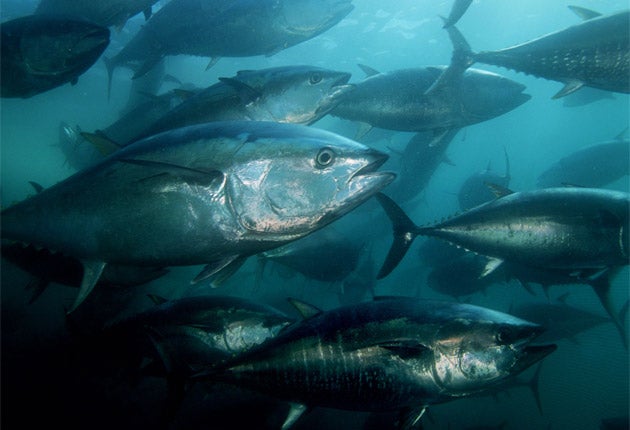
Europe is to throw its weight behind a campaign to save the bluefin tuna from decades of over-fishing after a breakthrough in talks in Brussels.
The European Commission announced a compromise deal backing an attempt to list the Mediterranean fish as an endangered species while waiting for further scientific evidence on the latest population numbers after the EU Fisheries Commissioner Joe Borg backed down.
Europe is now expected to vote as a bloc of 27 nations in favour of a proposal to protect bluefin tuna under Appendix I of the Convention on International Trade in Endangered Species (Cites) which – if approved by a majority of 175 nations around the world – would ban all international trade in the fish.
Environmentalists expressed their delight at the issue, saying it represented the best chance of allowing the tuna to recover from intense demand in Japan, which imports 90 per cent of Europe's bluefin for sushi.
At the last count the population of the Northern Atlantic Bluefin in the Mediterranean had sunk to 18 per cent of its 1970 level, although the small size of specimens on the Tokyo fish markets suggests its collapse is more serious.
Europe has been divided on what action to take. Britain, France, Germany, the Netherlands and Austria favoured a complete trade ban but the move had been resisted by the capital of the bluefin industry Malta and, it is thought, by Spain and Italy, which also have a big commercial interest in bluefin.
The Environment Commissioner, Stavros Dimas, who backed the Cites proposal, was at loggerheads with his fisheries counterpart, Mr Borg.
Mr Borg, from Malta, had been insisting that time be allowed for a bluefin recovery plan which was agreed by the International Convention on the Conservation of Atlantic Tunas (Iccat), whose poor record on conserving the fish has led to it being dubbed the International Conspiracy to Catch All Tuna.
The impasse meant support for a ban was in danger of collapsing, raising the prospect of a compromise of limited trade being allowed instead, which environmentalists said would provide cover for widespread illegal fishing.
However a compromise was reached after Mr Borg backed down, and the Commission provisionally agreed to back a proposal for a ban at Cites in March, subject to the latest assessment of stocks from Iccat in November.
In a statement yesterday, the EC said: "Given that the European Commission services share many of the concerns expressed by Monaco about the state of the stocks of Atlantic bluefin tuna, they consider that the Community could provisionally co-sponsor the proposal by Monaco requesting the listing of BFT in Cites Appendix I."
In a sign that the EC might drop its support if Icatt announces a recovery in bluefin numbers, the EC cautioned: "Whereas it appears for the time being that the criteria for such a listing may be met, the Commission services note that the assessment on which the Monaco proposal is based draws from scientific advice issued in October 2008."
The EC proposal will be put to a meeting of President Barroso's Cabinet tomorrow.
The Environment Secretary Hilary Benn said: "It is great news that the commission is showing its support for the proposal to give bluefin tuna the highest form of protection, which the UK is backing strongly." He said the UK would seek support for the proposal from other EU states.
Tony Long, director of WWF in Brussels, said: "Commissioners Dimas and Borg have made the right choice, leading the EU to heed urgent scientific advice that Atlantic bluefin tuna is dangerously close to collapse and needs a break." Willie Mackenzie of Greenpeace, said: "Today's move doesn't mean that this fish is saved yet. Member states still need to agree to support this ban, and follow the lead of countries like the UK."
Opposition to over-fishing has been growing since the release of the film The End of the Line, which pictures what may have been the last big summer hunt for bluefin in the Mediterranean. Charles Clover, the author of the book on which the film was based, also called The End of the Line, said: "It may have been collapsing while we were filming." Celebrities signed a letter by the actress Greta Scacchi to President Barroso urging him to avoid bluefin tuna going extinct "on his watch."
Join our commenting forum
Join thought-provoking conversations, follow other Independent readers and see their replies
Comments