Fangs but no fangs: bid to honour author of Dracula falls victim to Irish cash woes
We'll have the statue if you pay, Dublin city fathers tell Bram Stoker's descendants. David McKittrick reports
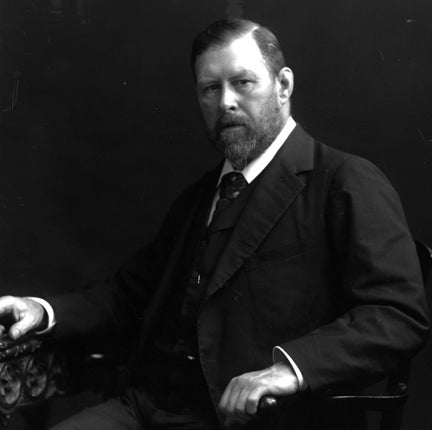
A campaign is under way to have a statue of the creator of Count Dracula – one of Gothic horror's most fascinating characters – erected in his native city of Dublin.
Many do not realise that Bram Stoker, author of the book Dracula, was an Irishman who spent much of his life in Dublin. In fact several of the numerous Draculesque theories maintain that his creation is grounded not just in Transylvania but in Irish folklore.
The statue proposal, which came from Dacre Stoker, the author's great-great-nephew, has found initial favour with Dublin Council's advisers.
But, since the Irish economy might these days be described as close to undead, the statue project – planned to coincide with the centenary of the author's death in 2012 – will only go ahead if the Stoker family can find the money for it. According to a council spokesman, a life-size statue would cost around €100,000 (£90,000).
In Dublin, Bram Stoker is certainly known as an Irish writer, though it might be said he is acknowledged rather than celebrated.
"It's an oversight. There is no permanent memorial in his home city to this guy," Dacre Stoker, who lives in South Carolina, United States, told Reuters.
During his lifetime, from 1847 to 1912, Bram Stoker was better known for handling the business affairs of Sir Henry Irving, the great English actor-manager, than for his own writing.
But in later years his creation has lodged in the popular psyche worldwide. Described as the founding text of the modern vampire myth, the book has never been out of print since the first edition was published in 1897.
It has also exercised a strong fascination first for the theatre and later for film and on television. Hundreds of actors have played the bloodthirsty count in hundreds of productions, sometimes as straight horror such as in the 1922 film, Nosferatu, an unauthorised version of the book; and occasionally as send-up, as in George Hamilton's portrayal of an urbane, fanged sophisticate in Love At First Bite (1979).
Dracula is associated with the Transylvanian folk figure also known as Vlad the Impaler. And many of the characteristics of Stoker's incarnation can be traced to the book Land Beyond the Forest, published nine years before the Irishman's work.
Stoker never visited Transylvania – Vienna was as far east as he got – though he carried out a lot of research on Romania in the British Museum and elsewhere.
But at least part of his inspiration may have come from closer to home, partly from visits to Scottish castles. A visit to the crypt of a Dublin church made a particularly strong impression on him. He may also have drawn on an earlier work by Irish writer Joseph Sheridan Le Fanu which – extremely daringly for Victorian times – featured a lesbian vampire.
Another highly political theory has it that the Dracula tale is a metaphor for heartless landlords sucking the blood and life out of their tenants during the Great Famine of the 19th century, and that the undead represent starving peasants.
Another approach has it that Stoker's Dracula was based on a great tyrant and wizard, based in the north of Ireland, who back in the mists of Irish legend was killed by his people. Dracula-like, he rose from the dead and demanded a bowl of blood from his people to sustain himself. He was slain again but came back demanding more blood. To despatch him permanently he was killed with a sword made of yew wood, buried upside down and covered with a large rock. Today the rock has a tree beside it and, it is claimed, anyone who tries to cut it down experiences strange and inexplicable events and sometimes accidents.
Over the years Stoker enthusiasts in Dublin have kept his memory alive with collections, exhibitions, conferences and newsletters. But with so many myths and legends floating around, there is clearly scope for a closer identification of ghouls, garlic and Gothic with Gaelic.
Join our commenting forum
Join thought-provoking conversations, follow other Independent readers and see their replies
Comments