Fireworks exploded. Horns were sounded. And so the nation of Kosovo was created

For free real time breaking news alerts sent straight to your inbox sign up to our breaking news emails
Sign up to our free breaking news emails
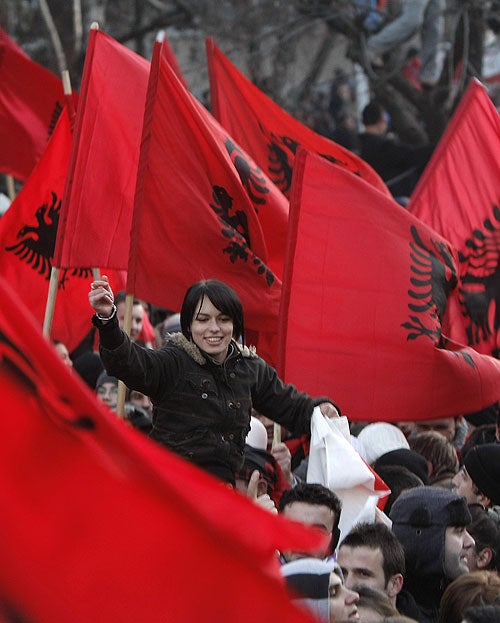
"It's the biggest day for a million years!" declared an ecstatic Kosovar, celebrating his country's independence along with tens of thousands of other ethnic Albanians in Pristina last night.
Fireworks exploded over the city, thousands of cars paraded through the streets, horns blaring and bonnets strung with Albanian flags, while men and women in traditional costume banged drums and danced and sang.
Kosovo became the world's 193rd nation state yesterday. For the Albanians who constitute 90 per cent of Kosovo's people, the declaration marked the end of generations of oppression by Serbs, who claim Kosovo as their historic homeland but for centuries have accounted for a minority of its population. Yet for all the euphoria, there was a decorous, almost sombre edge to the festivities. Kosovo takes to the world stage with the less than unanimous backing of Europe and amid angry denunciations by Serbia and Russia.
The declaration of independence by Prime Minister Hashim Thaci was immediately followed by a statement from his Serb counterpart, Vojislav Kostunica, vowing that Serbia would never recognise it. In Mitrovica, the main flashpoint of ethnic tensions during the Balkans' dark days, grenades were thrown, although they caused no injuries. Jubilant Kosovars shrugged off the threat.
"We don't worry about Serbia," said Mehmet Osmani, 49, a Pristina businessman celebrating with his brother. "Serbia lost Kosovo totally in 1999. This is the last moment they can tell us what to do – now we are equal. The Serbs are nervous now but in time they will calm down. And that goes for Serbians living in Kosovo. No one will do them any harm."
Nine years after the Nato bombing campaign – sparked by fears that Slobodan Milosevic was planning ethnic cleansing against the Kosovars – the country's 39-year-old Prime Minister announced the long-awaited birth of the new country. "This day has been long in coming," he said, "But ... from this moment on, Kosovo is proud, independent and free."
The former guerrilla and political leader of the Kosovo Liberation Army showed scant emotion as he read out the declaration. Referring to his own life, he said: "My family, like yours ... never wavered and never lost faith in our countrymen. From the brother who left his family to fight, to the farmer who would not cede his land, to the women and men who opened their homes and taught our children, to the student who stood up and said 'No more' ... we never wavered and never lost faith in our countrymen."
MPs cheered as Kosovo's new flag, with the country's outline on yellow under six gold stars on a dark blue background was hoisted above the assembly. Also witnessing the scene was the family of the late writer turned pacifist leader Ibrahim Rugova, the man who did more than anyone to foster Kosovo's sense of destiny. This was not the first time Kosovo has declared itself independent – Mr Rugova announced it way back in 1992.
Seven miserable years followed during which the government of Milosevic drove Albanians out of public life to keep the province in subjection. Kosovo has been straining at the leash ever since Serbia's defeat in the 1999 bombing campaign but was held back by the compulsion of its international backers to obtain international consensus for the move. It never arrived.
After a year of intensive negotiations with both sides, the UN special envoy Martti Ahtisaari concluded that a compromise between Serbs and Kosovars was impossible, and instead recommended "independence supervised by the international community".
That was expected to become a reality last year until Russia changed its mind and vetoed the proposal in the UN Security Council. It has been nearly a year since Mr Ahtisaari's report was delivered but the EU, stiffened by the US, has finally got up the courage to defy Moscow and Belgrade.
As Mr Thaci underlined before parliament, the challenges this tiny state faces are daunting. With the youngest population in Europe, 40 per cent unemployment and little in the way of industry or exports, it will have a hard job making its way in the world. Serbia has long threatened to implement a "secret plan" of retaliation if Kosovo broke away, which could include cuts in energy exports and road blockades. Serbia has also threatened diplomatic and trade measures against states that recognise Kosovo's independence.
Mr Thaci's speech was filled with references to the multi-ethnic nature of the new state. But the Serb government has instructed Kosovo's Serbians to boycott its institutions and has vowed to regain the province.
Ever since the end of the war, Kosovo's Serbians have followed orders from Belgrade to ignore the Albanian administration while accepting the role of the UN and Nato. With the UN mission Unmik to be phased out and replaced by a 2,000-strong European force of police, prosecutors and judges, relations with the Serbians are likely to worsen, as Belgrade has condemned the EU mission as illegal.
Yesterday, hand grenades aside, there were no signs of the violence of Kosovo's earlier rites of passage. Kosovars had been implored by their government to "celebrate independence with dignity for a bright start". "If I am happy, the Serbians should be happy, too," said one reveller last night. "Every Serbian who is honest and did not commit crimes is welcome to live with us."
Subscribe to Independent Premium to bookmark this article
Want to bookmark your favourite articles and stories to read or reference later? Start your Independent Premium subscription today.
Join our commenting forum
Join thought-provoking conversations, follow other Independent readers and see their replies