France burns as strike descends into violence
President Sarkozy vows to crush petrol blockades crippling country
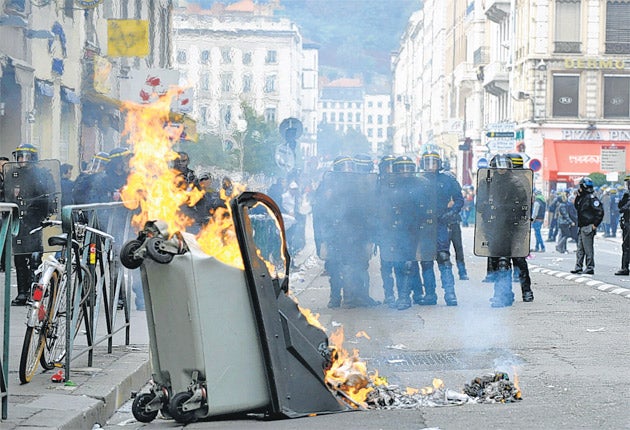
France teetered on the edge of a complex and multi-layered crisis yesterday as petrol shortages worsened and violence by disaffected suburban youths spread and intensified.
Around 3.5 million people, according to unions – about the same or marginally fewer than last week – joined marches around the country to protest against President Nicolas Sarkozy's plans to raise the retirement age to 62. One-day strikes in the public sector disrupted rail and air services but were patchily observed by workers in other sectors.
The sense of crisis threatening the country came not from these "official" protests but from spreading blockages of schools and universities by students and by continuing strikes at oil refineries and the picketing of fuel distribution depots by hardline union branches.
Mr Sarkozy promised rapid action to lift the fuel blockages as the government admitted that 4,000 – almost one in three – petrol stations were "waiting for supplies" (in other words empty).
The Prime Minister, François Fillon, said that "no one has a right to take an entire country hostage" and promised emergency action to restore petrol supplies to normal within five days. Potentially even more seriously, there was a second day of violent clashes between police and hooded youths in Lyon, in Nanterre, west of Paris, and in a score of other towns and suburbs. In Lyon, 200 youths – apparently unconnected to any pension protest – rampaged down the city's main shopping street, burning and overturning cars and looting and smashing shops.
A college, or middle-school, in Le Mans in western France was set alight and burned to the ground in the early hours of yesterday. Although authorities did not directly link the attack to other outbreaks of violence, it was an ugly reminder of the orgy of self-harm unleashed on the troubled multiracial banlieues by rioting youths in October and November 2005.
Fears that the petrol blockages, and piggyback acts of violence, could spiral out of control drew solemn warnings from Mr Sarkozy and Mr Fillon – but also, significantly, from moderate national union leaders. One union federation, the white collar CFE-CGC, called for a "pause" in the anti-pension reform protest to put an end to "excesses" and "exaggerations".
Moderate union leaders have been worried for some time that excessive militancy, even violence, could puncture the strong public support for the unions on pension reform and present President Sarkozy with a moral victory.
Mr Fillon, in a speech to the National Assembly yesterday, deliberately lumped together the refinery strikes and the mini-riots by suburban youths. He said "intimidation, blockages and violence" were a "negation of democracy and of our Republican values".
Mr Sarkozy said: "I appeal to the responsibility of all those involved to make sure things don't breach certain limits."
He said he intended to take new actions to break the refinery strikes and petrol depot blockades by the end of the week.
With the reform due to complete its final stages in the Senate, or upper house of parliament, tomorrow, the government hopes to divide the protesters' ranks by portraying continuing militant actions as "anti-democratic" or even unpatriotic. This may impress the more moderate union rank and file. It is unlikely to deter the other layers of protesters – from oil strikers to students to hooded youths – in a dispute which has become as much anti-Sarkozy and anti-establishment as anti-pension reform. Olivier Besancenot, the media-friendly leader of the Trotskyist New Anticapitalist Party, has been talking for days of a "new May 1968" revolt by students and workers. "The street has power and it can be more powerful than the government," he said yesterday.
Blockages of lycées (equivalent to sixth-form colleges) spread to 1,000 schools yesterday, according to student unions. There were also signs for the first time that university students were joining the protests in large numbers in Lyon, Rennes, Toulouse and Strasbourg. In Paris, lycée students took over part of the Place de la République, one of the city's main intersections, and pelted police with fruit and other soft missiles.
Although they are sometimes lumped together in media reports, there is a clear distinction between "political" student protests of this kind and the anarchic and "anti-system" actions of disaffected, hooded youths in Lyons, Nanterre and elsewhere. In some incidents, the youths have attacked the "official" student protesters simply because they belong to other suburbs or other schools.
In Lyon yesterday, several small groups of youths smashed and looted shops and burned or overturned 30 cars in the city's administrative and shopping district. Thirteen people were arrested. There were also renewed acts of violence and clashes with police in Nanterre, a suburb just west of Paris, and lesser incidents in a score of other areas.
Join our commenting forum
Join thought-provoking conversations, follow other Independent readers and see their replies
Comments
Bookmark popover
Removed from bookmarks