Gerda's long quest for the truth: who sent my family to their deaths?
Seventy years after she fled her home town in Nazi Germany, Gerda Shenfield returned in search of answers. Liane Wimhurst went with her
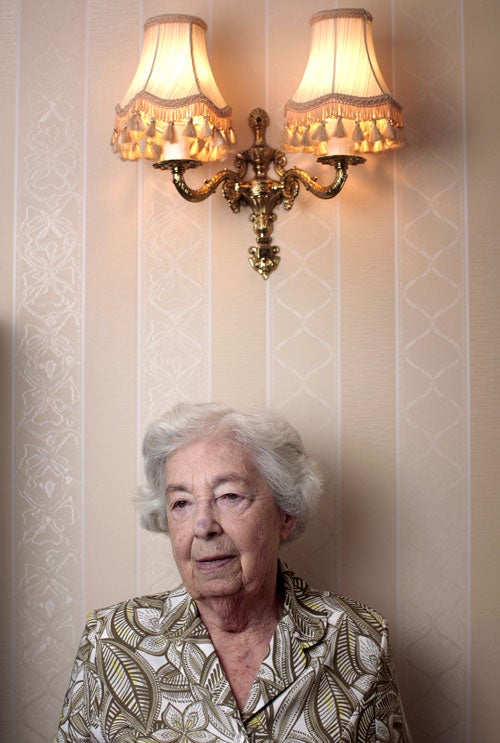
It is a bright morning on a German autobahn between Berlin and Rostock, and 91-year-old Gerda Shenfield is steeling herself. Armed with an arsenal of questions, she is visiting her home town for the first time in over 70 years. She is propelled by her fierce resolve to discover who sent her parents to their deaths in 1942.
Gerda was born in 1920 in the old fortress town of Teterow, north-east Germany, near the Polish border. Her parents had a thriving animal fur business, a three-storey house and stables. They were Jewish. The anti-Semitic creep in Germany was almost imperceptible at first, but when the Nazis stormed to power in 1933 it was everywhere. For Gerda, the bullying began at secondary school; teachers and other pupils acted alone or united to taunt and exclude her.
Teterow began to empty of Jewish families – Poles went to Poland, Austrians to Austria, but Gerda's family were German, and had nowhere to go. As the menace of Nazism intensified in the mid-1930s, Gerda's family suggested she get out. As a young, unmarried woman, she had the best chance of securing a working visa abroad. Her older sister Lieselotta, was married and pregnant, and so had little hope of escape. To Gerda's parents it was unthinkable they would be killed: they were good citizens and her father had won the Iron Cross for bravery in the First World War.
So Gerda planned a solo escape, hoping – once abroad – to find a way to rescue her family. She took a job at the Jewish Hospital in Frankfurt in 1938, believing it would improve her chances of securing a nursing permit. Daily, there were reminders of the worsening situation. At her hospital, the morgue drawers were full of the bodies of Jews who had thrust their heads in ovens rather than face the Nazis. Her parents stayed on in Teterow, their business failing as the Nazis boycotted Jewish companies. Forced to rent out the family home, they took shelter in the porch, near the stables.
Gerda's permit arrived in early 1939 but, desperate not to abandon her parents to an increasingly certain fate, she clung on until the eve of the Second World War. As German tanks massed on the Polish border, she knew the time had come – "we all knew war was in the air." It was 3 August, exactly a month before it started.
Leaving her family behind, she took the train that was her last chance of freedom – and of life. It was a journey out of Germany filled with anxiety, Her slow train to the Hook of Holland, and thence – God willing – a ferry to Britain, was packed with Jews too frightened to talk. The agitated silence was broken by the thud of Nazis bursting on board before Amsterdam. Passengers were separated into men, women and children, each treated with a different degree of cruelty. Several hundred adults were sent to their deaths; 10 youngsters were allowed back on board. Gerda was one of them: "I was just a child. I meant nothing to them."
By the time war erupted a month later, Gerda was in Merthyr Tydfil, the Welsh town to which her nursing papers had taken her. Day and night she crammed for her exams to avoid being sent back. In the local hospital she met the charming Harry Shenfield, who was recovering from a broken wrist. A smooth-talking Welshman, he instantly fell for Gerda, who gradually warmed to his advances.
As the war raged ceaselessly, Jews in Teterow had been rounded up and forced to live in the rabbi's house. They lived in squalor, unable to afford food or water. A handful of sympathetic townspeople delivered scraps to them, including the new owner of Gerda's family home, Herr Buhr. Gerda's hopes of rescuing her family faded.
The only glimpses of the terror she had left behind filtered through in Red Cross-distributed letters from her mother and sister, their fears and longing crammed into just one letter a month. Each had to be no longer than 20 words, and, one spring morning in 1942, what proved to be the last one arrived. With the words "Die letzten Grüsse" – the last greeting – her family said goodbye. By the time she read the shaky handwriting her parents were in Theresienstadt, her sister and baby in Buchenwald. Confirmation of their deaths would not reach Gerda until long after the war.
When the Red Army stormed Teterow, the town cowered. One man stood outside the town hall and waved a white handkerchief. The Russians publicly executed suspected Nazis and raped women. Mass suicides swept Germany. Around 200 people drowned themselves in Teterow's lake, and in nearby Demmin, about 1,000 took their lives in the largest mass suicide in German history.
In 1945 Gerda married Harry, and later named her only son Martin, after her father. For decades her husband gently thwarted her every impulse to return to Germany, but when he died eight years ago, the nightmares about her past began. Desperate to stifle the haunting scenes that plagued her sleep, Gerda suggested a family trip to her home town. Her family offered their support. Jonathan, her grandson, exchanged letters with Teterow's mayor, and the trip was on. Gerda, at 91, would return to her home town to seek answers to questions that had haunted her for nearly 70 years.
Teterow's narrow, cobbled streets and fortress walls are exactly as Gerda remembers them, the battle scars of its wretched history barely visible. Unwearied despite a day of travel, and with wide eyes, Gerda marches to the town hall. "Who put my parents on the train?" she demands of the mayor, Reinhard Dettmann.
The information, he says, does not exist. Her hopes of identifying her parents' betrayers were destroyed when the Russians torched the town's files.
Undeterred and hoping the answers are tucked away just out of sight, Gerda wanders the stony streets. Her parents' last home – the rabbi's house – no longer exists. The land is now owned by a grinning German couple who have turned it into an exquisite, fairytale garden. Its beauty and the history move Gerda and spark a surge of tears. At the edge of a well-manicured hedgerow, she places a pot plant to the memory of her parents.
Not far from the rabbi's house, Gerda's family home is now filled with quirky collections of clocks, Ikea furniture and the family photographs of strangers. "Do you know?" Gerda muses, "it's not my home. I think that's a good thing."
There is only one person left in Teterow who can remember Nazi rule, she is told, and 86-year-old Jürgen Berg is happy to exchange memories with a former resident of the town. They meet in a town hall room lined with the portraits of every mayor except those in power between 1933 and 1945. Gerda leans conspiratorially towards her family and says: "I'm not going to go easy on him." She then turns to Jürgen and demands, in German: "Who put my parents on the train?" He blushes and fiddles with his hearing aid. Eventually he ventures: "It was a long, long, long time ago."
Wartime events in Teterow elude Jürgen as he was conscripted to fight, and then held prisoner by the British in Schleswig-Holstein. He returned to find all but two members of his family had committed suicide. Jürgen's sister had been repeatedly raped by Russian soldiers. His father decided they had suffered enough. He and his wife stacked their rucksacks with rocks, cradled their children in their arms and waded to their deaths in the Teterow lake.
Both Gerda and Jürgen have enduring, bitter memories of the decades in which massacre and torture were the norm in Europe. Teterow's Jewish cemetery is a haunting testament to the attempted extermination of the Jews. The last Jew permitted a natural death here was Gerda's uncle, Julius Samuel, buried in 1932. The graveyard was a quagmire of green moss and overgrown grass until the mayor restored it. It is now a shrine to Gerda's family: a third of the stones bear the Samuel name. Her father is buried in a mass grave at Theresienstadt; her sister and her baby in Buchenwald. Her mother's body is missing.
The mayor, Mr Dettmann, is desperate to keep history alive as he fears a resurgence of fascism in Europe. Plaques across Teterow remind inhabitants and visitors of the Jewish deportations. He keeps the Jewish cemetery locked at night so the graves are not desecrated.
The truth of those who conspired in Gerda's parents' deaths is long buried. Standing before the only tombstones honouring her family, Gerda wipes tears from her face, points a shaky finger at her grandson Jonathan and says: "You better come back here. Don't you ever forget."
Join our commenting forum
Join thought-provoking conversations, follow other Independent readers and see their replies
Comments