Germany v Greece: A real Euro stress test
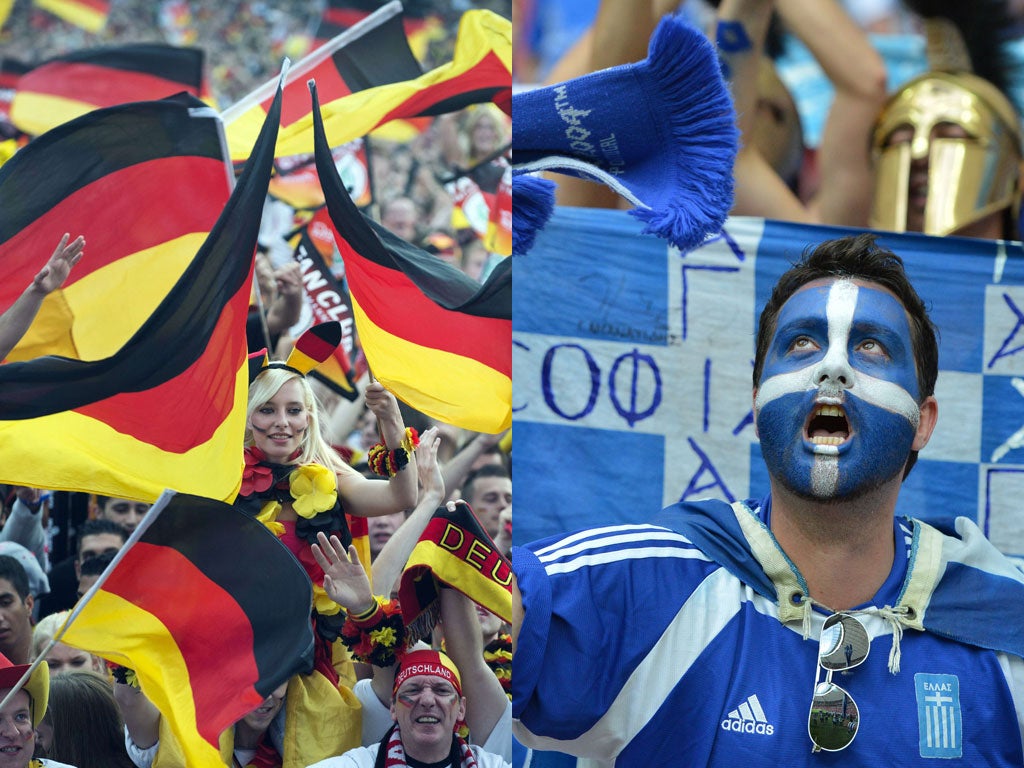
The eurozone crisis has brought relations between Germany and Greece – fraught at the best of times – to a new low. Tonight they will have it out: on the football pitch. Will they play nicely? Independent writers test the mood on either side of the divide
Germans in Greece, by Daniel Howden in Kardamyli
Roland Mueller needed a holiday. He was working 14-hour days running two businesses in his hometown of Ulm in southern Germany. A friend of his had an uncle living in the hills near Mani on the stunning western shore of the Peloponnese so he went there. One week later he had decided to go home, sell up and move to Greece. "I told myself I will never do this again and work like an idiot," he says.
The "basic and beautiful" life the electrician found in the stone villages that dot the side of the Taygetos Mountain was completely removed from the grind of home. Germans have been settling around Mani since the end of the Second World War when soldiers who served there during the occupation drifted back to the place they had come to love.
More than half a century later the sign for the Mani museum is in German and shops with names like Wunder Travel abound. Fourteen years on from his holiday, Mr Mueller says that going home to Germany is like entering "another dimension". The gardens in the village outside Ulm where his family lives are almost fake in their perfection, he says.
He can no longer see the chaos that his friends speak of when they visit him. And what appears to them to be "corruption" looks to him more like "cooperation". If you want to understand Greeks, he says, you only need to watch them when the bill comes at a taverna. "The Greeks will try to sneak in and pay for everyone, the Germans will try sneak out to avoid the bill."
That generosity doesn't extend to the Greek state, where the rule is that "everybody takes from the state, nobody gives". The 48-year-old who married a Greek and has a 12-year-old named Maximilianos, found people who retired at 45 and a state electricity company that was designed to lose money. It couldn't last and everyone knew that a financial crisis was coming, he believes. Now it has arrived, he's not happy with the way that it's being handled either by his adopted country or his birthplace. The Greeks needed to "make their expenditure match their income" while Chancellor Angela Merkel was "spineless" in her failure to tell Germans what they gain from bailing out a bankrupt south. "Germany can't afford to act like an island where everyone is happy and nothing else matters," he says.
The posturing in the popular press in both countries hasn't trickled down to any real resentment from his Greek neighbours, just good-natured banter. Mr Mueller volunteers for the local fire brigade and keeps their accounts. "Whenever I say that we can't afford something they start calling me Merkel."
Annette Hilbrecht has given up trying to be Greek and accepted that she is German but says it's not always a comfortable identity. The sculptor used her US-accented English to hide her roots when first visiting some parts of Greece. "You have a heavy load as a German and I would feel embarrassed when going to Crete with what happened during the war."
The legacy of that conflict and the German occupation which led to the worst European famine of the 20th century lives on – if only in the playground where her daughter has been called "nazi".
Amid the financial crisis, the 57-year- old sees disturbing echoes of Germany's Weimar past despite the sunny appearance of her Ioanian coastal idyll. "The future could be black," she says. "It could be going towards something ultra-conservative or fascist." She points to the rise of the neo-Nazi group Golden Dawn, some of whose candidates she used to know well enough to chat to. Their offer of pride and belonging is reaching a poorly educated minority, she says.
Golden Dawn took seven per cent nationwide at last weekend's election and did even better in the nearby city of Kalamata. Crime has become an issue and the postman was shot at and robbed last year. The "easy life" of 2005 has disappeared, just as the stereotype of lazy Greeks has evaporated. In the village of Agios Nikolaos, it was the German residents who appealed to authorities to stop Greeks who were disturbing the peace by wanting to work until midnight.
Sitting in a beachfront taverna, Ms Hilbrecht says things would have to get worse in Greece before she would move back to Germany. "Even in a crisis this is still a great place to live."
Both the electrician and the artist will be watching tonight's game as Greece. Mr Mueller admits he will be pulling for his adopted home even if he wears a German flag to wind up his fireman friends.
Greeks in Germany, by Tony Paterson in Berlin
They are playing it safe at Berlin's Taverna Hellas ahead of tonight's Euro 2012 football showdown between Germany and Greece. The message on the blackboard outside the restaurant, where the match will be screened, proclaims: "Ouzo on the house for every Greek AND German goal!"
Set on a back street in the city's working class district of Wedding, the Taverna Hellas looks purposely designed to meet every German's idea of what a Greek restaurant should be like: plaster Doric columns and antique statues adorn its interior, while "Zorba the Greek" music pumps out and a plastic Acropolis sits on the bar. "Of course we want Greece to win," insisted 43 -year-old Stefanos Demertzis, the taverna's senior manager. "But we have to play fair. We may be booked out for the game, but only a few Greeks will be coming to the restaurant to watch it, the majority of our customers are Germans."
Greeks make up the fourth largest immigrant group in Germany after Turks, Italians and Poles. Many came as guest workers in the late 1960s and early 1970s and stayed on. There are 300,000 Greeks in Germany. In Berlin, a city of more than three million, their population stands at just over 9,000.
But the euro crisis has put Germany's Greeks in an awkward predicament. Their native country has been depicted in much of the German media as a nation of corrupt backsliders who refuse to pay taxes and who have no better solution than to demand more bailout money from German taxpayers.
Greece has retaliated with its own media campaign which has included front-page pictures of the Chancellor, Angela Merkel, dressed as Hitler and claims that Berlin's politicians are behaving like the Nazis who occupied Greece during the Second World War.
The media slanging match has led 50,000 Germans to cancel summer holiday bookings in Greece this year because of fears about being blamed for the Greek government's austerity drive. Overall, German holiday bookings to Greece have dropped by half.
"Of course there is a war of words between Greece and Germany and as a Greek it is insulting to be treated like that by the German press," said Mr Demertzis. "But there are no Germans I know who blame me personally for the Greek dilemma. At least the problem has been identified and now it is not just Greece but the whole of southern Europe that is also involved."
Mr Demertzis is in the same boat as many Greeks in Germany. He first visited the country 13 years ago and got a job as a waiter in Heidelberg. There he met his future German wife, a Berliner. In time, he moved back to the German capital with her. They now have two young children. But Mr Demertzis says he would like to go home. "Like most Greeks who live here, I dream of some-day going back to Greece," he said. "But the crisis in my home country continues and it's becoming more difficult to find work there. I have to stay in Germany to survive."
Michael Kanatidis, 20, from Thessaloniki, who lives around the corner from the Taverna Hellas, came to Berlin two years ago to study music. He said that although he liked Berlin and had German friends, he felt Germany had coerced the Greeks into accepting austerity with warnings about losing the euro. "I wanted the far left to win the election. The German government blackmailed voters with their scares about what would happen if they got in." Even so, he is not inclined to return. "There is no way I can go back there. The work situation is terrible."
Like most Greeks in Germany, both will watch tonight's game in the firm believe that poetic justice will secure a Greek victory. The match has given both countries an excuse to step up political and sporting antagonism. Volker Kauder, a conservative spokesman, insisted on Wednesday that there should be no "softening up" of Greek austerity measures whatever the composition of the country's new government.
Meanwhile, Fernando Santos, the Greek side's trainer, has warned the German team: "We may not be the best, but anyone who plays against us will have to spit blood if they want to beat us."
Angela Merkel has rearranged her schedule to attend the match in Gdansk in person. It is first game in the competition she will attend. "Politics will not be on the agenda. It is a day for sport," her spokesman insisted.
Bitter comparison: Memories of occupation
Greece's problems with Germany over the eurozone crisis have inevitably invoked bitter memories of the Nazi occupation of the country in the Second World War.
After German forces invaded in 1941, more than 100,000 Greeks starved to death and the country's Jewish population was deported to death camps across Europe.
German forces also massacred civilians and burnt villages in a series of brutal reprisals for the deaths of Wehrmacht soldiers killed by the Greek resistance. One of the worst atrocities was carried out in the town of Kalavryata, pictured, right, on 13 December 1943.
German troops ordered 1,200 men and boys over the age of 12 to a nearby hill where they were all machine-gunned. Another massacre was carried out in the village of Distomo, north-west of Athens, for similar reasons in June 1944, with more than 200 civilians shot dead.
The victims' families have been trying in vain to obtain financial compensation from post-war Germany ever since, with some claiming that Berlin owes as much as $100bn in reparations.
Today, with the Greek economy mired in a deep recession, many Greeks complain that Chancellor Angela Merkel's insistence that Athens must adhere to a strict austerity programme has turned the country's poorer citizens into beggars forced to forage in dustbins for food. Some Greek tabloid newspapers have chosen to portray her on their front pages as a latter-day Adolf Hitler.
Tony Paterson
Join our commenting forum
Join thought-provoking conversations, follow other Independent readers and see their replies
Comments