History becomes a battlefield as Putin flies into Poland
Deep divisions over who was to blame for Second World War cast shadow over 70th anniversary meeting
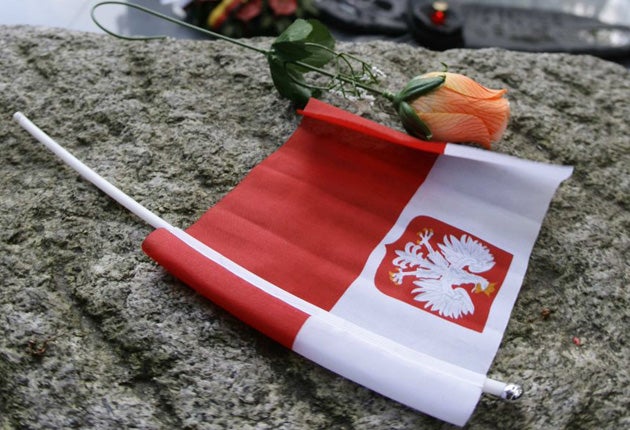
REUTERS
The grave of a Polish officer, Henryk Sucharski, killed at the start of the Second World War, near Gdansk yesterday
European leaders gather in the Polish city of Gdansk today to mark the 70th anniversary of the start of the Second World War, amid an acrimonious row between Moscow and much of Europe over who started the conflict.
The heavily politicised spat has been escalating throughout the summer as central European countries have sought to portray the Nazi-Soviet non-aggression pact as a key precursor to the war. Russia has responded furiously, insisting that Joseph Stalin had nothing to do with the outbreak of hostilities in Europe, and has even blamed Poland for starting the war.
The spat will overshadow today's summit, attended by German Chancellor, Angela Merkel, the Russian Prime Minister, Vladimir Putin, and the British Foreign Secretary, David Miliband. All eyes will be on Mr Putin, who is making his first trip to Poland since 2005, and has in the past reacted aggressively to European criticism of Stalin's role in the war and Soviet atrocities. He is expected to give a speech in Gdansk today, which will be watched closely by the rest of Europe. A foreign policy aide said that one of the main purposes of the trip would be to counter false theories about the start of the war.
The argument comes in the context of a concerted Russian effort to retain the entire war period as a glorious Soviet achievement. Earlier this year, the Russian President, Dmitry Medvedev, set up a body with the Orwellian title of the Commission to Prevent the Falsification of History to the Detriment of Russia's Interests, which could lead to prosecutions of people who seek to "rewrite history". Liberal critics have ridiculed the commission, and say it sets a dangerous precedent which could pave the way for anyone attempting to shed light on some of the darker pages in Russia's history to be silenced.
As the war anniversary has approached, Moscow has ratcheted up the rhetoric. On Sunday, President Medvedev said in a television interview that it was a "complete lie" to say that Stalin bore any responsibility for the war. Natalia Narochnitskaya, a Kremlin-friendly historian and member of the new commission, accused Poland of trying to paint itself as an "innocent victim". Actually, she claimed, for a full six months before the outbreak of war Poland was negotiating with Adolf Hitler to invade the Soviet Union. In Warsaw, such claims are denounced as outrageous lies.
On the eve of the Gdansk meeting, where Mr Putin will have talks with the Polish Prime Minister, Donald Tusk, the Russian Prime Minister appeared to strike a conciliatory tone, saying in an interview with a Polish newspaper that the Nazi-Soviet pact had been "immoral". He added, however, that the Soviet Union had been pushed into the agreement by the failure of Britain, France and other Western countries to form a united front against Hitler.
Mr Putin touched on another sore point in Russo-Polish relations, the Katyn Massacre of 1940, when the Soviets executed 22,000 Polish officers and intellectuals and buried them in a forest in western Russia. For years, Moscow blamed the massacre on the Nazis, and it was only with the fall of Communism that the truth came out. Mr Putin referred to the massacre as a "crime", though stopped short of satisfying a long-standing Polish demand and officially apologising for the atrocity.
Fyodor Lukyanov, editor of Russia in Global Affairs magazine, said: "This is quite surprising, and actually more than we could have expected from Putin, especially in the context of the rhetoric about the Nazi-Soviet pact inside Russia."
Moscow's fury stems from what it sees as the glorification of Nazi-allied partisans and nationalist regiments in Ukraine and the Baltic States. With central and eastern Europe worried about Russia's efforts to maintain a "sphere of interest" in former Communist countries, interpretations of history become ever more important.
"What Russia has in common with Estonia, Poland, Ukraine and all the other post-Communist countries is that they are still trying to build a national identity," said Mr Lukyanov.
"History is extremely important. While in western Europe, countries have been able to discuss historical problems outside of politics, in eastern Europe there is a long history of mixing history and politics."
View all comments that have been posted about this article.
Offensive or abusive comments will be removed and your IP logged and may be used to prevent further submission. In submitting a comment to the site, you agree to be bound by the Independent Minds Terms of Service.
- Print Article
- Email Article
-
Click here for copyright permissions
Copyright 2009 Independent News and Media Limited


Comments
it is therefore very important to note that Hitler would not have found it so easy to create an industrial war machine had it not been for the support of George W Bush's grandfather and the other American supporters of fascism. And of course there was Chamerlain's role in ensuring Britain was kept unprepared for a long as possible.
It is important to note that Britain and France sat idly by and watched as Poland was carved up between the Germans and the Russians: a decisive attack on the western front in the autumn of 1939 could easily have been devastating for the Nazis, who were preoccuoied in the east. clearly there was a genocide/depopulation agenda on all sides, (except the Poles of course).
It is also important to note that having spurrred an uprising later in the war, both the Russians and the West sat by and allowed further slaughtering of Poles.
Most 'official' history is the version the money lenders and global elites want people to believe and argue over., while they back both sides of conflicts and make war profits.
But that won't stop you claiming it was Russia, will it?
Britain and France hardly helped either, providing no material support to the under resourced Poles (bare in mind the Fist World War was largely fought over Polish soil, not simply the Ardennes as the myth makes would have it).
Britain even told the Poles to stand down their reserves because it might "antagonise the Nazi's"). The Poles still fought for two months with no assistance other than a declaration of war two days after the invasion. Russia invaded a week after the Nazi invasion.
Russia did not simply sign a pact they actually invaded and occupied large parts of Poland and hedl joint celebrations with their fascist comrades.
In fact you could go further back in looking at causes and Stalins machinations in controlling the German Communist Party and calling on it to attack the German Social Democrats, thus letting in Hitler and his fascists.
The Russian bear is flexing its gangster ridden muscles once more.
People who still have brains and education know how Chamberlain and the foreign office cozied up to Hitler, offering him all he could eat to his east as long as he left Britain's maritime domination unchallenged.
Chamberlain officially inaugurated Hitler's eastern banquet at Munich, along with Poland, which got a piece of the Czech pie called the Teschen, with the full approval of Hitler, Mussolini, Chamberlain, and Chamberlain's puppet Daladier. The Teschen was Hitler's taster for Poland, famous for its big appetite for imperial conquest unmatched by its military means to do it. Hitler made the Poles an offer they couldn't refuse: You can grab the rest of Ukraine from Russia if you join the anti-comintern pact to invade the USSR and hand over Danzig (Nazi foreign policy, 1933-1941: the road to global war
By Christian Leitz). The stupid Poles thought that this was a negotiation and tried to make Hitler back down on Danzig, trying to get something for nothing, just like they tried to defeat German panzers with cavalry a few weeks later. You have to admit Hitler wasn't being unfair. The Polish army was worthless so Poland joining the invasion wasn't going to help Hitler much, was he supposed to give away Ukraine for nothing?
As the above cite (from an article on a book by Chamberlain's ambassador to the Reich) proves, Chamberlain was still in cahoots with Hitler even when he made territorial claims on Poland. The "free hand in the east" blank check was still valid. Things only changed when Churchill got the upper hand, making Britain Uncle Sam's junior partner instead of Hitler's. At Munich, though, Germany, Britain, France, Poland, and Italy were all in league against the USSR, with Hitler leading the charge. THAT'S what started the war.
Rehabilitating Stalin, after he was responsible for the murder, of many millions of Russians, is a national disgrace, for a Russian government to put its name to. Then again Putin and his KGB ilk have a long tradition, stretching back to numerous Czars, of suppression and tyranny. Anyone who dares challenge this totalitarian monolith is soon imprisoned or "mysteriously" murdered. All the hallmarks of the mafia.
Poles would like us all to forget their penny-wise duplicity and greed (as evidenced by their eagerness to host US missiles and torture prisons, to torpedo the EU constitution, and to lock horns with Germany over the North Sea pipeline that would get rid of Europe's Ukrainian bottleneck) that had them occupying bits of Germany and Czechoslovakia and getting ready to invade the USSR alongside Hitler but picking a fight with Hitler over Danzig at the same time. They would like us all to forget their deeply ingrained hatred of Russia (as well of Jews, Gypsies, and just about everbody else), their insatiable lust for other peoples' land, and their underhand collaboration with fascism and the holocaust, for which Polish Jews paid the heaviest price.
Poles can forget all their dark and shameful past (and present) and imagine themselves as wronged heroes thanks to Zubrowka. Those with a more normal blood chemistry can't quite see it with the same eye.
because the attack was deemed illegal, the Soviet Union was expelled from the League of Nations on 14 December.
And perhaps the Northern pipeline should be renamed Ribbentrop-Mollotov.
........is this a case of.."...don't mention the war !!..."......or the Germans ....???
While we are on the subject. Why did the "glorious" Red Army sit on his collective ass on the other side of the Vistula, refusing to allow any material support, or for the Americans or British or Polish airman to lend support, as the Home Army rose in Warsaw against their oppressors, fighting for over two months with limited weaponry and supplies.
15,000 insurgents were killed, 5,000 wounded, 15,000 sent to Prisoner of War camps. Among civilians 200,000 were dead, and 700,000 expelled from the city. Approximately 55,000 civilians were sent to concentration camps, including 13,000 to Auschwitz. As with the 25,000 murdered by the NKVD (KGB) atKatyn this was another quick and easy way to get rid of any potential opposition to the tyranny to come.
This says everything you need to know about Russia, Stalin and what their objectives were. Defeating their former friends the Nazis wasn't the only objective. Installing a compliant, toadying regime, subservient to Stalin was all part of the tyrants game plan.
It is also rarely acknowledged by the Russians the many British sailors and airmen who died getting aid to USSR on the Murmansk convoys and Stalin was always demanding more. USA also provide a lot of
military aid of all kinds including fuel to USSR as well
You have a very unpleasant attitude, combined with a love of putting a bucket over your head.
Oh, and let's on no account forget the loss of india. There obviously is no connection between that catastrophe and the highly moral stance the british took on Poland, now is there?
May I congratulate the british on the glorious way they chose to destroy their empire?
In the "More What If?" book, Williamson Murray writes an intriguing chapter entited "The War of 1938", which argues that, had Britain and France had the cajones to refuse a deal with Hitler, it's just possible that the war of 1938 would have been a much more localised conflict for which the Wehrmacht was less ready to attack than the Czechs were to defend their frontier.
Fantasy, of course, but what compounds the shame of Munich is that there was no attack on Germany in the west as soon as Hitler went into Poland. The Maginot Line said it all: we will wait for you, Adolf.
But he went round it.
The other unwritten 'What If' involves the mystery of the man who sympathised with both Mussolini and Franco but eagerly jumped into bed with Stalin in June 1941.
http://www.amazon.co.uk/Churchill-Sovie
History, eh.
Let there be peace on earth, and let it begin with me.
can I be number 2 to sign up to peace please
the 70 yr old hatred in these coments is making me miserable
hold back your tears and move on (martin luther king)
this statement is self evident
lets not all argue the toss 70 years later
he duped us all
Poland was lied into believing that France/England/ U.S. Khazars would leap into the frey...they did but too late to help the Poles horse and buggy military.
Maybe if they had acted swiftly to stop the Danzig slaughter..... Think of the poor Russians, blamed for over 50 years for the slaughter of 1.5, (+/_), German citizens when it was Swedish Ashkenazi Eisenhower that had em murdered.
Six Jewish Companies Own 96% of the World?s Media