Hitler's 'lost fleet' of U-boats found in the Black Sea

For free real time breaking news alerts sent straight to your inbox sign up to our breaking news emails
Sign up to our free breaking news emails
For years, German submarines U-19, U-20, and U-23 were a terrifying presence beneath the waves, preying on British and Russian shipping. Then, 60 years ago, they suddenly vanished to the bottom of the Black Sea.
Now the hulk of one of the lost submarines has been found by divers who are confident they can pinpoint the other two boats too.
The fate of "Hitler's lost fleet" was the talking point of a conference on international shipwrecks at Plymouth University at the weekend, when the Turkish marine engineer Selcuk Kolay described his painstaking search for the missing wrecks.
The search began along the Turkish coast near the town of Zonguldak in 1994, after the Turkish navy complained that it was having difficulty conducting minesweeping operations. Local people had known for years that the submarines were out there under the water somewhere, though the remarkable story of the U-boats is one of the lesser known episodes of the war.
The three submarines were originally part of a six-boat flotilla harassing Allied shipping around the North Sea. U-23 had patrolled the Spanish coast during the civil war, under the command of a young Sea Lieutenant, Otto Kretschmer, who was to become Germany's top U-boat ace. He was known as "Otto the Silent" for his mastery of silent running and his reluctance to make radio contact with Germany while he was at sea.
His career almost finished before it had properly begun when a British submarine spotted U-23 off the Danish coast in October 1939 and fired three torpedoes at it. All three missed. Before he was transferred to another boat, Kretschmer scored his first hit of the war in U-23 when he sailed into the Moray Firth and sank a 10,000 ton Danish tanker on 12 January 1940.
The U-boats of the 30th flotilla were small by Second World War standards – only 140 feet long – which made them popular with the Kriegsmarine when it was rearming in the 1930s. The Type II-B, nicknamed Einbaum (dugout canoe), were cheap to build and could be run off an assembly line quickly. Once war began, the smaller submarines were taken out of action in the Atlantic and North Sea as soon as larger boats could be built to replace them.
But their size was an advantage when choosing craft for their next deployment. After the invasion of the Soviet Union in June 1941, the German high command decided that it needed the flotilla to attack Soviet ships in the Black Sea.
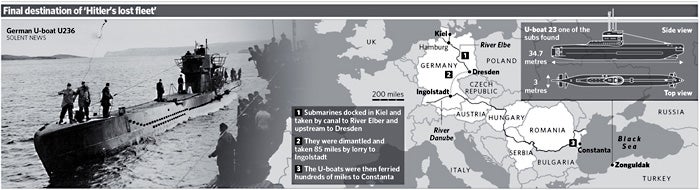
To have taken the subs by sea past Great Britain and Gibraltar would have been hazardous. And they would then have had to go through Turkish waters, violating that country's neutrality. So it was decided they would go by land. Each weighed just under 280 tons, making it easier to convey them on their 2,000 mile (3,300km) journey overland.
The submarines docked in Kiel and were taken by canal to the Elbe, then upstream to Dresden. There they were dismantled and taken 85 miles by lorry to Ingolstadt, on the Danube. They were then ferried hundreds of miles through Germany, Austria, Hungary and Romania, to the Black Sea port of Constanta.
Over the next three years, the flotilla sank 45,000 tons of Soviet shipping, while losing three boats.
But in September 1944, the Red Army entered Romania, its government switched sides, and the remaining three subs were stranded. Their crews were ordered to scuttle their boats and try to make it home by land. They rowed to Turkey, but were interned for the rest of the war.
Mr Kolay used German divers, interviews with survivors, and sonar soundings in his search for the three sunken U-boats. His divers have found U-20, which is two miles off shore and about 80 feet under water. "It's in wonderful condition, still fully intact," he said.
He believes he has also pinpointed U-23, under 160 feet of water three miles off the coast, and thinks he knows roughly where U-19 is, further out and more than 1,500 feet down.
Only 20 Type II-B submarines were ever built, and just one survives, making the prospect of retrieving three of them in good condition an enticing one for naval historians. And as the 25 man crew of each ship got out alive, they are not considered to be war graves.
Subscribe to Independent Premium to bookmark this article
Want to bookmark your favourite articles and stories to read or reference later? Start your Independent Premium subscription today.
Join our commenting forum
Join thought-provoking conversations, follow other Independent readers and see their replies