In Spain's heart, a slum to shame Europe
The continent's largest shanty town – just a 15-minute drive from the affluent centre of Madrid
Canada Real Galiana is a 16km-long, 75m-wide strip of economic and social misery. Believed to be Europe's largest shanty town, it is a mere 15-minute drive from Madrid city centre. "This place reminds me of one of the most run-down slums in Guatemala I used to work in," says Susana Camacho, who works for Fundacion Secretariado Gitano (FSG), a local NGO.
It is in stark contrast to the wealth, elegance and sophistication of nearby Madrid, a city voted among the most liveable in the world. Ms Camacho's van makes its way down the single heavily rutted, mud-splattered track that runs through the Galiana, lurching past lines of flimsy tin or wooden shacks, broken only by the odd few bungalows behind walls so high they could withstand a siege. Aside from perhaps a hundred metres of poorly laid tarmac road – paid for by the residents – it is quickly back to a sea of mud, punctuated only by rubbish, scrawny chickens, wrecked cars and mounds of rubble.
Dubbed the "slum of shame", the 40-year-old settlement, home to 30,000 people, is completely devoid of any public services – no pavements, schools, sewage or drainage systems. Many of its residents are long-standing, legal immigrants from Portugal, Romania, Morocco or South America. "For many, this place is the last resort," confirms Pablo Asua, another FSG worker. "People in the Galiana have fallen through one support network after another. They don't want to know about society any more, and society doesn't want to know about them."
The area is infamous for two things: rubbish – it is right next to the capital's biggest refuse incinerating site – and being Madrid's principal outdoor drugs supermarket. More than 4,000 refuse lorries belch and grind their way across the Galiana every day en route to the incinerators. And social workers estimate 90 per cent of Madrid's illegal drug supply is channelled through here. Actual dealing is overwhelmingly limited to a 1km-long open-air "shooting gallery" within the township. Even on a rain-soaked midweek morning, business looks brisk, with most buyers coming in vehicles. Scruffy-looking men in their twenties or thirties standing around braziers urgently wave down any passing cars. Few addicts actually get out: most can be seen, half-slumped in their seats, through steamed-up windows of the four dozen or so cars lined on either side of the track.
Official indifference to the Galiana is great. Only a single mobile health unit covers the entire township. Local social workers volunteer to help, but often clandestinely in order to avoid their bosses' disapproval.
"We've got six people in our foundation working here. Of 1,800 families, we've reached 80," Ms Camacho adds. "Some of their situations are truly dramatic. I know of families forced to choose between heat and food. They can't afford both."
As if appalling living conditions, zero political interest and having Madrid's largest junkie paradise a stone's throw away from their back doors were not enough to cope with, the Galiana's dwellers now face another challenge: losing their homes altogether.
In March this year, Madrid's regional government announced the Galiana had lost its status as a drovers' trail, with the land now belonging to three different municipalities. A deadline of 2013 has been set to resolve the Galiana's future.
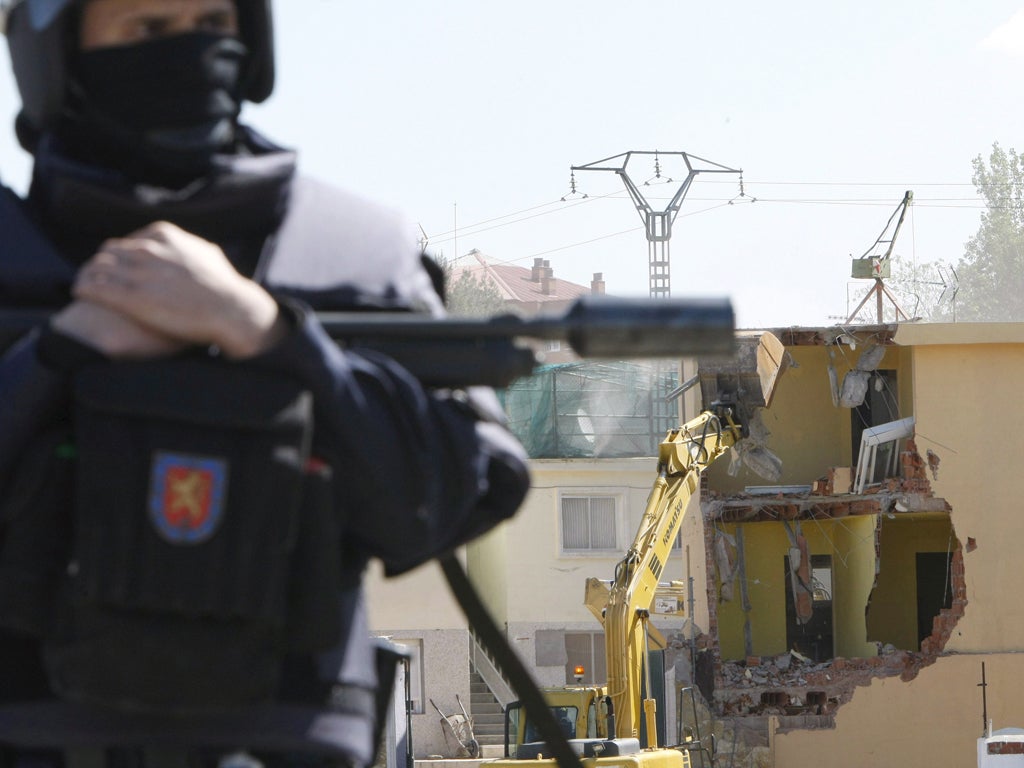
Not surprisingly, its citizens are keen to leave. "We're desperate to get out but there's nowhere to go," says Adelito, an unemployed Portuguese man. He claims he owes €3m in fines to the local authorities for his illegal Galiana shack. But so far, the only "solutions" the Galiana residents have seen are bright yellow diggers from a local company that enter the township with increasing frequency to demolish their shacks, and fines of up to €600,000 apiece for living in illegal dwellings. "The post doesn't reach here," Ms Camacho points out wryly, "but the fines do."
Once their homes are knocked down, there is no resettlement scheme, just a maximum of three nights' lodging in an emergency centre. After that, they are out on the street. As Amnesty International warns, by 2013, it is a fate that could await all 30,000 residents.
For now, should any evicted families return to the township, their first stop is the demolition company's warehouse – the Galiana's equivalent of Poundland, where anything that fell into the skips during the eviction can be bought back by its former owners. Then families invariably either rebuild another shanty – often more precarious and even more of a health risk. Or in some cases, according to Ms Camacho, they just dig out a hole in the rubble of where their first residence stood and make do with that.
"We get no help and then they do this," says Lucilia, a Portuguese woman now facing a €22,000 fine for building a second shack – made almost entirely out of cheap plywood doors – after her first was knocked down. "We didn't have anywhere else to live, so we saw everybody else had built a shack here, even if they were just made out of cardboard, and so did we. Now the authorities say we don't want shacks. That's fine. But they have to provide a solution. All they're doing is throwing us out in the street as if we were stray dogs."
"Strangely enough, it's always the residents with the least money, the foreigners and the Gypsies, who get the eviction orders first. There's definite discrimination," one social worker in the Galiana says. "But what are the people who live there now going to do? Disappear off the face of the earth?"
Join our commenting forum
Join thought-provoking conversations, follow other Independent readers and see their replies
Comments