Ireland's weakened economy provokes new abortion crisis
Women challenge government at European Human Rights Court on forced overseas terminations
Minutes after the test revealed she was pregnant, Amy saw only one option – to leave Ireland and have an abortion in Britain. Her architect partner had lost his job in Ireland's property crash and she was worried about hers, so the 29-year-old office assistant felt she had no choice. "We found it hard enough to finance the abortion," said Amy, who declined to give her full name because of the sensitive subject. "So how could we support a child?"
Women's activists say Ireland's deep economic crisis may have driven more women to consider an abortion. But, as Ireland prepares to defend its abortion legislation in the European Court of Human Rights, a growing number cannot afford to be among the thousands who travel to Britain for the procedure and may be forced into the hands of underground abortionists.
A year later, Amy has not told her parents. Growing up in mainly Roman Catholic Ireland, abortion was taboo and she recalls how women rumoured to have had one were shamed. "Abortion was a no-no then, and still is now," she said.
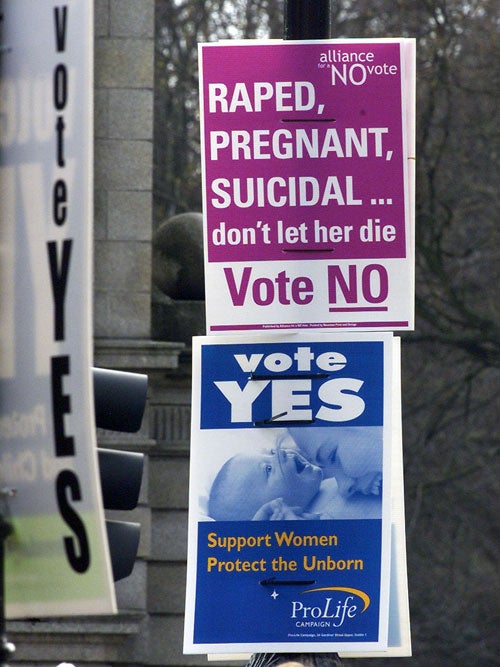
Ireland has some of the strictest abortion laws in Europe, allowing the termination of a pregnancy only when the mother's life is in danger. Women who have an abortion for other reasons still face a maximum sentence of life imprisonment. Even that situation is more liberal than before a 1992 referendum which gave women the freedom to receive abortion information and to travel abroad to terminate pregnancies.
Following the former Celtic Tiger's slide from boom to bust, Amy is not alone in seeking that route, although statistical evidence is hard to find. Last year, 15 per cent of the 1,300 women who visited the Dublin Well Women Centre cited financial problems as the main reason for seeking information on terminating a pregnancy. "Financial pressure might have always affected a woman's decision around whether she continued with her pregnancy, but in the last year there was some sort of shift in the priorities," Alison Begas, the chief executive of the centre, said. "She would say she had lost her job, or her salary had been cut; there are even those for whom the guy has lost his job."
Ann Rossiter, a London-based Irish author who for years helped Irish women seek terminations in Britain, has warned that the credit crunch could bring a return to illegal abortions. Abortions in UK clinics start from £350. There are also travel costs. "I see no reason why we wouldn't have a return to the back-street or self-induced abortions," she said.
Between 1980 and the end of 2009, at least 142,060 women travelled for abortion services in England and Wales, according to the Irish Family Planning Association (IFPA). Last year, 4,422 women providing Irish addresses had terminations in England and Wales, British figures show – down 178 on 2008. Numbers have fallen since 2001. But the IFPA says the figures are an underestimate as not everyone wants to disclose an address. Women also travel to the Netherlands.
Women in Catholic Poland also face strict laws. Official statistics show several hundred abortions performed annually but pro-choice campaigners estimate hundreds of thousands are performed underground or abroad, sometimes in poor conditions.
Spain has legislated to make it easier for women to have a termination, but some conservative regions will not allow their hospitals to perform them.
Ireland is defending its abortion law at the European Court of Human Rights, countering a challenge by three women who said it endangered their health and violated their rights. The two Irish women and a Lithuanian living in Ireland went to Britain for abortions. "It could be the case that gets the political system focused on trying to resolve the issue," said Niall Behan, the chief executive of IFPA.
Join our commenting forum
Join thought-provoking conversations, follow other Independent readers and see their replies
Comments