Is Baader Meinhof film a 'tasteless action movie'?
Film-makers have tended to treat Germany's Baader Meinhof as a sympathetic resistance movement rather than a terrorist organisation. But a new work by the director of 'Downfall' aims to set the record straight. Tony Paterson reports

For free real time breaking news alerts sent straight to your inbox sign up to our breaking news emails
Sign up to our free breaking news emails
For a blockbuster movie that claims to be the first to show the warts-and-all horror of what has been described as Germany's biggest post-war tragedy, the beginning of The Baader Meinhof Complex is disarmingly innocuous.
The film opens with shots of the idyllic playground of Germany's rich and famous, the North Sea holiday island of Sylt. It is the late 1960s and a newly married couple from a wealthy Hamburg background are shown cavorting about on the lawn of a luxury seaside home. The bride is Ulrike Meinhof, the woman whose name was soon to become synonymous with post-war Germany's radical, left-wing, Red Army Faction terrorist gang. Yet, at that stage in her career, she looks like a society debutante on her way to a coming out party.
Within minutes, the images switch to a scene on the streets of capitalist West Berlin in the early summer of 1967. Lying in the road is the student Benno Ohnesorg, an innocent bystander who was shot dead by police during violent left-wing protests that coincided with the Shah of Persia's visit to the city earlier that day.
In the folklore of the German left, Ohnesorg's shooting was the catalyst that inspired a generation of young West Germans to rise up against a parents' generation which was seen to have failed to meet its moral obligation own up to the country's Nazi past.
Ohnesorg was seen as the first victim of a resurgent fascist state. Not only Joschka Fischer, Germany's former Green foreign minister, then a radical left-wing firebrand, but even wealthy debutantes like Meinhof rallied to the cause. But what followed was something that perhaps could only have happened in the Germany of the late 1960s. In their efforts to achieve their aim, a radical offshoot of the country's anti-American, anti-establishment left started to employ tactics that were just as fanatical and violent as those of their perceived Nazi enemies.
The Baader-Meinhof gang which took its name from Ulrike Meinhof and the radical left-wing activist Andreas Baader went on to become Germany's feared Red Army Faction of RAF. For nearly three decades, the terrorist organisation traumatised post-war West Germany as it waged war on what it claimed was a morally bankrupt state.
The gang started out in the late 1960s by lighting fires in department stores to protest against consumerism. But, by the end of the 70s, it had carried out dozens of kidnappings, bombings and shootings in which 33 people were killed, many of them prominent bankers, businessmen, industrialists and other members of the German establishment
The RAF's campaign reached its height in 1977 when the gang kidnapped the industrialist Hanns Martin Schleyer and hijacked a Lufthansa airliner and flew it to Mogadishu. The incidents presented the West German government, led by Chancellor Helmut Schmidt, with its worst crisis since the Second World War.
A second RAF generation continued the organisation's campaign right up until 1998 when the group officially disbanded. Christian Klar, one of the RAF's last unrepentant members, is still in prison. There is a debate about whether he should be officially pardoned even though, like many other former RAF members, he has refused to show remorse or publicly apologise for his crimes.
The Baader Meinhof Complex which goes on general release in Germany today is an attempt to do justice to this dark chapter of recent history. The film's producer, Bernd Eichinger, won fame with his taboo-breaking portrayal of Hitler's last days in his besieged Berlin bunker, the box office hit Downfall, released in 2004.
His film about the Baader-Meinhof gang, is reputed to be the most expensive German movie ever made and is based on a book by Stefan Aust, until recently the editor of Germany's Der Spiegel magazine.
The production has been selected as Germany's Oscar entry and glowing proclamations that the film "destroys the myth of the RAF" and it "finally stops seeing them as they never were" have been plastered across the cover of Aust's news magazine weeks ahead of today's debut.
Germany's Red Army Faction, may not have won its war on the West German state but, at its height, it managed to polarise West German society. Its campaign pitched the established right, championed by Germany's mass circulation Bild newspaper, against a 1968 generation of young, left-leaning idealists.
Many argue that the RAF has remained surrounded by a fog of misleading "terrorist chic" ever since. Some left-wing intellectuals still argue that the Baader-Meinhof gang prevented a resurgence of Nazism.
Previous films about the gang have portrayed its members with a degree of sympathy. The brutality of their kidnappings, aircraft hijackings and cold-blooded murders was played down, their perceived role as victims of a morally bankrupt society emphasised.
One recent television film by the director Christoph Roth portrayed Andreas Baader as an eminently "cool" fashion-conscious terrorist concerned about his jeans and the cars that he hijacked. T-shirts emblazoned with a "Prada Meinhof" slogan or images of the gang's Heckler & Koch machine guns were all the rage among German 20-year-olds only a couple of years ago
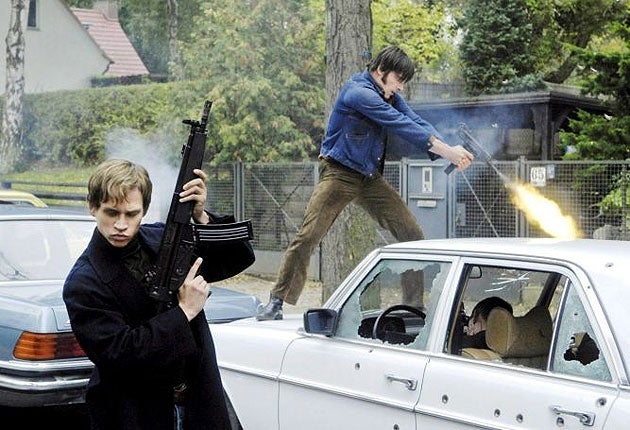
The Baader Meinhof Complex breaks radically with that tradition. In one scene, a fanatical RAF woman is shown wheeling a pram across a zebra crossing to stop the car of a prominent member of West German society. She then pulls a machine gun out of the pram and pumps bullets into the vehicle.
The approach has received warm praise from official bodies such as Germany's Federal Agency for Civic Education. "Until now, films tended to make heroes out of the main character in the RAF," said Thomas Krüger, its president. "This is a bloodstain that soaks a strain of German history and it needs to be confronted honestly," he added.
But the film has been fiercely attacked by critics for its obsession with violence. The children of Baader Meinhof gang members and their victims have described it as tasteless hero worship and even some former terrorists have complained that the production is merely a callous attempt to reap maximum box office profits.
Mr Eichinger insists such explicit depictions of violence are essential. "People are judged by their deeds and not by their motives," he insisted, "That is why we have made a film about what they did," he added.
Jörg Schleyer, the son of the industrialist who was kidnapped and murdered by the RAF, has welcomed Eichinger's approach. "You see how my father's chauffeur and another passenger in the car were just slaughtered," he said. "It hurt me to watch it but it is the only way to make clear to young people how brutal and bloodthirsty the RAF was at the time."
Subscribe to Independent Premium to bookmark this article
Want to bookmark your favourite articles and stories to read or reference later? Start your Independent Premium subscription today.
Join our commenting forum
Join thought-provoking conversations, follow other Independent readers and see their replies