L'Auteur turns his poison pen on himself
Michel Houellebecq's latest novel is set to propel the writer to even greater notoriety
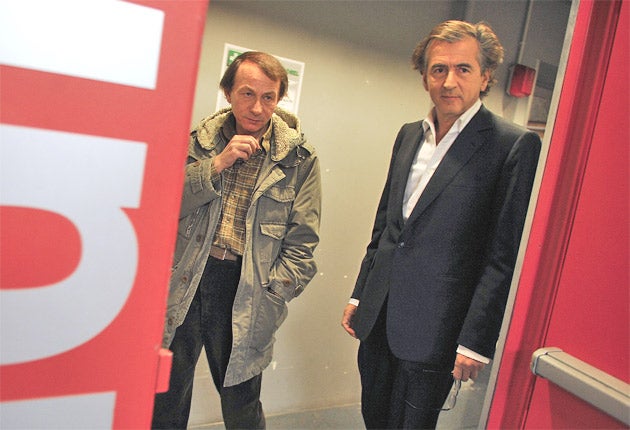
Michel Houellebecq, one of the few contemporary French writers to be acclaimed abroad, has found a new target for his vicious pen – himself. In a much-awaited new novel, his first for five years, Mr Houellebecq satirises a handful of French media celebs, including a foul-smelling, alcoholic, badly-dressed writer called Michel Houellebecq.
The fictionalised Houellebecq – who bears some resemblance to the real one – lives in a tumble-down house near the river Shannon which has the "worst-kept lawn in Ireland". The real Houellebecq lived until recently in a former guest-house in County Cork, which still had plastic numbers on the bedroom doors.
The mocking self-portrait may or may not be the writer's response to his mother, who took exception to a devastating portrait of her in a previous best-selling Houellebecq novel Plateforme. Two years ago, Lucie Ceccaldi, wrote a revenge book in which she described her son as a "liar, an imposter... a parasite" and "someone who has done nothing with his life except cause pain to those around him".
Like some of her son's publicity-seeking comments, her remarks went a little over the top. Houellebecq (pronounced "wellbeck"), 54, has been attacked variously as a pornographer, a fascist, a racist, a trouble-maker, a drunk; a self-publicist and a nihilist. He has also been lionised, in France and abroad, as one of the most eloquent living writers; a spokesman for the inchoate fury and frustrations of a rootless, globalised, sex-drenched but sexless generation.
His new book, to be published on 8 September, was supposed to be kept under wraps until the so-called "rentrée literaire" (literary return to work) at the end of this month. Over 600 new novels, two thirds of all those published in France each year, are traditionally tipped onto the bookshop shelves in early September.
The newspaper Le Parisien jumped the gun yesterday by publishing a synopsis of the most awaited of this year's "rentree" novels. The newspaper described La Carte et le Territoire as "fascinating and unnerving", but less deliberately provocative than Houellebecq's four previous novels (including Atomised and The Possibilities of an Island). The new book – part-thriller, part-satirical comedy – centres on the triumphs and demise of a young, contemporary artist who has a worldwide success by photographing old Michelin maps. Several French minor celebrities, including two news anchors and a game-show presenter, appear under their own names.
Unlike Houellebecq's previous books, the new one contains, according to Le Parisien, no attacks on Islam and no overt misogyny.
One of the reasons why so many French novels are published in September is that it puts them into the running for the three or four big, French literary prizes which are awarded by the end of the year. The other explanation for the avalanche is that there are almost no literary agents in France to filter, or impede, would-be writers. Publishing houses toss half-way promising new novelists onto the market all at once to see which will sink or swim. Most sink.
Mr Houellebecq's new novel – as yet unseen by most of literary France – is already the runaway favourite to win the biggest of all French book prizes, the Prix Goncourt, this autumn. This is nothing to do with its merits. It has become embarrassing, even in the perverse world of literary France, that one of the French writers most admired and read abroad has never won the Goncourt. His last novel The Possibilities of an Island was overlooked in 2005 in favour of another which everyone conceded later was a dud. The other – and probably more important – reason why La Carte et le Territoire may win the 2010 Goncourt is that Mr Houellebecq has changed publishers. He left Flammarion last time for Fayard for a fat transfer fee. He has returned to Flammarion this time.
Winning the Goncourt is partly, some say largely, a question of which of the large French publishers can persuade the jury that it is their "turn" to win. It is generally reckoned to be Flammarion's turn in 2010.
Houellebecq, now living in Spain, has not been inactive since 2005. Two years ago he published a book of conversations with the celebrity philosopher, Bernard-Henri Lévy. He also directed a film version of Possibilities of an Island which was greeted with derision by movie critics and hardly troubled the box-office. It was his second novel, Les Particules élémentaires, later translated into English as Atomised, which rocketed him to stardom in France and beyond in 1998. It tells the story of two 40-something half-brothers, who live in a world of masturbation, peep-shows, sex-clubs and fluffed opportunities for fulfillment.
After late childhood, the book suggests, modern western men and women (but especially men) are incapable of achieving spiritual or physical happiness. They are trapped in an illusory world of ersatz pleasure, obsessed with sex but incapable of love. His third novel, Plateforme, published in 2001, was about sexual tourism and Islamic terrorism. Houellebecq was taken to court – and acquitted – for describing Islam in an interview as "dangerous" and "the most stupid of all religions".
His "hatred" (his own word) for Islam has always hovered, disturbingly, on the frontier between Houellebecq the writer and Houellebecq the psychologically fragile man (his official biographical notes cheerfully admit to several nervous breakdowns). His mother left him when he was a toddler, to start a new life and then converted to Islam. He was brought up by his devoutly Stalinist grandmother, loving her but detesting her ideology.
Critics favourable to Houellebecq have suggested that his greatest work may come when he has exorcised these personal demons. By placing himself, in satirised form, in his new book, Mr Houellebecq may be attempting to do just that.
In his own words...
Houellebecq on... Religion
"I had a kind of revelation in the Sinai, where Moses received the Ten Commandments. Suddenly, I experienced a total rejection of monotheism. In this very rocky, inspiring land, I said to myself that the idea of believing in only one God was cretinous... And the stupidest religion of all is Islam."
... Society
"I don't like this world. I definitely do not like it. The society in which I live disgusts me; advertising sickens me; computers make me puke."
... Life
"Life is painful and disappointing. It is useless, therefore, to write new realistic novels. We generally know where we stand in relation to reality and don't care to know any more."
... Single men on holiday
"People are suspicious of single men on vacation, after they get to a certain age: they assume that they're selfish, and probably a bit pervy. I can't say they're wrong."
Join our commenting forum
Join thought-provoking conversations, follow other Independent readers and see their replies
Comments