Miliband met by icy reception on debut mission to Moscow
Strained relations evident as Russia once again refuses Foreign Secretary's request to extradite Litvinenko suspect
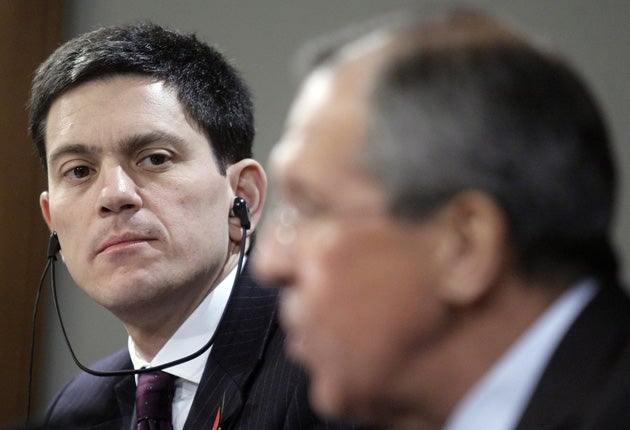
David Miliband's demands that the man suspected of involvement in the murder of Alexander Litvinenko be extradited to London were again refused by the Russian government in high-level talks in Moscow yesterday.
The British Foreign Secretary's trip was the highest-ranking official British visit to Russia in years. But his Russian counterparty, Sergey Lavrov, made it clear that Mr Miliband's efforts to secure the extradition of the former security agent and current MP Andrei Lugovoi, as well as to make progress on a range of other issues that plague bilateral relations, would come to naught.
Mr Lugovoi is suspected of playing a role in the radioactive polonium poisoning of Mr Litvinenko, a former Russian security agent, in 2006.
"I suspect that our British counterparts are aware of the fact that a demand to change our constitution is not realistic," Mr Lavrov said, in a reference to Russia's argument that its law forbids extradition of citizens.
Relations between the two countries have been particularly strained since Mr Litvinenko's murder. But a range of other sticking points remain. Britain is still aggrieved by the closure of regional offices of the British Council, which President Dmitry Medvedev has accused of being a front for British spies, while the Russians are frustrated at the refusal of the British courts to extradite a number of Kremlin opponents living in Britain.
As Mr Miliband and Mr Lavrov met yesterday there was pointedly no talk of "pressing the reset button" with Russia in the same way that the administration of Barack Obama has done since the US President took office. It was instead made clear that the important differences between the countries would not simply go away, but that focus should be put on the areas – most notably the economy – where common interests are aligned.
Not only does Britain have the worst relationship with Russia of any major Western country, but there is also little love lost between the two ministers themselves. Mr Lavrov was alleged to have subjected Mr Miliband to an obscenity-filled tirade over the telephone, shortly after Russia's war with Georgia last year.
This visit was played as an attempt to move on and find areas where co-operation is possible, such as trade links and co-ordinating action over Iran's nuclear programme, Afghanistan and nuclear disarmament.
"Our discussions have been marked by mutual respect; personal, but also between our countries," said Mr Miliband. "Not only do we understand each other better, but we are going to find ways to work together better."
Nevertheless, the differences were there for all to see. The two ministers discussed the Litvinenko case at length, but it was clear that a mutually acceptable solution will not be found. Mr Lavrov, besides noting Britain's "unrealistic" demands, again suggested that Mr Lugovoi could be tried in Russia with the involvement of British law enforcement agencies, if Britain were to send Russia the required evidence. Mr Miliband insisted that British prosecutors had already sent their Russian counterparts all the materials necessary for them to co-operate, while Mr Lavrov retorted that this was not the case.
Analysts in Moscow said that Russian officials have little time for Mr Miliband, given his history of harsh words about Russia and vocal support for Georgia and Ukraine's entry into Nato. They expect a more conciliatory approach to be forthcoming from a potential future Conservative government.
The visit was unfortunately timed to coincide with the third anniversary of Mr Litvinenko's poisoning, which prompted angry words from his widow, Marina. "The fact remains that a British citizen was murdered in the centre of London in a state-sponsored act of nuclear terrorism," she said in a statement released last month. "The apparent softening of Mr Miliband's position is a great disappointment to me."
In addition to meeting Mr Lavrov, Mr Miliband met Mikhail Gorbachev, and also did the rounds of the few independent media outlets remaining in Russia, giving an interview to Ekho Moskvy radio and Novaya Gazeta, the newspaper where the murdered reporter Anna Politkovskaya worked.
Britain and Russia: Diplomatic incidents
*January 2006: The FSB accuses British diplomats of using a fake rock planted on a Moscow street to hold secret data.
*December 2006: Britain complains that ambassador Anthony Brenton has been subjected to harassment "bordering on violence" after he addressed an opposition meeting.
*April 2007: Russia renewed their request for extradition of tycoon Boris Berezovsky, an enemy of Vladimir Putin, but the requests were denied. Mr Berezovsky was granted political asylum in September 2003.
*May 2007: Britain makes first formal extradition request for Andrei Lugovoi over the murder of Alexander Litvinenko. Russia turns it down.
*January 2008: Russia demands British Council offices close after a tax dispute. Ultimately only one remains open.
*June 2009: Ongoing tensions are exemplified by David Miliband's warning that Russia "needs to change course".
Join our commenting forum
Join thought-provoking conversations, follow other Independent readers and see their replies
Comments