Mystery solved as tests prove Tsar's entire family was murdered
DNA analysis of bone shards shows no one escaped 1918 slaughter in the cellar
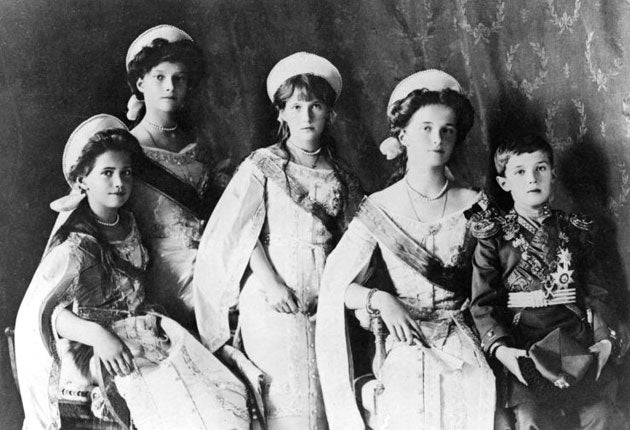
In the early hours of a July day in 1918, one of history's most infamous murders was perpetrated on parents, their five children and their loyal servants in a cellar in the city of Yekaterinburg, central Russia.
The gunshot-and-bayonet murder of the Romanovs – the family of the last Tsar and Tsarina of Russia – spawned countless conspiracy theories, including the belief that at least one child had survived to escape abroad.
Since that fatal dawn, about 200 people have claimed to descend from one or other of the Romanovs who had somehow survived the slaughter in the basement of Ipatiev House. But now a scientific study based on meticulous DNA evidence has finally provided irrefutable evidence to show that all five children had indeed perished with their parents at the hands of nervous Bolsheviks of the Ural Soviet, worried about a possible rescue bid by nearby White Russian troops.
Scientists have pieced together DNA evidence from two graves near Yekaterinburg and have conclusively shown that Tsar Nicholas II and his wife, the Tsarina Alexandra, died with all five of their children, Olga, Tatiana, Maria, Anastasia and their haemophiliac son, the crown prince, Alexei. The only remaining mystery is whether the girl buried alongside Alexei in a separate grave from the rest of the family was Maria or Anastasia, says a study printed in the online journal Public Library of Science.
The story should have come to a close soon after a mass grave near Yekaterinburg (formerly Sverdlovsk) was revealed in 1991 by a local geologist, Alexander Avdonin, who had kept the discovery secret for more than a decade, until the fall of the Soviet Union.
Scientists, including Peter Gill from Britain's Forensic Science Service and the Russian geneticist Pavel Ivanov, managed to extract enough DNA from the bone fragments of nine skeletons to show that they included a family of two parents and three daughters.
A comparison with the DNA of living Romanov relatives, including Prince Philip, proved that the family was that of the last Tsar and Tsarina, with the four remaining skeletons belonging to the family doctor and three servants.
But the two missing children only generated further conspiracy theories, according to a report on the study written by an international team of scientists, led by Michael Coble of the US Armed Forces DNA Identification Laboratory in Rockville, Maryland.
"Rather than bring closure to the mystery of the fate of the Romanovs, identification of only five of the seven family members continued to fuel speculation that somehow two miraculously escaped the bullets of the executioners and made their way out of Russia," Dr Coble said.
But then, in 2007, amateur archaeologists found a second grave just 70 metres away, containing dozens of charred human bone fragments that someone had tried to cremate. "Of the 44 bone fragments and teeth present, it was possible to determine that at least two individuals were present, one female and one putative male," the report added. The mystery is solved.
DNA: The detective in the grave
The Romanov study used three different ways of analysing DNA to determine family relationships within the graves – and the relationship, if any, to living relatives of the Russian royal family. Mitochondrial DNA, inherited only down the maternal line, was used to assess the relationship of Prince Philip, who is related to the Tsarina through his mother, with bone fragments found in the grave. This helped to determine that the Tsarina and her four daughters were indeed buried in the two graves. DNA known to be inherited only from fathers by sons on the male Y chromosome was used to determine the relationship between the crown prince, Alexei, and his father, Tsar Nicholas II. And finally, DNA from the rest of the chromosomes was used to find out who was who in the mass graves – separating family members from three servants and a doctor.
Join our commenting forum
Join thought-provoking conversations, follow other Independent readers and see their replies
Comments