No money for bulls in this bear market: town votes to axe fiesta
Decision to cancel festival 'another devastating blow' for Spanish bullfighters
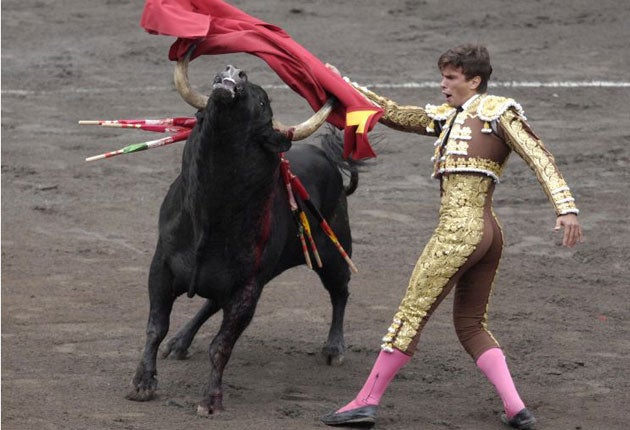
Spain's economic woes have bitten into the heart of the nation with one small town voting at the weekend to scrap its annual bullfighting festival to save public money.
The festival in Manzanares El Real, north of Madrid, is held in August. Residents decided in a referendum that the four-fay fiesta would not feature bulls this year. Dedicated aficionados fighting to uphold their bullfighting traditions were furious.
The town's vote is bound to have an impact on the nationwide debate about the ethics of bullfighting.
As Spain's bullfight season shifts into top gear, anti-taurine campaigners and cash-strapped authorities are likely to question whether the huge sums spent annually on the "national fiesta" amount to wasteful extravagance during the economic crisis.
The mayor of Manzanares told townsfolk last month that the cost of mounting this year's four-day fiesta – €125,000 (£116,000) – would eat up more than a quarter of the annual municipal budget for culture, sport and basic social services.
So heated was the outcry that the town hall called a referendum on the matter and sent out nearly 6,000 ballot papers to residents' homes. Of the 1,200 or so who replied, 53 per cent voted to scrap the festive bullfights, 34 per cent voted to keep them and just 12 per cent opted for a scaled-down celebration involving fewer bullfights using younger animals.
Noisy altercations broke out in the town hall on Saturday when preliminary results were announced. Supporters of the bullfights argued that a turnout of just 22 per cent was far too low to warrant cancelling them.
Most of those resigned to a non-taurine celebration this year are ardent bullfight supporters. Councillors insisted the vote had nothing to do with the national debate over the ethics of bullfighting but focused on the impact of the economic crisis on the town.
But those fighting to keep the tradition alive seemed in no doubt that the decision amounted to a devastating blow to bullfighting; the economic argument seems set to become a powerful weapon in the armoury of anti-bullfight campaigners.
Fifty-six Spanish towns, 53 of them in Catalonia, where anti-bullfighting sentiment is strongest, have already declared that they are in favour of abolishing bullfights. Many more have cut all financial aid for a business that is heavily subsidised by the public purse. Nearly €600m of public money was spent last year on promoting bullfights, subsidising local fiestas, maintaining bullfighting schools and, according to Alejandra Garcia of the campaign Stop Our Shame, "even designing websites for popular bullfighters".
More than 1,300 Spanish farmers breed bulls for the ring. As producers of meat for consumption, they receive an EU subsidy of €220 per bull. Enthusiasm for bulls is falling: fewer than a third of Spaniards say they are interested in "los toros", compared with about 50 per cent in 1985. Up to 40 per cent oppose bullfights. Those in Catalonia and Aragon are least interested, while the Murcia and Valencia regions are the keenest.
Manzanares's Socialist councillors were worried about the cost of buying land to house the bullring. "It would only be used four days then lie idle all year," the deputy mayor Jose Manuel Lujan said. He was trying to calm opposition from dozens of taurine enthusiasts who besieged the council chamber during Saturday's count.
But aficionados here, as in many small towns across Spain, remain unconvinced. "Without bulls, there'll be no fiesta and Manzanares will be dead," one shouted. "It's a disgrace. "We've always had bulls here; they are our tradition," said another.
One councillor seemed to waiver. "There'll always be bulls here, and we should never have got into this disagreeable situation," said Antonio Fernandez, who is responsible for fiestas.
The mayor, who will make the final decision, is inclined to compromise: "It's a very low turnout on which to base such a radical decision as suppressing the bulls completely," Oscar Cerezal said yesterday. "But it's clear that a majority of nearly two-thirds of residents want some sort of reduction in the festivities, and we'll work towards that, even if we don't cancel them completely."
Bullfighting
A struggle to survive
*Bullfighting dates from Roman times but Spain's medieval Moorish conquerors turned the practice (never called a sport) into a celebration. Today's "corrida" emerged in 18th-century Andalusia, where matadors faced the bull with a cape and short sword, accompanied by music.
*There were always detractors and it was often banned by governments who deemed it dangerous and barbaric. But it was popular among highest and lowest classes and admired by European travellers and artists.
*Franco encouraged bullfighting to boost national pride. The death-defying torero in his spangled suit became an international symbol of Spanish manhood. Humbly-born matadors often married aristocrats.
*Radicals like the film director Pedro Almodovar cruelly subverted bullfighting's kitsch image after Franco's death in 1975. Its mass appeal faded and protests grew but it retains a passionate following, and good matadors are treated like rock stars.
Join our commenting forum
Join thought-provoking conversations, follow other Independent readers and see their replies
Comments