Now Russia gets caught in the credit crunch
First G8 nation to have rating downgraded since start of global financial crisis
The Russian economy, already pummelled by falling oil prices, trade disputes with neighbours and fleeing investors, took another step towards the abyss yesterday as the country's credit rating was downgraded. Russia is the first G8 nation to have suffered a downgrade since the start of the global financial crisis.
After several years of booming commodity prices that have filled the country's coffers and allowed Vladimir Putin to remain popular at home and aggressive abroad, there is a new feeling of doom in Moscow. With the rouble sliding against the dollar – it hit a new low on Tuesday – rising inflation, collapsing growth and soaring unemployment, the country is experiencing the first stirrings of social unrest. Last weekend saw the biggest display of public disaffection for years, with anti-government protests in all major Russian cities. As the economic hardship begins to trickle down, and ordinary Russians become aware of the scale of the crisis, the numbers on the streets are likely to swell.
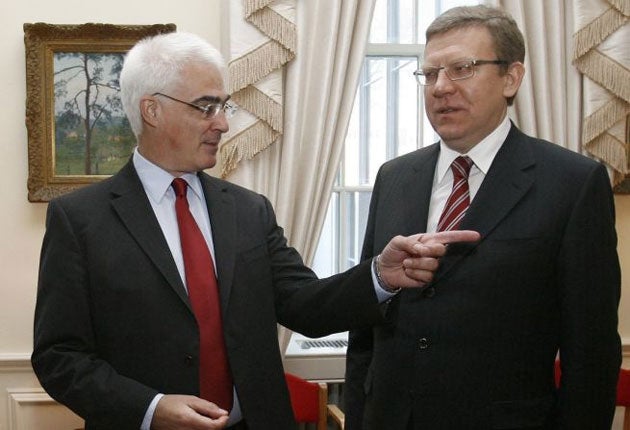
Amid the deepening international economic gloom, Russia's Deputy Prime Minister and Finance Minister, Alexei Kudrin, held talks in London yesterday with cabinet ministers including the Chancellor, Alistair Darling, and the Secretary of State for Business, Peter Mandelson.
Mr Kudrin conceded that Russia, long one of the world's fastest-growing economies, now expects zero growth this year. To make things worse, while many other countries are seeing the worsening economy at least curb inflation, he said Russia expects prices to rise by a staggering 13 per cent this year. That's much higher than most developed economies, and may also put pressure on the government to raise interest rates – further hurting the economy. "We're facing some very difficult challenges," Mr Kudrin said. "So certainly the forecast for Russia at the moment is worse now than at the end of 2008."
The leading credit ratings agency Fitch added to Russia's economic woes yesterday by downgrading its rating on the country's sovereign debt to BBB. This could make lenders more reluctant to lend, and force Russia to pay higher interest to those who do.
Most developed countries, such as the US or UK, have the top credit rating of AAA. Russia's rating is now eight notches below this, and a mere two notches above a so-called junk rating, at which point it would be prohibitively costly for Russia to borrow.
But the country faces several problems at once. As a big exporter of commodities and natural resources it is a casualty of the sharp slowdown in demand in other countries. The country has additionally suffered from diplomatic disputes with its neighbours, such as the spat over gas with Ukraine in January and last summer's war with Georgia.
In boom times, Russia benefited from Western cash as investors looked to harness its higher-than-average growth. But economic pressure at home and banks calling in their loans has forced such investors to curtail their spending in Russia, creating a flight of capital from the country.
The current situation may further spook Western investors as it risks echoing the Russian crisis of 1998, when a similar fall in commodities prices led to a slide in the value of the Russian currency and eventually the country defaulted on its debt, prompting huge losses among those who had placed money in the country. Britain has in recent years been among the biggest foreign investors in Russia.
This time, while analysts do not forecast complete collapse, Russia is far more dependent on international factors. "Russia is responding to world events that are out of its control," said Roland Nash, head of research at Renaissance Capital in Moscow. "It's all very well for Putin to say that things will improve at the end of this year, but there's not much he can do about it if they don't."
Mr Putin, the Prime Minister, made his prediction in a recent interview, and many analysts agree with him that in the long-term Russia is still a good investment opportunity. But in the short-term, the focus will be on defending the currency and preventing banks and oligarchs, many of whom have huge debts to Western banks, from ruin. According to one estimate Russian oligarchs have lost a total of $230bn (£160bn) since last summer. The rouble has lost more than 30 per cent of its value against the dollar in recent months.
All the economic woe could translate into political problems for Russia's leaders. Mr Putin still has astronomically high approval ratings for now, but he will not be able to distance himself from the effects of the crisis.
Oligarchs feeling the pinch
Roman Abramovich
The Chelsea owner, below, has lost more than $20bn, according to Bloomberg, though he is believed to have large cash stocks and was less indebted to banks than some counterparts.
Oleg Deripaska
SmartMoney estimated in October that Mr Deripaska, Russia's richest man last year, had lost $28.4bn – moving him into the red. He is known to have taken out several huge loans from Western banks, secured against shares in his companies that then slid in value. He is the worst hit of Russia's oligarchs and will be reliant on state support to see him through the crisis.
Vladimir Potanin
The president of the Russian mining and metals conglomerate Interros is also the controlling shareholder of Norilsk Nickel, the world's leading nickel producer. He reportedly lost $13.2bn after his stock in the company plunged by 65 per cent, fuelling rumours of an imminent merger.
Alisher Usmanov
The metals billionaire and Arsenal shareholder has reportedly suffered losses of more than $14bn.
Alexei Mordashov
Steel magnate has lost up to three-quarters of his $22bn paper fortune.
Join our commenting forum
Join thought-provoking conversations, follow other Independent readers and see their replies
Comments