'President' Blair loses Sarkozy's support
Britain's semi-detached attitude to EU may scupper ex-PM's bid for top post
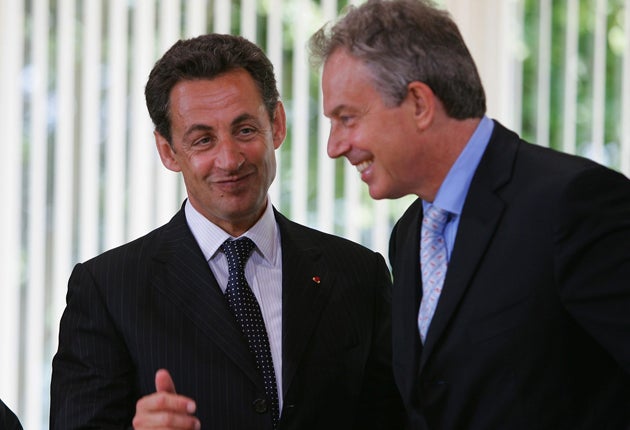
Tony Blair's chances of becoming the first EU "president" nose-dived yesterday when President Nicolas Sarkozy distanced himself from the former prime minister's undeclared campaign for the post.
Mr Sarkozy, who had been Mr Blair's most prominent backer, suggested that Britain's non-membership of the euro was a "problem" which could wreck his chances of becoming the new "strong symbol" of Europe.
Although Mr Blair remains the runaway favourite with British punters and bookmakers, a powerful tide has been running against him in recent days. The Benelux countries and Austria, and influential political figures in France, have all spoken out against Mr Blair, partly because of what they see as Britain's semi-detached attitude to the EU.
Asked in a newspaper interview yesterday whether Mr Blair would make a "good candidate", President Sarkozy gave a cautious and non-committal response. The French President told Le Figaro that the EU had still not decided whether it wanted a low-key managerial "president" or a "strong and charismatic" figure who could "symbolise" Europe. "Personally, I believe in a Europe which is strong politically and symbolised [by a strong president]," he said. "But the fact that Great Britain is not in the euro remains a problem."
The 27 EU leaders had been expected to have at least a preliminary discussion on candidates for the so-called presidency of Europe when they meet at a summit in Brussels on Thursday week. But the post will exist only if all 27 countries ratify the Lisbon treaty on the reform and strengthening of EU institutions.
After the Irish referendum Yes vote this month, 26 countries have ratified the treaty. The Eurosceptic Czech President, Vaclav Klaus, is refusing to sign the ratification papers which have been agreed by the Czech parliament.
The Brussels summit is likely to be dominated by the Czech "problem", and ways of satisfying Mr Klaus, without reopening the negotiations. If it does come into force, the Lisbon treaty creates a European high representative for foreign affairs and a permanent president of the European Council, which is the formal title for the twice-yearly EU summits. Whether this amounts to a "president of Europe" is open to question.
The chosen person will replace the rotating half-yearly presidency of EU summits but member governments will continue to take turns to chair other ministerial meetings.
Some European leaders, including President Sarkozy, say that the post will become important if the first incumbent is a strong and charismatic figure, with global name recognition. Hence, partly, Mr Sarkozy's support for Mr Blair. The French President is believed to be interested in moving to the new Brussels job after a couple of terms in the Elysée Palace, but only if it can be established as a powerful position.
Other EU leaders, including the German Chancellor, Angela Merkel, would prefer to limit the new presidency to the tasks of business manager and referee, not political "symbol" or leader. They would therefore prefer not to have a political "Big Beast" such as Mr Blair in the job.
Governments in Benelux and Austria oppose Mr Blair for other reasons. They still remember his role in appearing to divide Europe into pro- and anti-Bush camps before the US-British invasion of Iraq in 2003. They object, in principle, to any British figure taking the post while the UK remains outside the euro and the common, passport-free borders established on the continent by the Schengen agreement.
The three Benelux governments suggested that they would block any candidate from a country not fully signed up to important EU policies.
The only senior figure who has strongly backed Mr Blair's chances in recent days has been the Italian Prime Minister, Silvio Berlusconi. On Wednesday, Mr Berlusconi published an open letter in the Italian newspaper, Il Foglio, in which he said: "Tony Blair has what it takes to become the EU's first president."
The rumour-mill in Brussels now prefers the chances of the Dutch Prime Minister, Jan Peter Balkenende, the former Finnish prime minister Paavo Lipponen or the former Irish president Mary Robinson.
Join our commenting forum
Join thought-provoking conversations, follow other Independent readers and see their replies
Comments
Bookmark popover
Removed from bookmarks