Protesters test the limits on first day of burka ban
The first day of France's "burka ban" turned into a game of constitutional cat-and-mouse yesterday.
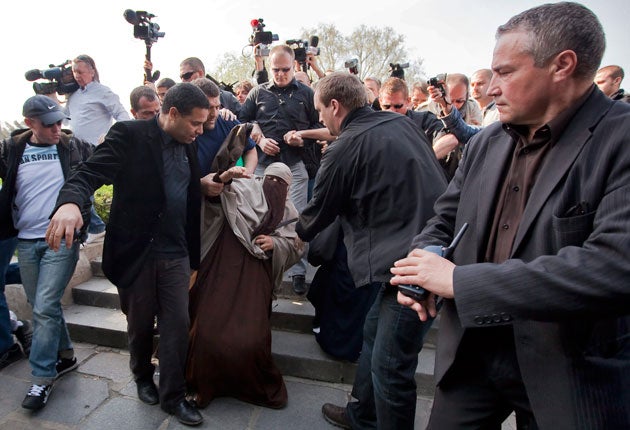
Two women wearing face veils were arrested, with a handful of other demonstrators, outside Notre Dame cathedral in Paris. Another fully-veiled woman was arrested outside the Élysée Palace. All were deliberately seeking arrest in order to challenge the ban under European human rights law. They were arrested for taking part in unauthorised demonstrations, not for wearing face-covering veils.
French police were under orders not to enforce the ban on its first day, and one senior officer said he doubted whether the ban could ever be enforced properly.
Kenza Drider, 32, donned her brown and beige niqab, or Saudi-style veil, then tipped off local media before boarding an express train from Avignon to Paris. Later in the morning, she was one of about a dozen women – two wearing veils and the others wearing headscarves – who were arrested outside Notre Dame for demonstrating without permission. A crowd of about 100 journalists, mostly from foreign television stations and outnumbering protesters almost 10 to one, were there to witness the event.
All of these challenges to the ban on the full-face veil were organised by Touche Pas à Ma Constitution, run by Rachid Nekkaz, a moderate Muslim businessman and politician from the Paris area. Mr Nekkaz, 39, has started a €1m (£880,000) fund to pay the €150 fines of any women charged with breaking the new law. He also plans to take a test case to the European court of human rights in Strasbourg.
Mr Nekkaz was arrested earlier outside the Élysée Palace with a woman wearing a niqab. "We wanted the police to charge her [for wearing a veil] but they refused," he said.
Mr Nekkaz may have to wait a little while for his test case. Most of the estimated 1,900 habitual niqab-wearers in France appear to have stayed at home yesterday or bowed to the law and taken off their veils. In any case, police are under orders to proceed with the utmost caution to avoid incidents which would bring the law into disrepute. Women wearing veils will not be ordered to remove them. Their names will be taken and habitual offenders "may" eventually be charged.
Yesterday, the government was anxious to avoid provocation while the international media spotlight was focused on the ban. "Today, there is no question of us arresting women for wearing veils," Alexis Marsan, the Paris police commissioner for public order offences, told journalists covering the small demonstration, or "prayer vigil", outside Notre Dame. "These people were arrested for trying to hold an unauthorised demonstration." France is the first country in the world to ban the full-face veil, although lesser restrictions are in place in several other European countries. The law against "concealing the face in a public space", passed by the parliament last October, does not mention the niqab or burka by name. It proscribes all facial coverings, except for reasons of health or safety.
It also allows exceptions for carnivals and Father Christmases. Any woman who wears a facial veil can be fined €150 for a first offence. There are stiffer punishments, rising to a €30,000 fine and one year in jail for anyone who forces a woman to wear a veil "by threats or violence".
Manuel Roux, deputy head of the union of senior police officers, said yesterday that the ban would be "infinitely difficult to enforce" and would probably be "very little enforced".
Join our commenting forum
Join thought-provoking conversations, follow other Independent readers and see their replies
Comments