Revealed: how Italy tried to cut a deal with the Mafia
Supergrass says politicians negotiated with gangs even as judges were bombed
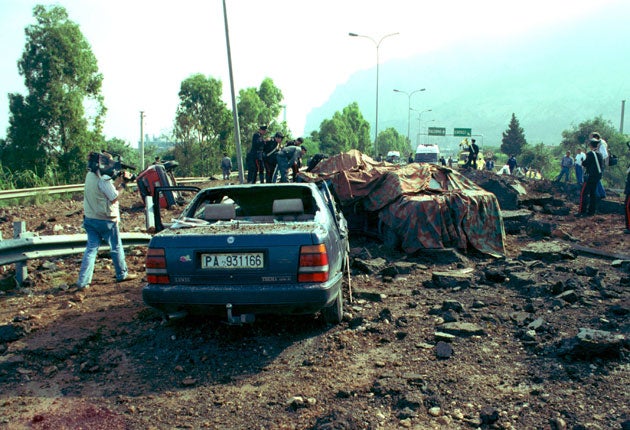
The murders of two courageous Sicilian judges in 1992 shocked Italy to the core, scandalised Europe, and forced the Italian state to take the Mafia threat seriously for the first time.
But this week Giovanni Brusca, the man who killed the first of those judges, Giovanni Falcone, by detonating a huge bomb under the Palermo airport motorway, told a heavily-guarded "bunker court" inside Rome's Rebbibia jail that the Italian authorities were secretly trying to cut a deal with Salvatore "Toto" Riina, the capo di capi of Cosa Nostra at the time and the architect of the atrocities. Their efforts went on to the last minute.
Until he turned pentito, or super-grass, Giovanni Brusca was one of Sicily's most ruthless mobsters, held responsible for between 100 and 200 murders. Nicknamed Il Maiale – the Pig – it was Brusca who kidnapped an 11-year-old boy called Giuseppe di Matteo, the son of another gangster, held him for 26 months, then had him strangled before dissolving his body in acid.
Brusca told the hearing that shortly before Falcone's assassination, Toto Riina met a politician who was accompanied by a police escort, and handed the politician, whom he refused to name, a list of demands that had to be met before the Mafia would stop its increasingly brutal war against the state.
The magistrate who now holds Falcone's post of chief anti-Mafia magistrate for Palermo, Antonio Ingroia, told The Independent that he took Brusca's claims very seriously. "I don't just think it's possible, but in fact that it's extremely probable this is true," he said. "We would be very interested indeed to learn the name of the person Riina is supposed to have met with, though I don't think we're going to yet."
Another high-profile victim of the Mafia in 1992 was Salvo Lima, who as mayor of Palermo was regarded as Christian Democrat leader Giulio Andreotti's contact for the Mafia. Brusca told investigators in Rome this week that between Lima's murder and the killing of Falcone two months later, politicians suggested to Riina that he stand for election to the European Parliament. The implication is that, far from being committed to taking resolute action against the Mob, Rome's politicians were flirting with them even as Mafia attacks on the state escalated.
Brusca, who is serving a life sentence, was giving evidence against two senior Carabinieri police officers, Mario Mori and Mario Obinu, who are suspected of having links to the Mafia.
Falcone, his wife and three bodyguards were killed by a bomb planted under the highway outside Palermo on 23 May 1992. Two months later his magistrate colleague Paolo Borsellino and five bodyguards died in a similar attack. Both murders were ordered by Riina, who was captured in 1993.
The killings were prompted by the magistrates' increasing success in prosecuting mobsters. Falcone and Borsellino were key members of the Anti-Mafia Pool of investigating magistrates, who combined forces, sharing information and responsibility to prevent the Mafia being able to end investigations with a single bullet. Both complained, however, that their work was being hampered by Mafia informers within the security services.
"But Riina wasn't satisified, he wanted more," Corriere della Sera reports Brusca as saying. "Someone suggested that he make contact with the Italian Northern League," – the secessionist party based in Lombardy that is today part of Silvio Berlusconi's ruling coalition. Brusca added: "I don't know what came of it because in the meantime Riina had found a strategy he was very satisfied with," which is an apparent reference to the policy of high-profile assassinations.
The killings shocked the nation, but rather than increase Cosa Nostra's influence, they caused widespread revulsion. The backlash against the group and the subsequent crackdown is thought to have allowed rival crime syndicates, including Naples' infamous Camorra, to expand.
Brusca also claimed that Riina's successor as Godfather, Bernardo Provenzano, backed the assassinations of the magistrates, despite his reputation as the "moderate Mafioso". "Provenzano didn't like spectacular attacks," he said, "but he shared the blame for the killing of Falcone and Borsellino with Riina."
After the bloody years of the Eighties and early Nineties, the arrests of Riina, Brusca and other senior gangsters seriously wounded Cosa Nostra. However, it appears to be regrouping, according to Mr Ingroia. He said that Cosa Nostra was currently trying to re-establish links with Mafias in the US, and hopes to speed its transition from the bloodthirsty organisation of the 1980s and early 1990s to an international financial crime syndicate.
But he added there was no obvious Cosa Nostra capo di capi like Riina or Provenzano, who was captured in April 2006 near his home town of Corleone after decades on the run.
Boss of bosses seized: 16 January 1993
*The rejoicing in Italy at the arrest of Salvatore Riina, head of the Mafia, is not merely due to the fact that one of the century's most terrifying criminals has been brought to justice.
It is because his arrest is seen as demonstrating that the unseen protection from certain politicians which, it is believed, enabled him to remain free for 24 years and allowed the Mafia to flourish, has collapsed. It seems to mean that the prosecutors, the police and the carabinieri are at last no longer fighting with their hands tied behind their backs.
"This is a historic turning point," said Luciano Violante, chairman of the parliament's Anti-Mafia Commission, which had begun investigating the links between the Mafia and politicians revealed in part by pentiti (supergrasses), some of them close associates of Riina. "Now we can fight and beat the Mafia," he said.
Quite how it all worked and who was involved is unclear. But the commission has learned that Salvatore Lima, a Christian Democrat and the most powerful politician in Sicily, was the Mafia's chief link with the rulers in Rome, arranging favours, protection and judicial leniency. He was killed, they said, after he could no longer produce what was wanted.
Here, at least one pentiti has mentioned the name of Giulio Andreotti, the powerful leader of Lima's corrente or faction within the Christian Democrat Party and a former prime minister. Mr Andreotti's assurances that he had no idea that Lima was involved with the Mafia and still does not believe it, convinced few.
Toto Riina, as he is called in Sicily, has partly himself to blame for losing this protection. The Mafia had been a shadowy parallel power, getting what it wanted through favours or threats, sometimes feuding bloodily but largely anxious to ensure it could carry on racketeering in peace. Riina instigated a head-on conflict with the state – and lost.
The more people he murdered – particularly courageous, dedicated men such as the magistrates Giovanni Falcone and Paolo Borsellino – the more the public was outraged and the authorities were forced to crack down.
He also paid for changing the Mafia itself. From a loose association of clans with one accepted "Boss of Bosses", he turned it into a dictatorship of fear, eliminating anyone, even his closest friends, who stood in the way of total control for himself, backed by his Corleone gang.
But this policy produced the pentiti, sidelined, embittered and disgusted, who accepted the protection given by Italy's new supergrass law and told all they knew – 270 of them to date.
No one knows yet what led to Riina's capture and whether he was betrayed. But the Interior Minister said there were rumours of fierce disputes in the top Mafia echelons about his policies.
The battle with the Mafia, experts warn, is far from over; but the reign of terror Sicily has known under Riina in recent years, almost certainly is.
Patricia Clough
Join our commenting forum
Join thought-provoking conversations, follow other Independent readers and see their replies
Comments