Rise of Europe's extreme politics
Vanessa Mock: The economic gloom and public disillusionment with incumbent governments has Euro MPs worried that voters will turn to the fringes
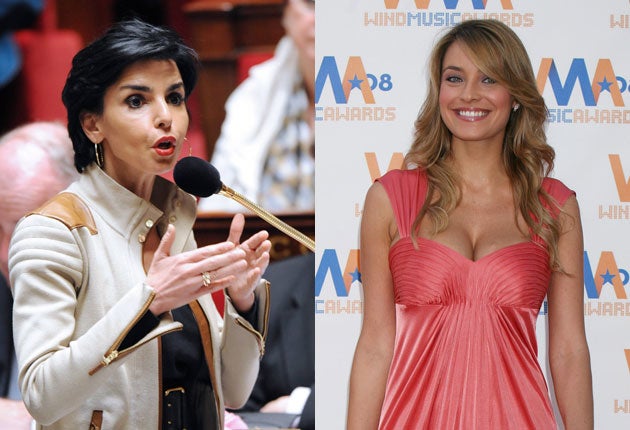
AFP/GETTY
French politician Rachida Dati, left, and Miss Italy contestant Barbara Matera, right, are standing for election
From Stockholm to Sardinia, Waterford to Warsaw, a noisy and eclectic band of nationalists and eurosceptics are on the campaign trail hoping to unseat their mainstream rivals in the European Parliament.
Dutch anti-Islamists, Hungarian nationalists, Italian separatists and an Irish-backed anti-Lisbon Treaty party are all clamouring for seats when Europe goes to the polls between 4 and 7 June. And a combination of dismally low voter turnout and the economic downturn looks set to play into their hands in the vote. Job losses and the grimmest economic forecasts in decades have created the ideal conditions for single-issue candidates and marginal groups hostile to the EU to win seats in the Strasbourg assembly.
"It's a worrying trend" says Urszula Gacek, a centre-right Polish MEP whose country is itself home to several arch-conservative Catholic parties and headed by a eurosceptic President, Lech Kaczynski. "The extremists are better at mobilising their voters, by playing on citizens' fears and talking up the need for protectionism and the closing of borders."
Many, like Ms Gacek, view the possible arrivals from the extreme fringes of the political landscape with a trepidation bordering on fear, fretting that their new fellow parliamentarians will attempt to hobble the workings and powers of the institution to which they are seeking election. "It is bad enough having our sessions broken up by anti-EU ranters from the United Kingdom Independence Party [Ukip], but what if these people actually get power now?," says one Portuguese deputy.
During their last pre-election session of parliament in Strasbourg, chatter about the looming changes to the balance of power dominated the corridors. Over glasses of wine in the parliament's bars, politicians pondered about possible alliances to disrupt the traditional dominance of the centre-right and the socialists. One prospect is the establishment of a new eurosceptic faction, thanks to the British Conservatives' much criticised plan to abandon the powerful centre-right, umbrella grouping European People's Party. The Conservatives are now reportedly seeking to team up with Irish businessman Declan Ganley's Libertas, a pan-European movement set up specifically with the ambition of derailing the Lisbon Treaty.
More worrying is the threat from the far-right, which could well include the British National Party (BNP). The BNP is poised to win at least one seat and has been seeking "greater co-operation between European nationalists". Last month, Nazi salutes greeted the BNP's deputy leader, Simon Darby, at a far-right rally in Milan, organised by Roberto Fiore, an Italian MEP and head of Forza Nuova, which seeks the expulsion of about 150,000 Roma gypsies from Italy.
"It's really very ironic that these groups have decided to go European, given that they are all basically campaigning against the EU," says the Green Party's co-president Monica Frassoni. But she points out that these parties are so rooted in domestic politics that Romanian and Hungarian groups campaigning on an anti-Roma gypsy ticket are unlikely to get into bed with, for instance, the Vlaams Belang, which wants independence for Flanders. "I can't see how they will organise themselves into a credible new faction given the complete disarray and isolation they've faced before."
A new party of far-right groups, Identity, Tradition, Sovereignty, collapsed spectacularly just weeks after its creation in 2007, when Italy's Allessandra Mussolini hurled verbal abuse at her "scum" Romanian colleagues, and Poles were left fuming over Austrian mutterings about the need to change the Polish-German border – a far cry from the cosy European spirit that has seen even British members grow used to kissing their foreign colleagues on both cheeks.
"Inevitably it all dissolved into a shambles and now they will never make up the numbers they need to create a new political entity," says Andrew Duff, a British Liberal MEP, referring to recent changes to triple to 28 the minimum number of politicians needed to form a viable political grouping. Only a group can wield power at the parliament, he says, as they can chair committees and sway voting. "Independent members count for nothing, which is why the risk posed by these extremists is in reality so insignificant."
At the other end of the scale, the parliament risks being seen as a depository for outlandish wannabes or failed has-beens. France's fallen political star, the former justice minister Rachida Dati (UMP), can at least boast cabinet experience, unlike the string of female soap-opera starlets and models being fielded by Italy's Silvio Berlusconi for his centre-right party, to the outrage of his wife, who last week filed for divorce, calling the move "shameless".
In Britain, the former Apprentice star and Met Office worker Katie Hopkins announced she will stand as the sole candidate for the Katie Olivia Hopkins Independent Party in Exeter. "It makes us look like a bunch of amateurs," said one Dutch MEP.
Although the parliament has massively increased its powers since it became a democratically elected chamber three decades ago and now wields its zeal for regulation wherever it can, the world's only trans-national parliament still leaves most Europeans cold: two-thirds say they know little or next to nothing about what it does and only one-third plan to vote next month, one poll found. "Everyone is worrying about the economic crisis, but people don't necessarily believe that the parliament can address it," says Ms Frassoni.
Its 785 MEPs like to blame the media for the plummeting public interest, accusing it of failing to report on its achievements in swaying legislation on issues as diverse as working hours for employees, EU environmental targets and mobile phone roaming charges. Instead, the assembly's reputation is all-too-frequently dogged by scandals over MEP allowances and the extravagant idiosyncrasy of being the only parliament in the world with two houses.
MEPs and armies of assistants and translators leave the gleaming steel-and-glass hemisphere in Brussels once a month to travel several hundred miles to Strasbourg for a four-day plenary session in a time-honoured practice branded the "travelling circus', "Euro gravy train" or any variation of the two.
The monthly move to France of thousands of staff wheeling boxes of documents as well as the upkeep of a state-of-the-art premises which stands mostly empty costs European taxpayers about €200m a year. Even if Strasbourg's restaurants buzz with the nightly patronage of the MEPs during sessions, many elected representatives don't even bother to show up. "We had around 150 colleagues missing during the last session, which is completely unacceptable and dangerous as it skews voting results." says the British Liberal MEP Andrew Duff. "Some Mediterraneans hardly ever show their face".
Others seethe with frustration at the parliament's reluctance to self-reform. "In the past, Strasbourg was a symbol of Franco-German reconciliation. Now it's a symbol of waste," says Alexander Alvaro, a German Liberal MEP who wants to scrap the Strasbourg location – a historic arrangement enshrined in EU treaties. However, there are signs the European Parliament is getting the message. New rules on allowances will curb some of the excess. And if Ireland passes the Lisbon Treaty in a second referendum in the autumn, Strasbourg will be conferred with a greater say over justice, immigration and foreign policy, rather than wasting its breath on passing resolutions on matters beyond its remit.
Ironically, the europhobes and extremists may find themselves wielding real power rather than just disrupting hand-wringing debates on the situation in Burma or the disappearance of the brown bear.
View all comments that have been posted about this article.
Offensive or abusive comments will be removed and your IP logged and may be used to prevent further submission. In submitting a comment to the site, you agree to be bound by the Independent Minds Terms of Service.
- Print Article
- Email Article
-
Click here for copyright permissions
Copyright 2009 Independent News and Media Limited


Comments
Veritas is in favour of the EU but it is against the Lisbon treaty. Veritas wants an open and accountable EU that has a deepening relationship with the people of the EU through consent.
It does not want a politicians and beaurocrats EU, it wants an EU by and for the people.
What is extreme about that?
More info at www.libertas.eu
Patently it is not us, the voters, who are frightened. Rather it is the ruling elite in Brussels. Their fear is real, a fear that their arrogance, the inevitability of their hegemony, their utter distain for the intellect of the electorate, their corruption and self-serving interest, indeed their very hold on the reins of power, is about tho be eclipsed.
Once again it becomes apparant that, in the absence of ANY ploicy that strikes a chord with the electorate the only weapon left in the establishment's arsenal is 'spin' - the blatant manipulation of puplic perception. The inexorable march of federalism and beurocracy holds no appeal for large swathes of the pan-european electorate who in the face of diminished soverignty, job losses in part due to migratory populations and the imposition of an intrusive and undemocratic state, turn to those who offer redemption. It is the lack of empathy with the needs of the electorate that is damaging politicians of all persuations in western europe, both at state and europen level. "The extremists are better at mobilising voters" quotes Ms Mock. Of course they are, their manifesto is geared to addressing the real concerns held bu many european voters. How can they be on the "extreme fringe of the political landscape" if they are "better at mobilising their voters" who seem to be buying into the party vision in their droves?
The article is a classic example of the use of double speak on behalf of 'the establishment', aimed at manipulating the public's perception and sufficiently muddying the waters to frighten the average 'tribal voter' away from delivering his protest vote into the hands of a party who may, by their force of argument, actually be in accord with his own view. The usual tools have been deployed,(unsubstanciated sources -"one portuguese deputy" is a good example), to discredit groups who legitimately use the mechanics of state to prevent legislation which is counter to the interests of their electorate and which interfere with the agenda of the elitist establishment.
One must bear in mind that, in modern poltics, most legislation is enacted as a result of intense lobbying by corporate groups and alliances to increase their profitability and competitive edge. (Source - Robert Reich 'Supercapitalism - The battle for democracy in an age of Big Business') Most legislation does not benefit the interests of the ordinary citizen, whilst a business centric agenda will turn on the tap financially in terms of party funding, largesse and massive contribution to campaign funds
Therein lies the real fear of the elite and explains their drive to detroy opposition by any means - they have been found out by an increasingly savvy electorate who look for real change. In our suppressed society registering a protest vote, (or indeed not voting at all), is the only way most people can express their anger.
No their manifestos are geared to appealing to the baser instincts of mankind. They offer "simple solutions" to complex problems, and that is not because they are more in tune with the "man on the Clapham omnibus", but rather that they are more clever at manipulating and praying on peoples fears and feelings. These groups encourage people to become more tribal and teach that it is OK to take away a mans loaf of bread for oneself if he is from a different tribe. Down that path lies eternal war and the eventual decimation of one or more groups of people.
When did UK join EU. Hence UK IS NOW IN NATO Recently and after 1950s. UK was in 1949 n NATO BUT if EU is in NATO in 1999 Then UK is IN NATO in 1999. LOGIC.
NATO Science for Peace and Security: Homepage
Offers support for international collaboration between scientists from countries of the Euro-Atlantic Partnership Council and the Mediterranean Dialogue.
www.nato.int/science/ - 35k - Cached - Similar pages
All the furniture is stolen
For its first few years, NATO was not much more than a political association.
Read the above.
The combined military spending of all NATO members constitutes over 70% of the world's defence spending, with the United States alone accounting for about half the total military spending of the world and the United Kingdom and France accounting for a further 10%.
Nato.Org
Click here for NATO.int. WhiteHouseComments.Com is not affilliated with the United States Government, or The North Atlantic Treaty Organisation.
www.nato.org/ - 5k - Cached - Similar pages
I thank you
Firozali A.Mulla
The EU Superstate is most certainly extreme. Hardly anybody wants it in its current makeup. Either it must change radically, The Lisbon Treaty must be roundly defeated, or Britain should leave it and come to an agreement on how to do business with it.
Admit it, the reality is (like it or not) best way to shock the political establishment into taking not of understandable but ignored public concerns like mass immigration is for BNP and similar parties to win a seat.
I thank you
Firozali A.Mulla
I thank you
Firozali A.Mulla
Libertas "is in favour of the EU but it is against the Lisbon treaty. Libertas wants an open and accountable EU that has a deepening relationship with the people of the EU through consent." I think 'michaelji' probably meant Libertas.
As a Libertas/Labour supporter, I rather hope Libertas doesn't do a deal with the UK Conservatives but the possibility shows that Libertas is not a 'fringe' party. Unfortunately, the Labour government is now out of touch with its supporters on Europe and denying the promised referendum will cost it dear. I will not only be voting for Libertas but standing for Libertas in Yorkshire and Humber on 4th June.
Not politically active before, I am incensed by the lack of transparency in Europe and the MEP's, MP's, bankers' gravy trains we are paying for. (Our UK MP's expenses scandal is trivial compared with the waste and corruption in the EU bureaucracy).
To lump Libertas together with UKIP and the BNP is an outrage. If those parties pick up more votes as a result of recent events and scandals it will be a tragedy. But even UKIP is democratic compared with the President of the European Parliament who wants to stamp out all opposition and can't bear noisy opposition of the sought we were once accustomed to in the UK parliament.
Let's stay in Europe and make it work!
Kind Regards to Independet Team
The term "extremist" or "fringe" politician is just a smear term directed by the controlled politicians toward people that might upset the status quo. The people in power now (and that includes their official "opposition") are simply running a scam on the voters by pretending there is a difference between them, while smearing anyone who isn't part of the Club with scary names. Maybe what we need is a little "extremism."
Ken
http://www.LaserGuidedLoogie.com
The sort of LAB-LIB-CON which rules in most countries is being eroded. Austria, Flanders, Italy, the Netherlands show up the ghastly mistakes of our politicians probably because of the "multi-cultural" propaganda emanating from Wall Street and the States.
Now that multi-culturalism has been comprehensively proved to be the killer of any nation and is loathed by most Europeans, it would be silly if journalists were to follow bankers and politicians in the low exteem in which they are held by the parties.
We should resolve on Election Day to vote for any party which is not part of the Establishent and to vote for politicians who love their country and their Continent and who are aware that Europe is "full"
So all you trolls start yapping your traps while you can. We are sick of you.
Andrew Duff (Liberal MEP) says that "Independent Members count for nothing". That tells you everything that you need to know about the EU Parliament! (or was it a Freudian Slip?)
The people of Europe are not anti EU because the generation of mrs Deyevski has failed to promote it but because we have been betrayed and lied to. We have not been properly and honestly consulted as is our right, and those that were have been ignored and patronized. Our leaders had the gall to offer us the selfsame 'constitution' we rejected, thinking that scrambling and making it even less transparent would fool us. It is insufferable
Furthermore: every European citizen is aware of the fact that he will be rendered politically neutered when Lissabon goes into full swing: democracy is de facto abolished when our countries cease to exist, and we will be rendered powerless under a dishonest, greedy and foolish political class.
Mr. Ganley, who has been shamefully slandered and reviled by politicians and journalists alike in fact is far too friendly and civilized: Europe is an abomination. We do not want more government, but less - much less!
MEPs propose, vote and decide the laws by which their country shall be ruled.
Governments are only an excetive body whose power rest the confidence of a majority of MEPs, or a lack of a non-confidence majority.
Sadly, the EU is run by the none elected, but selected commission who propose and implement their own laws, and who does not answer to the European Parliament, who in reality is little more than the commissions blotting paper.
It reminds me of the Nicaraguan Parliament under president Somoza.
Miss Barbara Matera is young and beautiful, but I have no doubt whatsoever that she wont be as good a MEP as the majority og the current MEPs.
And she will be heard by the younger generation of Europe because they can relate to her, they might even believe that she may listen to them and heed their advise.
Normally the main reasons people stand for election to the European Parliament are the pay, the perks and the champagne.
As I am Norwegian, I am happily not able to stand for election for the European Parliament.
On the other hand, as I am now supplying 10% of Western Europes natural gas consumption from my platform in the North Sea, and a resident of the Canary Islands, maybe the Canarios should elect me to be their MEP.
After all, I feel I contribute more to Europe that most MEPs, and I should like to work alongside miss Matera.
But I prefer cava to champagne so I wont move to Strasbourg, and the selection of beers is good in Brussels.
My regards, and may the best looking ladies win.
Odd M. Kvaloe
Arguineguin
Gran Canaria.
However, the fact that the Independent newspaper got this wrong, is (perhaps) funniest because it demostrates how far the bias towards the party system is built into the European Parliamentary elections in the UK! Ireland's system for electing MEPs is, for example, different.
There are three Independent candidates standing for election as MEPs in the UK on 4 June: Peter Rigby (East England), Francis Apaloo (North West) and Katie Hopkins (South West and Gibraltar).
Their existence, as Independent candidates, emphasises issues around quite how ridiculous the D'Hondt system can be. It won't happen; but if everyone in the East of England voted for Peter Rigby there would have to be a second European election. Why? Because there are 7 seats to fill to respresent the East England constituency; but only one MEP would have been selected.
Another joke may be the positioning of the names on the ballot papers... we shall have to see... does "I" for Independent appear above "P" for Party? Does "K" for Katie appear above "L" for Liberal Democrat and "L" for Labour? Or is the listing not alphabetical? If not, how is objectivity maintained? To get a sense of the impact, visit the confusion at Wikipedia:
http://en.wikipedia.org/wiki/South_West
http://en.wikipedia.org/wiki/North_West
http://en.wikipedia.org/wiki/East_of_En
All good fun and games!