Rome's delis have had their salami
Two thousand years of culinary tradition are coming to an end in the Italian capital, as supermarket competition and rising costs are driving its famous neighbourhood delicatessens out of business. Peter Popham reports
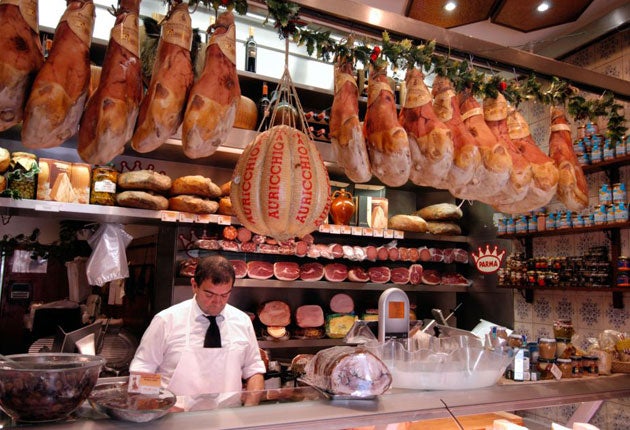
The neighbourhood delicatessens of Rome, whose roots go back 2,000 years to the Roman Empire, are on their last legs. Until two decades ago, in the traditional pockets of Rome there was a droghiere on practically every corner, its windows crammed with prosciutto hams, its display cabinets full of wheels of parmigiano and tubs of ricotta and mozzarella cheese. There was pancetta and salami and Norcia sausages, trays of pickled baby artichokes and anchovies and grilled aubergines, with ceci e bacala, chickpeas and dried cod, on Fridays only.
They were called droghiere because droga means spice as well as drug and spices were their early standby, but they had evolved into all-round grocers, providing bitter black olives from Gaeta, cheap, decent table wine, locally baked bread, as well as milk, beer, soap powder and corn flakes.
Then the supermarkets arrived, and one by one they began to disappear. "Until 1980 or 1985, there were lots of us, more than 20 in this neighbourhood," said Sergio D'Amico, owner of one of the last survivors in his area. "There were no supermarkets here till 1980; after that they exploded. And many of us closed down. Now there's only a handful of us left."
And the annihilation of many of the rest cannot be far away. Recent research on retail trends shows that more than 7 per cent of the capital's remaining family-run food shops closed between 2005 and 2008. The present recession is likely to finish off yet more, as shoppers concentrate on the bottom line.
"There's no one single explanation," says Valter Giammaria, secretary general of Confesercenti Roma, a shopkeepers' association. "There are a number of factors, and there is the growing competition of shopping centres, of which there were 26 and soon there will be 40."
Mr D'Amico cites another crucial factor, and that is the running costs of the shops, particularly soaring rents. His story is typical of many. In his corner shop in the working-class neighbourhood of Garbatella, a couple of kilometres south of Rome's city walls, time, one feels, has stood still. The bold sign outside, stretching the length of the frontage, reads "Superalimeentai", "super foods", and is unchanged since the shop was opened by his father in 1953. "I started working with him when I left school at 16 and I have kept going ever since," he said.
Has he seen many changes in that time? "Not really, no. I've always enjoyed the work, perhaps because I've done it for so many years. And this is a family business so we don't have the sort of problems that a larger business might have. It's just a little shop. My father's dead so now there's my mother, Emma, who operates the till, Sylvia my wife, my uncle Alvaro and me."
Sergio was born near by, but like most of Rome's droghieri or small grocers his family's roots are in Umbria, the place his father left to migrate to the capital after the war. "They call us the Norcini, the famous Norcini who migrated to the city in search of work," he said. "We Norcini are famous all over the world for our skill at rearing and butchering pigs, making prosciutto, salami, sausages, all those sorts of things. They are our specialities."
Norcia is a small town in the far south-east of Umbria, the region due north of Rome which has become a popular alternative to Tuscany for British people hunting an affordable Italian pied-á-terre. A few centuries ago, it was the centre of the migratory trade in sheep, which were pastured in the Umbrian hills during the summer then brought down to winter in the countryside outside Rome and Florence.
But back in Roman times, the "Norcini" had already established what they were really good at. The Umbrian hills were full of oak woods and became a centre of pig-rearing. Two millennia ago, the people of the town were already known for their skill at butchering and carving the pigs which gorged on the local acorns. Sergio D'Amico plays down the difficulty of the core skill in the droghiere's trade, which is slicing the prosciutto hams by hand. "Slicing the prosciutto is something that comes with experience," he says. "You watch someone bigger than you doing it, you observe him closely and gradually you learn the trade. At first it's not easy slicing with such a narrow-bladed knife; some customers want the ham fine, others want it in thicker slices, but with the passing of years you get the hang of it. The knives are also very sharp, which is important. Once a week the sharpener comes by with his grindstone."
But the art which he practises with so little fuss has been handed down from father to son through the ages. So expert did the medieval Norcini become at carving the carcasses of pigs that at some point they were called on to apply their skills in a different sphere.
"In the Middle Ages, the word Norcia came to be used pejoratively for a lesser individual who could take the place of a surgeon," a website of Norcia droghieri reports. "The Norcini who were known in ancient Rome as experts at the art of castrating pigs and working with meat developed a manual ability which made them ideally suited for carrying out operations" for ailments including hernias, cataracts and tumours. Notoriously, they were also called on to castrate musical young children from poor families who were secretly sold to theatres, to be trained as castrati singers.
Sergio D'Amico expects to carry on wielding his knife for a few more years yet, but once he hangs it up for good, "Superalimentari" is likely to go the way of all the others. "The future is grey," he admits. "I'm 55 now and I'm waiting to collect my pension, then that's it. Buona notte."
Roman specialities
*Spaghetti alla carbonara: pasta with "guanciale" or "pig's cheek" bacon, pecorino cheese and egg.
*Fiori di zucca: fried courgette flowers stuffed with ricotta and anchovies.
*Coda alla Vaccinara: oxtail stewed in a rich and savoury tomato sauce.
*Pasta cacio e pepe: spaghetti dish with cacio cheese, pepper, olive oil.
Join our commenting forum
Join thought-provoking conversations, follow other Independent readers and see their replies
Comments