Russia aims to topple the 'last dictator in Europe'
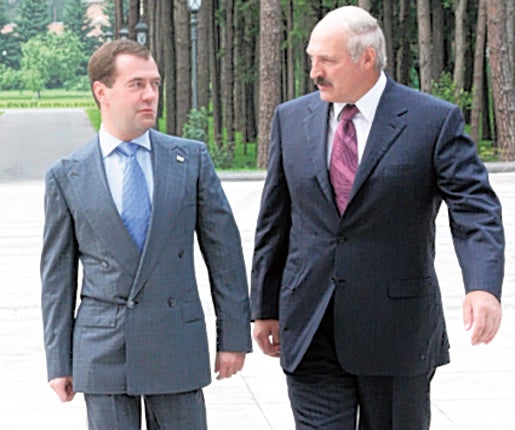
Alexander Lukashenko, the moustachioed former collective farm manager often described as "the last dictator in Europe", could be about to see his iron grip on power in Belarus turned to jelly by an intervention from his domineering neighbour and erstwhile ally, Russia.
Until recently Mr Lukashenko was expected to win presidential elections that are due in the neo-Soviet state next February at a canter. But in the last few weeks the Belarusian President has engaged in what might be an unwinnable media war with Moscow. Questions are now being asked about whether eastern Europe's great political survivor might be on his last legs.
It started two weeks ago, when Russian television aired a ruthlessly personal tirade against Mr Lukashenko, called "The Belarusian Godfather". The documentary told dark tales of human rights abuses, authoritarianism and persecution of the opposition. It was nothing new to seasoned observers of Belarus but the fact it was aired on Russian television – which is beamed into many Belarusian houses – was significant.
Those schooled in the traditions of Soviet-era agitprop smelled a rat, and remembered that Russian television had taken a sudden interest in uncovering human rights abuses in Kyrgyzstan earlier this year, fanning the flames of popular discontent which eventually led to a revolution that ousted the president, Kurmanbek Bakiyev. Mr Bakiyev had angered Moscow by going back on a deal to close a US airbase in his country. In a curious coincidence, the only country to offer Mr Bakiyev asylum when he fled Kyrgyzstan was Belarus, and he is now said to be living under the "personal protection" of Mr Lukashenko.
The Belarusian President was said to be infuriated by the documentary, and responded with his own piece of media aggression, sending a television correspondent to Tbilisi to interview the Kremlin's most hated statesman – Georgian President Mikheil Saakashvili. The Georgian leader was given free rein to criticise Russia's political elite, in a lengthy programme shown to Belarusian viewers in a prime time slot.
Since then, the disagreement has spiralled into an all-out media war. Russian television aired "The Belarusian Godfather – Part II", while last night television viewers in Minsk were to be treated to an interview with Latvia's President about "imperialistic neighbours". Also expected in Minsk in the coming days is acting Moldovan president Minai Ghimpu, who recently infuriated Moscow by instituting a "Soviet Occupation Day" in his country. Additionally, a state-run Belarusian newspaper published extracts of a critical report on Vladimir Putin's presidency by Russian opposition leader Boris Nemtsov.
The rumour mill spun further into action when leading Belarusian opposition activists were spotted in Moscow at the 60th birthday party of Leonid Gozman, a veteran Russian oppositionist on Wednesday. Also at the party were several Russian ministers, who apparently were engaged in long conversations with the visitors from Minsk. Yesterday's Russian press was in no doubt – the party had been a "casting session" to look for candidates to back against Mr Lukashenko in February's elections.
Mr Lukashenko has always relied on Moscow for support, in the face of criticism from the West, and Russia and Belarus are officially part of one "Union State". But in the past two years he has attempted to rebuild bridges with Europe and become increasingly aggressive in his dealings with Moscow. First, he refused to follow Moscow's lead and recognise Georgia's breakaway states of South Ossetia and Abkhazia after the 2008 war. In recent months he has been embroiled in ill-tempered negotiations over gas tariffs, as well as on entry into a long-planned Customs Union between Russia, Belarus and Kazakhstan.
Some analysts feel that Moscow has finally had enough of its tempestuous neighbour to the West and has decided to seek an alternative leader, even if it is somebody who will push Belarus further towards the EU. Others suggest that the current battle is all part of a vicious bargaining process on issues such as the Customs Union.
"I still expect that some kind of compromise will be reached, because there are no credible opposition figures for Moscow to back," says Fyodor Lukyanov, editor of Russia in Global Affairs magazine and an analyst of Russian foreign policy. "But the next few months will be interesting. A quarter of Belarus' population watched the Russian report about Mr Lukashenko, and while he can ignore criticism from the West, he isn't used to operating against a background of vociferous criticism from Russia, that is accessible to his population."
Join our commenting forum
Join thought-provoking conversations, follow other Independent readers and see their replies
Comments