Russia denies terror link to air disaster
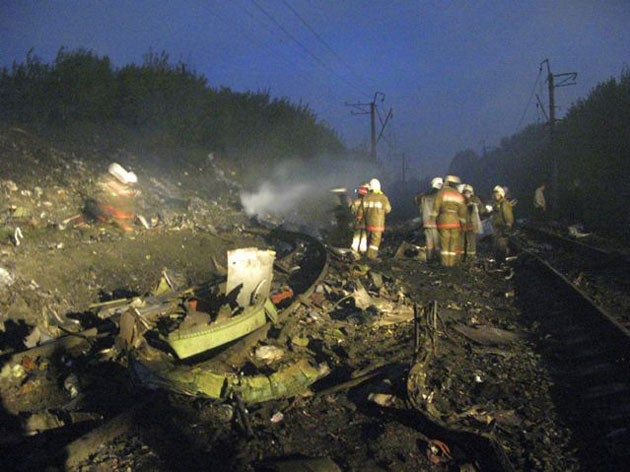
A Russian airliner has crashed in the Urals, killing all 88 people on board including a general who led the Russian army in Chechnya in 2000.
Officials rushed to blame the accident on engine failure, dismissing eyewitness reports of an explosion before the plane belonging to the Aeroflot subsidiary Aeroflot Nord, fell to earth.
The Boeing 737-500 was descending to land at Perm after a two-hour flight from Moscow when it burst into flames and plunged into scrubland on the edge of the city, narrowly missing houses. The wreckage cut off a stretch of the Trans-Siberian railway.
Russian television and news agencies quoted eyewitnesses who said they saw an explosion before the plane crashed. "It was burning while still in the sky and it looked like a falling comet," one witness told Russia's Vesti-24 television. Wreckage was spread over a wide area, fuelling speculation about a terrorist attack.
But Russian officials investigating the crash said a faulty engine had brought the plane down. "We have no information that the aircraft exploded in mid-air," Igor Levitin, Russia's Transport Minister, told Interfax news agency.
Alexander Bastrykin from the Russian Prosecutor-General's office, who is investigating the crash, blamed it on a technical fault, according to RIA Novosti news agency. "Judging by inspections of the scene, the crash was connected to technical defects of the right engine," he said.
An Emergency Situations Ministry spokeswoman said: "There were 88 people on board, 82 passengers and six crew. All of them died. There were no casualties on the ground."
Seven children were killed in the crash and Aeroflot said 21 foreign nationals were among the dead – nine from Azerbaijan, five from Ukraine and one person each from France, Switzerland, Latvia, the US, Germany, Turkey and Italy.
Russian news agencies said one of the dead was General Gennady Troshev, who in 2000 commanded the Russian army against separatist rebels in Chechnya. Four years ago, two Chechen suicide bombers blew up a pair of Russian passenger planes within minutes of each other.
Russian television news showed firefighters walking around the smouldering remains of the plane. One of the few recognisable pieces of the aircraft was a white fuselage panel showing the logo of Aeroflot, Russia's national carrier.
Russian aviation has a patchy safety record. The Perm disaster was its worst since 170 people died in August 2006 when a TU-154 plane crashed in Ukraine on a flight from the Black Sea resort of Anapa to St Petersburg.
Aeroflot, a debt-ridden airline in the 1990s when it had a fleet of mainly Soviet-built planes, has transformed itself into an image conscious, profit-making company with global ambitions.
The last Aeroflot plane crash was in March 1994 in Siberia, when 70 people were killed. Investigators found that the pilot's teenage son had been allowed to enter the flight cabin and had accidentally switched off the autopilot.
Bad record
*Yesterday's crash, the worst involving a Russian plane for over two years, broke a period of relative calm for the country's ropy air safety record. The Russian Aviation Service made some progress in improving safety in the years after the collapse of the Soviet Union: 200 small airlines were closed down a decade ago. But the death toll in recent years – between 2001 and 2006 alone nearly 850 passengers and crew died in seven incidents – shows much remains to be done.
Join our commenting forum
Join thought-provoking conversations, follow other Independent readers and see their replies
Comments