Sarkozy forces Foreign Minister to quit over links to ousted Tunisian regime
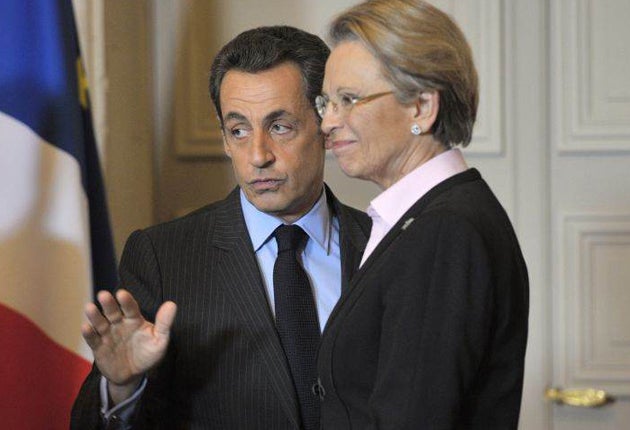
The “Arab Spring” claimed its first high-profile victim in the West last night with the forced resignation of the French foreign minister, Michèle Alliot-Marie.
In an attempt to put an end to France’s stumbling and incoherent response to the democratic revolt in North Africa, President Nicolas Sarkozy announced that Ms Alliot-Marie would be replaced by the former prime minister and foreign minister, Alain Juppé.
Mr Sarkozy, in a rare television address to the nation, also called for an emergency EU summit meeting to discuss ways of supporting fledgling Arab democracies and preventing "tragedies" and “uncontrollable floods” of immigrants to Europe.
Ms Alliot-Marie, 64, foreign minister for only three months, had been undermined by series of revelations and less than frank admissions about her connections with a Tunisian businessman closely allied with the deposed regime of President Zine Ben Ali. She also paid the price for growing criticism of the muted French reaction to the Arab revolt and the alleged cacophony of wider foreign policy under Mr Sarkozy – neither of which were primarily her fault.
As the Tunisian popular revolt spread in late December, Ms Alliot-Marie and her family spent a holiday in Tunisia in which they twice took free rides in the private jet of businessman closely associated with the regime. Her father was also revealed to have been making property deals during what was originally presented as a family holiday.
Although there was nothing illegal or improper in these activities, “Madame Alliot’s holidays” have come to symbolise the cosy relationship between France and the autocratic regimes in its former colonies in North Africa. President Sarkozy initially tried to defend Ms Alliot-Marie - not least because he had himself taken a regime-subsidised holiday in Morocco at Christmas and his Prime Minister, François Fillon, and family, had spent several days in Egypt partly at the expense of the then President, Hosni Mubarak.
After a growing drum-beat of criticism by opposition and press, and even by politicians in his own centre-right party, President Sarkozy decided privately last week that Ms Alliot-Marie – known as MAM - would have to go. In his address to the nation last night, he conceded that France – like other western countries – had had friendly relations with the “autocratic” Arab regimes in Tunisia and Egypt but said that there was “nothing to fear” in the “immense upheaval” which was bringing “democratic values to both sides of the Mediterranean for the first time.”
Nonetheless, he suggested, EU leaders should meet to discuss common action to prevent “tragedies” and “uncontrollable floods” of refugees to Europe.
Mr Juppé will be replaced as defence minister by the veteran right wing politician Gerard Longuet. Mr Sarkozy also took the opportunity to remove his unpopular long-time friend Brice Hortefeux from the interior ministry and replace him with a senior aide from the Elysee Palace, Claude Gueant.
The whole episode has been acutely embarrassing for Mr Sarkozy. His long-delayed government reshuffle last November – in which Ms Alliot-Marie became foreign minister – was supposed to create a confident new right-wing government to shore up his electoral base before the presidential election next Spring. Instead, Mr Sarkozy has been forced to rebuild his government after only three months.
The appointment of Mr Juppé as foreign minister is also, in effect, an admission of weakness or even failure. Mr Juppé, a foreign affairs specialist unlike MAM, is closely associated with Mr Sarkozy’s estranged former mentor, ex-President Jacques Chirac.
An anonymous group of senior French career diplomats last week criticised Mr Sarkozy’s foreign policy as “impulsive” and “amateurish”. The Elysee Palace – which has dominated foreign policy-making since Mr Sarkozy came to power - has dismissed the attack as the work of a few, frustrated malcontents.
However, the appointment of Mr Juppé implies that control of foreign policy will now shift, at least in part, back to the Foreign ministry on the Quai d’Orsay.
The departure of Ms Alliot-Marie probably marks the end of a career in which she became, successively, the first French woman to be defence, interior and foreign minister. MAM was known mostly for her stiff public manner and her moral correctness rather than her contribution to political debate. Her forced resignation on an ethical question was greeted by the French press as a supreme irony.
Join our commenting forum
Join thought-provoking conversations, follow other Independent readers and see their replies
Comments
Bookmark popover
Removed from bookmarks