Sarkozy goes to war with Napoleon's legal legacy
President accused of putting government above the law with plan to repeal 200-year-old system
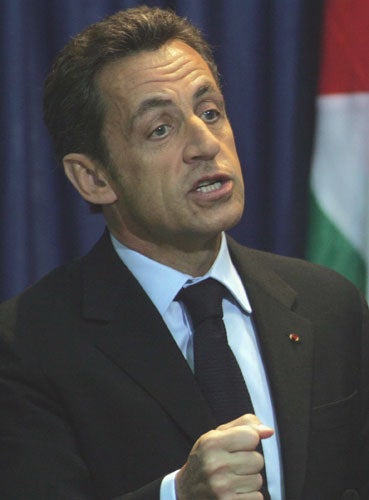
President Nicolas Sarkozy will raise a political and legal storm today by pronouncing a death sentence on the "examining magistrates" who have been the linchpin of the French judicial system for two centuries.
In a speech to France's highest court, M. Sarkozy will call for the abolition of the juges d'instruction created by the Emperor Napoleon in 1808, magistrates with independent, sweeping powers to investigate serious crimes ranging from murder to political corruption.
Instead, all criminal investigations would be handed over to the parquet or public prosecution service, which would remain under the direct control of the government. Although the French system of "investigating magistrates" is frequently criticised as cumbersome and draconian, President Sarkozy's reform plans drew a barrage of protest yesterday from opposition politicians, lawyers and judges.
They said that his proposals, although not yet spelt out in detail, would expose the criminal justice system to increased political influence and would, in effect, put an end to independent legal investigation of members of the government in power.
As with many of M. Sarkozy's reforms, the proposed changes can be read in two ways: an attempt to streamline France; or an attempt to increase the power of government. At one level, the abolition of investigating magistrates is a move to reform a system which has generated a series of abuses and failures and has been all but scrapped in other continental countries. On another level, the proposals leaked to the newspaper Le Monde yesterday suggested a clear shift of judicial power into political hands.
The reform would also imply an end to France's cherished system of "inquisitorial" justice and a shift towards a more "adversarial" British or American pattern where guilt or innocence is established by prosecution and defence lawyers slugging it out in court.
One of France's best-known investigating magistrates, Gilbert Thiel, the head of the judicial anti-terrorist unit, broke the customary silence of juges d'instruction yesterday to reject the proposals as anti-democratic. "This reform will mean that all sensitive cases, not just political investigations, but also large fraud and public health cases, will be subject to political interference," he said.
Emmanuelle Perreux, head of the centre-left magistrates' union, SM, said that M. Sarkozy's reform was the predictable reply of the governing classes to successful investigations of corrupt politicians in the past 20 years.
Most criminal cases in France are already dealt with directly by the parquet. Just under 5 per cent of the most serious or complex cases – about 32,000 investigations a year – are handed formally by the parquet to one, or more, of the 613 juges d'instruction.
Once entrusted with a case, an investigating magistrate is independent and impartial. He or she is supposed to assemble all the evidence suggesting both innocence and guilt. When the investigation is complete, he or she recommends whether the suspect should be prosecuted or cleared.
The magistrates use police detectives to help in their investigations. They can keep people in custody (with some safeguards). They can ask for suspects to be bugged. They can make unannounced swoops on homes or offices to search for incriminating documents. The 19th-century French novelist, Honore de Balzac, once said that the juge d'instruction was the "most powerful man in France".
The longest, most complex and most talked-about inquiry by a French investigating judge in recent years was the two year inquiry in 1997-99 into the death of Diana, Princess of Wales. Hervé Stephan concluded that Diana's death after the car crash in Paris was an accident caused partly by a drunken chauffeur, a conclusion confirmed last year by a British inquest.
But there has been a series of bungled cases by investigating magistrates and instances of alleged abuse of magisterial powers. In Outreau, near Boulogne, in 2000, a dozen people were wrongly imprisoned after a deeply flawed investigation by a young and inexperienced magistrate.
The case led to a parliamentary commission of inquiry which recommended that investigating magistrates should be abolished but – crucially – that the prosecution service should be made independent.
According to the proposals leaked to Le Monde, President Sarkozy will announce today that he wants to abolish the juges d'instruction but maintain the parquet, or prosecution service, under the control of the Justice Ministry.
Defence lawyers would be given access to the prosecution dossier from the beginning, something not allowed under the present system.
Nonetheless, Professor Didier Rebut, one of France's foremost experts on penal law, said yesterday that the proposals would skew the system against the rights of the defendant. French law is based on the principle that complex investigations must be "contradictory", or look into both sides of the case.
President Sarkozy's proposed reform would destroy this balance, Professor Rebut said. "Would the police be ready to allow defence lawyers to take part in police interrogations?"
Sarkozy vs Bonaparte: A short history
* Both men are known for their short stature. Nicolas Sarkozy is 5ft 5in and Napoleon Bonaparte was one inch taller (actually above average height for the early 19th century).
* Both men had foreign ancestry: M. Sarkozy is half-Hungarian; Napoleon came from an Italian-Corsican family.
* Both men had beautiful wives who were taller than they were.
* They both set out to reform the judicial system. The Emperor's "Code Napoleon" remains the basis of much of French law to this day. M. Sarkozy has made some piecemeal changes – imposing rigid, minimum sentences for violent crimes and life terms on some sex offenders.
* Both men set out to change the way that France thinks about itself.
* Both liked to be regarded as peacemakers. Napoleon's idea of making peace was to make war. M. Sarkozy intervened successfully in the Russia-Georgia conflict in the summer, less successfully in the Israeli assault on Gaza this week.
Join our commenting forum
Join thought-provoking conversations, follow other Independent readers and see their replies
Comments