Shy maths genius leaves million dollar prize money on the table
Russian recluse holed up in apartment urged to give unclaimed reward to charity
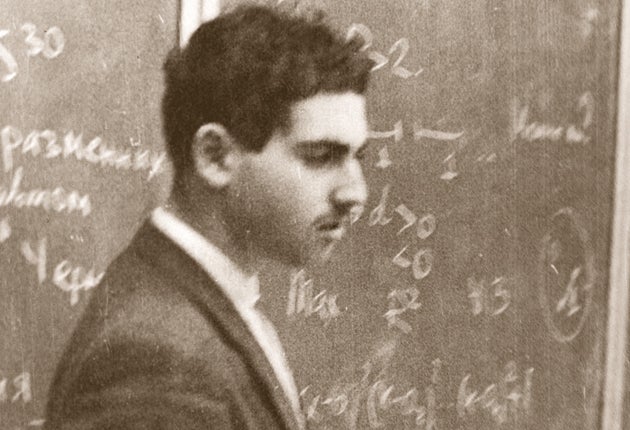
On the outskirts of St Petersburg among the dreary high-rises of the Kupchino district, lives one of the world's greatest mathematical geniuses in a tiny apartment that neighbours say is infested with cockroaches. But Grigory Perelman, 43, is no longer very interested in maths.
He has turned down jobs at several Ivy League universities, declared himself retired and done everything he can to avoid the limelight – most remarkably in 2006 by refusing mathematics' highest honour, the Fields Medal, for his work in solving a problem that had baffled extraordinary minds for 99 years.
This week Dr Perelman, a virtual recluse, was awarded the Clay Mathematical Institute's $1m Millennium Prize for his work. But he has refused to say whether he will accept the honour. "He replied that he needed to think about it," says James Carlson, president of the Institute, in Cambridge, Massachusetts.
But the indecision that Dr Perelman may have hoped would make the world go away seems to have had the opposite effect – and he has come under fire from Russian charities who have urged him to take the money and give it to them. The Warm Home charity in St Petersburg has urged him to donate it to good causes across Russia, while the city's Communists have suggested they could use it to maintain Lenin's tomb in Red Square.
Journalists have this week been hammering on the door of his apartment. But as Dr Perelman resists the insistent overtures of the outside world, he may reflect that if he had hoped to avoid the public eye, he might have been better off taking the money.
Dr Perelman has always been an outsider. When he worked in the US, colleagues noted that his fingernails were several inches long, and that he lived on a diet of only bread, cheese, and milk. At the age of six, when most children are singing nursery rhymes, he was a lover of opera.
"He is someone who sees the world a little bit in black and white," says Marcus Du Sautoy, Oxford University's Professor for the Public Understanding of Science. "He doesn't really go for greys."
Dr Perelman solved the Poincaré conjecture – a problem to do with the structure of three-dimensional shapes – in 2002, and sent his work to a group of scholars who had not heard from him in years.
The solution was so brief, and yet so complex, that it took his peers years to verify that it worked.
The $1m prize would be swiftly accepted by most mathematicians. But Dr Perelman, who turned down prestigious jobs in the US in favour of a $100 a month position in St Petersburg, sees things differently.
"I have all I want," he is said to have shouted, from behind a closed door, to a Daily Mail reporter this week. Meanwhile, his elderly mother, also from behind the door, was blunt with the Komsomolskaya Pravda newspaper: "We don't want to talk to anyone," she said. "Don't ask us any questions about the award."
Few people claim to fully understand Dr Perelman's rationale, but most agree that it has something to do with his perception of the moral failings of his peers. In 2006, a Chinese mathematician, Shing-Tung Yau, who also worked on the Poincaré conjecture, said that many of Dr Perelman's ideas were only "sketched or outlined", in a statement that many viewed as a shocking act of egoism. And Dr Perelman had fallen out with colleagues long before that.
In a rare interview, Dr Perelman once told The New Yorker that the mathematical community's ethics dismayed him: "It is not people who break ethical standards who are regarded as aliens," he said. "It is people like me who are isolated ... there are many mathematicians who are more or less honest. But almost all of them are conformists."
Whatever the truth, those mathematicians long for the chance to welcome him back to the fold. "It's very, very curious," said Professor Du Sautoy. "We all want to celebrate what he's done."
Poincaré Conjecture: The riddle Perelman solved
*Henri Poincaré thought explaining the proof of his famous conjecture would take far too long. But even trying to explain the conjecture itself is not easy without recourse to visual props such as rubber bands, footballs and doughnuts. It's all to do with topology, the science of surfaces, or – as some would call it – "rubber sheet geometry".
One way of looking at Poincaré's conjecture is to imagine the surface of a football. Whether inflated or not, it stays the same, and in that sense it is said to be two-dimensional. Imagine stretching a rubber band around the circumference of the inflated football. It is possible to move the band towards one end of the ball without tearing the band or allowing it to leave the surface. In this sense, the surface of the football is said to be "simply connected".
Now imagine stretching a rubber band around a doughnut, a sphere with a hole in it. In this case it is not possible to move the band without tearing the doughnut. So the surface of the doughnut is said to be not simply connected. Poincaré proposed that all closed, simply connected, three-dimensional surfaces, those which lack holes and are of finite extent, were spheres. His conjecture was a way of stating this observation, but proving it mathematically had defied generations, until Perelman came along.
The conjecture has implications for cosmology, which is fascinated with the idea of the shape of the space-time continuum. The mathematics behind the conjecture could help scientists to determine the shape of the universe. Steve Connor.
Join our commenting forum
Join thought-provoking conversations, follow other Independent readers and see their replies
Comments