Spain finally asks for bailout and receives €100bn lifeline
Emergency meeting of finance ministers grants eurozone's fourth largest economy aid for its banks
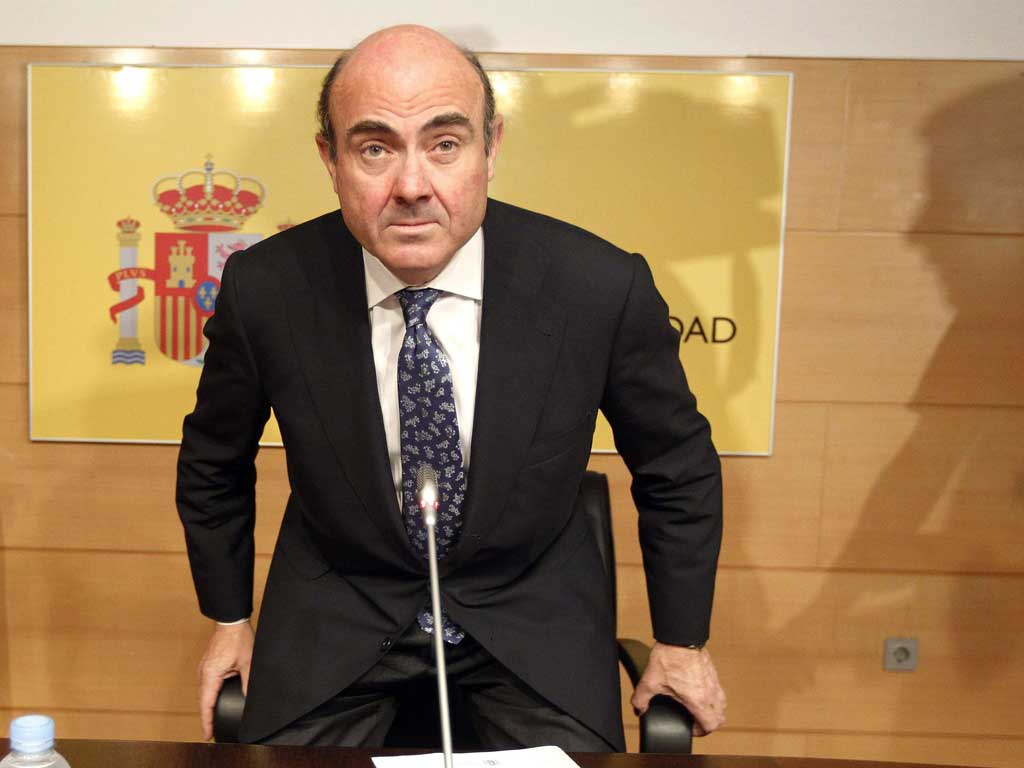
After months of speculation, denials, and hoping for something – anything – to turn up, Spain has formally requested a bailout, by far the largest economy to do so. After an emergency telephone conference of eurozone finance ministers yesterday, an official statement was issued saying that the sum involved could be as large as €100bn.
Spain, whose banks are struggling with toxic property loans and assets, becomes the fourth member of the 17-nation eurozone to get a bailout since the continent's debt crisis erupted two years ago. In announcing the request, Luis de Guindos, economy minister, said the final figure was still in question and would remain so pending results of two independent audits of the banking sector, due by 21 June. But he insisted it would fully cover the needs of the country's banks, and not be followed by a request for further funds.
The minister was also at pains to stress that no further austerity measures would be attached as conditions for receiving the funds, which would be used expressly for the banks that need them, rather than to help cover Spain's public debt, which, as a ratio of gross domestic product, is lower than Germany's.
Only 10 days ago, Mariano Rajoy, Spain's Prime Minister, was adamant that his country's banking sector would not need bailing out. Few observers were persuaded, not least because of widespread suspicion that the full extent of Spanish banks' toxic debt is still unknown.
Back in the early days of the financial crisis, it looked as if Spain's economy – the fourth-largest in the eurozone – could withstand the squalls coming its way. But then its boom, based on inexorably rising property prices, began to totter and collapse. House prices went into freefall, and unemployment, a mere 8.3 per cent in 2007, began to rise, first to 18 per cent in 2009, and to the fearful figure of nearly 25 per cent now.
By 2009, the financial sector was sitting on €445bn of property-related loans, and regional governments saw their incomes plunge as the lucrative issuing of new construction licences and taxes dried up. Austerity measures were introduced and some lenders nationalised, but Spain's borrowing costs continued to rise. It became clear that it would be just too expensive for the country to borrow the money necessary for a bank rescue from the markets.
Eurozone finance ministers said in a statement that the bailout money would be fed directly into a fund Spain has set up to recapitalise its banks, but emphasised that the Spanish government is ultimately responsible for the loan. Still, that allows Spain to avoid making the onerous commitments forced on Greece, Ireland and Portugal when they sought bailouts.
Spain's rescue may not be the last. Attention will now switch to Italy, and Cyprus could also seek help. As the Swedish Prime Minister, Fredrik Reinfeldt – whose country does not use the euro – said: "We're talking about one of the greatest financial rescue operations the world has seen."
Join our commenting forum
Join thought-provoking conversations, follow other Independent readers and see their replies
Comments