Spain: the new crisis in Euroland
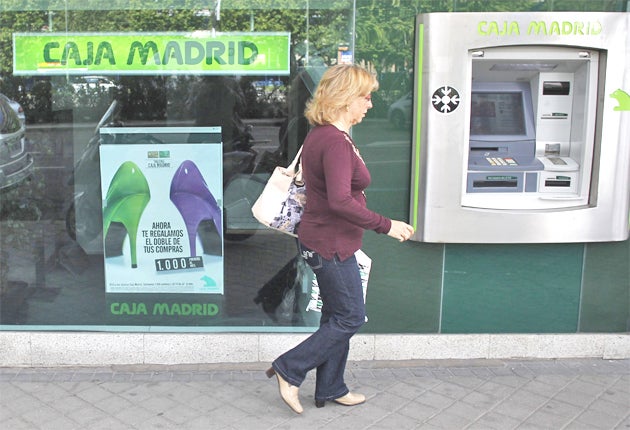
European leaders meet in Brussels today amid growing fears that Spain, Europe's fifth-largest economy, is preparing to ask for a bailout which would dwarf the €110bn (£90bn) rescue plan for Greece.
The Spanish government yesterday dismissed reports that it was already in discussions with the European Commission, International Monetary Fund and the US Treasury for a rescue package worth up to €250bn.
Officials in Madrid, Brussels and Paris were forced to deny that a Spanish bailout – which would take the European debt and euro crisis into a potentially dangerous new phase – was on the Brussels summit agenda.
"Spain is a country that is solvent, solid and strong, with international credibility," said its Prime Minister, Jose Luis Rodriguez Zapatero. The European Commission spokesman said: "I can firmly deny [that a Spanish rescue is under discussion]. I can say that that story is rubbish."
Brussels diplomats have been at pains to send out feel-good signals ahead of a summit in which Europe's leaders are supposed to take the first steps towards more disciplined and co-ordinated, control of national finances. Those reforms are meant to restore confidence in the euro and underpin the €750m EU and IMF safety-net, created last month for euroland countries that lose the confidence of the financial markets.
However, it is proving hard to shake off persistent market fears about Spain, which, if it needed a lifeline, would swallow up a large part of the emergency fund. Worryingly for the EU, the doubts about Spain – whether real or driven by speculation – are eerily similar to the gradual seeping away of confidence that sent Greece into a financial death spiral in March and April. The Spanish government's cost of borrowing hit a new record yesterday. The interest rate gap, or spread, between 10-year Spanish bonds and their German equivalents, rose by more than 0.10 of a point to 2.23 percentage points.
A senior Spanish banker, Francisco Gonzalez, chairman of the BBVA financial services group, confirmed that foreign private banks were now refusing to provide liquidity to their Spanish counterparts. "Financial markets have withdrawn their confidence in our country," he said. "For most Spanish companies and entities, international capital markets are closed."
As a result, the European Central Bank is said to have provided record amounts of liquidity to Spanish banks in recent days. The closure of bank-to-bank credit to Spanish institutions recalls to some market commentators the ripple of crisis through the global financial system after the fall of Lehman Brothers in the Autumn of 2008.
The IMF chief Dominique Strauss-Kahn is expected in Madrid tomorrow to see Mr Zapatero – but brushed off speculation of a crisis. "It's a working visit," he told reporters in Paris. "I am in France [today] – are there such rumours about France?"
Fears over Spain's finances checked the recovery of the euro on money markets yesterday. The single currency lost much of the gains it had made in the past seven days.
One of the proposals on the table at the Brussels summit is public "stress tests" to force banks to reveal the state of their books. The Spanish government offered yesterday to open the books of its own private banks unilaterally to prove that they were sound.
Today's summit in Brussels was intended to be a time for the EU leaders to catch their breath and discuss ways of restoring the euro's long-term credibility. The threatened Spanish crisis may blow all that out of the water.
Despite an apparent rapprochement between Paris and Berlin this week, President Nicolas Sarkozy and Chancellor Angela Merkel remain deeply divided on how to prevent the currency and debt crisis from dumping Europe back into recession. Mr Sarkozy has agreed to drop his proposals for new institutional machinery for a political "government" of the euro by its 16 member states. Ms Merkel prefers to talk of a vague "governance" of the euro, and European state spending, by all 27 EU governments.
More fundamentally, Paris is deeply concerned that the austerity plans announced by Berlin last week could – on top of budget cuts in other countries – plunge Europe into crisis.
The French fears were echoed yesterday by the billionaire investor, George Soros, who warned that Europe would almost certainly face a recession next year which might generate "social unrest" and the kind of populist nationalism seen in the 1930s. "That's the real danger of the present situation – that by imposing fiscal discipline at a time of insufficient demand and a weak banking system... you are actually... setting in motion a downward spiral," he said.
The collapse of Spain's housing boom has helped fuel a deep downturn which has sent unemployment spiralling to 20 per cent, the second worst in the EU. Mr Zapatero introduced a range of measures last month, including spending cuts of €15bn over two years and reductions in public sector wages and spending. Unions have called a general strike over labour reforms.
Join our commenting forum
Join thought-provoking conversations, follow other Independent readers and see their replies
Comments