Step aside, Sartre: this is the new face of French intellectualism
While the West threw billions at global poverty, Esther Duflo tried to solve the problem with science. It has made her France's most fêted thinker, says John Lichfield
Everyone knows what a world-renowned, French intellectual looks like. There is the older sort, now rare, who has a squint and smokes cigarettes and haunts the cafés of the Paris Left Bank. There is the newer kind, who has flowing hair and an open-necked shirt and haunts television studios.
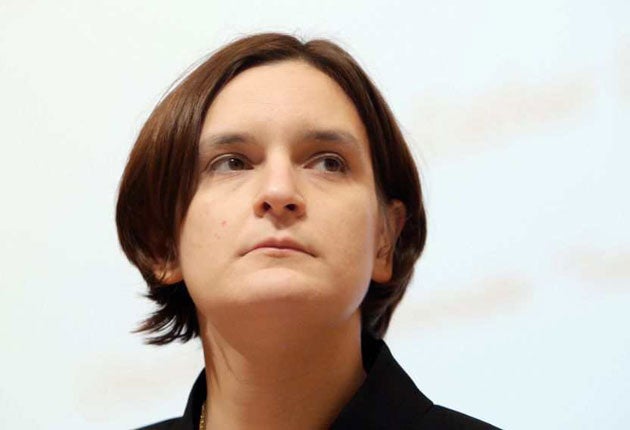
Wrong and wrong again. The new face of the world-leading French intellectual is a brisk 36-year-old woman with the pleasant but no-nonsense look of a primary school teacher, who climbs mountains in her spare time.
She is Esther Duflo and was recently named one of the 100 most influential thinkers in the world (she came 91st). She begins a season of lectures this week at the Collège de France, the Everest of French intellectual life: a kind of PhD-level OU with no students and free lectures for all.
Mme Duflo is the youngest woman ever to be asked to lecture at this prestigious, 500-year-old institution at the heart of the Left Bank. Her introductory talk was the hottest (free) ticket in town. Several hundred people, including the former prime minister, Dominique de Villepin, arrived too late and were locked out.
Mme Duflo is a "development economist" one of the world's greatest experts – perhaps the greatest – on why development programmes in poor countries often fail and why they sometimes succeed. Her precise field of expertise has existed less than a decade. She is among its inventors.
Why is she attracting such attention? "Partly, I think, because it's so unusual for such a young person, especially a woman, to be asked to lecture at the Collège de France," Mme Duflo said in an interview. "I suppose people are asking 'Who is this person? What is all the fuss about?' Partly also, I think the subject is something that intrigues people. Why is it so difficult, despite all the efforts which have been made, to help people to escape from poverty?"
Mme Duflo is not an abstract theorist, as French intellectuals are assumed (often encouraged) to be. She investigates, in elaborate detail, the practical, small things which can make a difference in trying to improve the lives of the poorest of the poor. For instance, not just "education, education, education" but how to make sure pupils and their teachers turn up at school. (Answer: tiny incentives, such as free meals or uniforms, can transform attendance in poor countries.)
Mme Duflo has, above all, developed and promoted the concept of "scientific" testing of anti-poverty programmes – what works and what doesn't but also, crucially, why things work and why they don't. She believes – and has proved – that the effectiveness of anti-poverty programmes can be explored by "random testing", in the same way pharmaceutical companies test drugs.
Esther Duflo does her research not so much in government archives and university libraries but villages in India, Ghana or Kenya. She is left wing but in a "whatever it takes" kind of way. She has spent most of the past 10 years in the US, where she is a professor at the Massachusetts Institute of Technology. Three years ago, she founded the Poverty Action Lab, to put her ideas into practice. The World Bank incorporated ideas developed by "random testing" in 87 of its programmes last year. "Some of what we prove may seem obvious but we have to overcome prejudices," she said. "Many aid organisations, for instance, believe people should not be given bribes to improve their own health."
"We have framed tests in different countries, which show that people will take, say, de-worming medicine in far greater numbers if you give them a tiny incentive, such as a kilo of beans."
Esther Duflo was brought up in Asnières, just west of Paris. She rocketed through the French education system and emigrated to US academia after working indirectly for the renowned economist Jeffrey Sachs on a research programme in Russia. In Massachusetts she worked with the MIT professor Abhijit Banerjee, who was one of the pioneers of development economics. Professor Banerjee says before Mme Duflo, theories of development economics existed and practical knowledge of aid programmes existed. She was one of the first to put them together systematically; to apply economic skills to discovering what was going wrong and adjusting policies.
The intellectuel engagé – or intellectual committed to a cause – has a long history in France. Mme Duflo's intellectual work and her cause are the same thing. She had expected to become an academic historian who volunteered for aid programmes in her spare time. She became an economist, she says, when she grasped it might be possible to put her "academic gift" and "work against poverty" together. Her spare time is devoted to running to get herself fit for her other passion: climbing in the Alps.
Starting her inaugural talk last Thursday, Mme Duflo appeared shy, even overawed: a tiny woman in a black skirt and jacket and cherry blouse. Collège de France professors – grey-haired men in brown cord jackets – filled the front rows.
Mme Duflo is no orator but once into the meat of her subject, she was compelling, even inspiring. Despite billions thrown at "development", she said, desperate poverty thrives. Two solutions are usually prescribed: give up and rely on the market; or throw in more billions. Mme Duflo believes in a "third way": making anti-poverty programmes work better.
Instead of imposing abstract theories, she said, economists should believe in their "scientific" skills. But they should also be more "modest" and get out more. They should, she says, turn the "dismal science" into a human science, "generous" and determined to make a difference.
Les intellectuels
The days have long gone when French intellectuals such as Jean-Paul Sartre and Simone de Beauvoir held court in smoke-filled brasseries of the Paris Left Bank. Few intellectuals could now afford the rent of apartments in Montparnasse or Saint-Germain-des-Prés.
Sartre (1905-1980) is still for many the archetype of the French intellectual with a cause. Anti-bourgeois, anti-capitalist and anti-imperialist, his shifting definitions of "existentialism" – there are no absolute truths; each individual must find his own path to "freedom" – are back in fashion with radical academics in America, a country he detested.
His lover Simone de Beauvoir (1908-1986) influenced generations of young women all over the world with her seminal feminist text Le Deuxième Sexe [The Second Sex], published in 1949. The couple had a bizarre on-off love affair in which they probably never slept together in the last 30 years of their lives – but they were buried together in death.
The very image of a more modern, media-savvy French intellectual is Bernard-Henri Lévy, 60, who holds court mostly on television and in his weekly magazine column in Le Point. M. Levy challenged the unthinking leftist consensus of French intellectual life with his book La Barbarie à Visage Humain [Barbarism With A Human Face] in 1977. He has since been – depending on your viewpoint – a committed and courageous or vain and self-regarding critic of tyranny and human rights abuses from Bosnia to Afghanistan.
Join our commenting forum
Join thought-provoking conversations, follow other Independent readers and see their replies
Comments