Swiss gun fight looms for modern William Tells

For free real time breaking news alerts sent straight to your inbox sign up to our breaking news emails
Sign up to our free breaking news emails
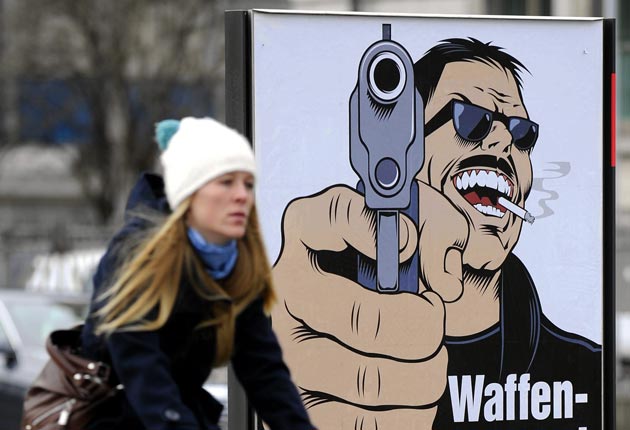
Swiss voters will take part in a nationwide referendum tomorrow that will decide whether to scrap a controversial law that allows citizens to keep guns at home according to a tradition going back to the country's legendary folk hero, William Tell.
Switzerland maintains a small national militia-type army comprised mainly of conscripts. However when soldiers leave the military they become reservists and keep their weapons.
Anti-gun campaigners say the provision has led to an estimated two million weapons being kept in Swiss households, a spiralling suicide rate and a number of mass shootings including one involving a commercial version of the army's SG 550 assault rifle. The government banned the keeping ammunition at home in 2008 in an attempt to crack down.
Elsa Kurz, a spokeswoman for Swiss anti-gun campaign group, Stop Suicide is convinced changing the law will bring a sharp decline in Switzerland's 26 per cent suicide by firearm rate, which is the highest in Europe. "If you make guns less accessible, there will be fewer suicides, it's as simple as that," she said.
Doctors and women's groups argue that guns in the home also result in serious accidents and sometimes a lethal end in cases of domestic violence. They say the Army offers the weapons to departing conscripts at rock bottom prices encouraging the practice.
In Sunday's "weapons initiative" referendum, which is backed by Greens, Social Democrats and anti-military groups, voters are being asked to approve or reject proposals to collect all privately held military firearms and deposit them in public arsenals.
However the initiative is strongly opposed by shooting clubs, army organisations, the Christian Democrats, liberals and perhaps most significantly, the populist Swiss People's Party (SVP). The right-wing organisation is the biggest political party. It recently initiated two highly controversial laws banning the construction of minarets at mosques and giving the authorities the right to deport foreign criminals.
One of the main organisations fighting the initiative is Switzerland's gun lobby, "Pro-Tell". The group takes its name from the 14th century Swiss folk hero, William Tell who famously used his hunting crossbow to assassinate a despised Austrian governor during one of Switzerland's independence wars.
"Pro Tell" president, Willy Pfund is dismissive of claims that a ban on guns in the home would cut the suicide rate. "Anyone who wants to kill himself will find a way," he said. The group claims that if those behind the initiative get their way the only people left with guns in Switzerland will be criminals.
Daniel Möckli, a senior researcher at Zurich's centre for Security Studies points out that keeping a gun at home is a deep-rooted tradition. "The concept goes back several hundred years," he said, "It is a sign of trust by the state in its citizens. The concept is about national security. It is not like American gun culture which is about individual security.
Markus Müller, a spokesman for a Swiss army officers association said that the initiative aimed to weaken the whole concept of a militia army. "It will take away the confidence the state put in its citizens," he said.
Opinion polls suggest that the proposal to surrender firearms will be carried by a slim majority with about 52 per cent of the vote on Sunday. The results show that a big turnout by women voters could tip the balance against guns at home.
Power to the people: Where the referendum rules
*Switzerland is the only country in the world that allows its people to have a direct say on legislation through frequent referenda.
Under the Swiss system of direct democracy, national and regional referenda are regulated by legal procedure, meaning that the government cannot decide if or when they are held. Special votes, known as "obligatory referenda" are compulsory for any changes to the constitution or for major international treaties. However, any federal law can also be subject to a "facultative referenda" if at least 50,000 people petition for the vote.
These are the most common type of referenda, which are mostly executed by political parties or interest groups. Recently, Swiss voters have used votes to show their support for controversial plans to make the expulsion of foreigners convicted of serious crimes easier, and for a ban on the building of minarets, which the Swiss People's Party regarded as a sign of "Islamisation".
Individual citizens also have the right to initiate a law, though they must collect 100,000 signatures within a time period of 18 months to ensure a referendum on the subject.
This proved to be too tall an order for a high-profile campaign to prevent Swiss banking secrets being passed to the US government, which failed in June last year.
Switzerland has long been famed for its secretive banking system, but the party leading the petition failed to gather enough valid signatures to force a national vote.
The Federal nature of Swiss government also encourages national issues to be decided by votes, so as to ensure that power is not centralised in one place.
Subscribe to Independent Premium to bookmark this article
Want to bookmark your favourite articles and stories to read or reference later? Start your Independent Premium subscription today.
Join our commenting forum
Join thought-provoking conversations, follow other Independent readers and see their replies