The Big Question: Why are Dutch soldiers being sued for the massacre at Srebrenica?
Why are we asking this now?
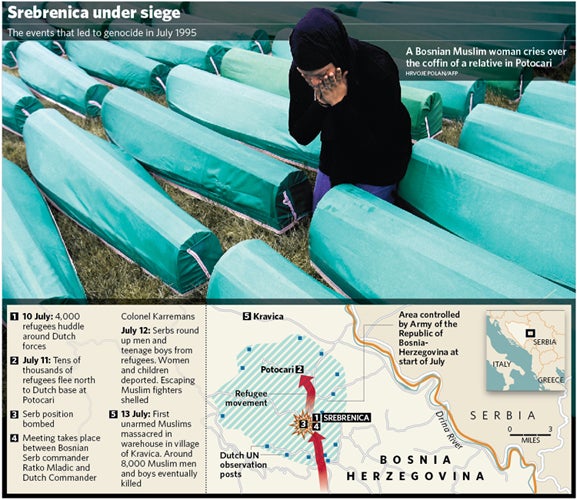
Relatives of the dead have brought a civil action alleging that the Dutch state is liable for the deaths of 8,000 Muslim civilians who were executed when Bosnian Serb forces overran the town during the Bosnia War in July 1995. It was the worst atrocity in Europe since the Second World War. The case, which has been three years coming to court, is being heard in The Hague this week. Relatives have demanded $1bn compensation.
What happened?
Srebrenica was a UN safe-haven where thousands of Bosnian Muslims from surrounding villages had gathered for protection by UN peacekeepers from the Dutch army in 1995. But when Serb forces attacked, the Dutch soldiers put up little resistance. The Dutch forced the Muslims out of a UN military base in the town and handed them over to Bosnian-Serb troops. The women, boys and old men were deported. But men of fighting age, 16-60, were rounded up by Serbian troops and paramilitaries under the command of General Ratko Mladic and massacred.
Why didn't the Dutch repel them?
There were just 400 lightly armed Dutch infantry – no match for thousands of Serbs backed by armour and artillery. The 10sq km area was impossible to defend with small arms and so few troops. That said, the Dutch denied Bosnian Muslim fighters the return of weapons they had surrendered to the peacekeepers, although they could not have defended Srebrenica for long in the face of a concerted attack.
Instead, the Dutch Commander, Colonel Ton Karremans, urged the Bosnians to withdraw from defensive positions south of Srebrenica where he believed that Nato aircraft would soon be launching air strikes against the advancing Serbs. But the air strikes never came and the Serbs took 30 Dutch soldiers hostage.
Why weren't there Nato airstrikes against the Serbs?
Because the Nato HQ in Sarajevo said the request for close air support had been submitted on the wrong form. By the time it was resubmitted, Nato planes had returned to base in Italy to refuel. It has also been said that senior Dutch military officials over-ruled the request, fearing their soldiers could be hit by "friendly fire". So Colonel Karremans did a deal, exchanging about 5,000 Muslims who had been sheltering at the Dutch base at Potocari in return for the Dutch hostages. He was filmed drinking a toast with General Mladic, who promised that the Muslims' safety would be guaranteed if they handed over their weapons.
A few days later, the Dutch Blue Helmets were ordered by their government to leave Srebrenica. Mladic was later witnessed supervising the executions.
Did the Dutch know that people were to be murdered?
They certainly knew that there had been a few summary executions. Dutch troops witnessed definite signs that the Serbs were murdering some Bosnian men. One saw an actual murder and reported it to a United Nations military observer who was impeded by Serb troops when he went to investigate. But the Dutch could have had little idea of the scale of the carefully orchestrated mass executions which followed. Men were held in schools or warehouses and then loaded on to buses or trucks and taken to isolated killing fields. There, they were taken off the trucks in small groups, lined up and shot. The crime was labelled a genocide by the International Criminal Tribunal for the former Yugoslavia set up by the UN to try war crimes committed during the conflict.
What do the Dutch say?
There was much soul-searching in the Netherlands when the truth emerged. An official Dutch report found in 2002 that the government had sent its peacekeepers on an "impossible" mission. The entire Dutch government resigned.
But the Netherlands insists its troops were abandoned by the UN, which had liability for the acts of the Dutch battalion. "The Dutch state made available soldiers for the peacekeeping mission, to keep apart fighting parties," its lawyers told the court. "The fact they didn't succeed does not mean they are liable for the atrocities." Only the UN, they argued, should be liable for compensation. More controversy was provoked in 2006 when the Dutch government awarded those who served in Srebrenica an insignia in "recognition for their behaviour in difficult circumstances".
So was it the UN's fault?
The UN admitted in a report issued by the secretary general in 1999 that it had failed adequately to protect the Muslims of Srebrenica from mass murder. But it said that none of its officials could be held responsible and invoked its legal immunity.
What do the Serbs say?
At the time they argued that they attacked the town because its safe-haven status was being abused by the Muslims to launch counter-offensives against Serb forces and that the UN was failing to stop this. But Dutch troops say there was no evidence for this beyond the odd raid on Serb villages to find food for the besieged town after the Serbs had refused access for humanitarian convoys.
A report by the government of Republika Srpska exonerated its troops but later Serb officials acknowledged that their security forces planned and carried out the mass killing. In 2004 Paddy Ashdown, the UN's High Representative in the area, forced the Republika Srpska government to investigate. It produced a report which confessed that 8,731 men were missing and 7,800 were known to have died in the planned mass murder. Its president issued an official apology.
What do the relatives of the dead say?
That their loved ones were "exposed to the enemy" in contravention of Bosnian law, European law, the Geneva Treaty and the international treaty on genocide. They accuse the Dutch of negligence saying "they had a humanitarian assignment, but acted contrary to their instructions".
What happened to the killers?
In April 2007, a Serbian war crimes court sentenced four members of a paramilitary group to a total of 58 years in prison for executions in Srebrenica. General Radislav Krstic, who led the assault on Srebrenica with General Mladic, was convicted by the International Criminal Tribunal of aiding and abetting genocide and was jailed for 35 years. Former Serb president Slobodan Milosevic, accused of genocide for crimes which included the Srebrenica massacre, died while on trial in 2006. Mladic is still at large.
Were the Dutch really to blame for the Srebrenica massacre?
Yes...
* They bungled the military operation to hold off the Serbs by not calling in Nato airstrikes in time
* They refused to re-arm the Bosnian Muslims as the Bosnian Serbs moved on Srebrenica
* They were naive in handing over Muslim refugees to Serb commanders falsely promising them safety
No...
* Serb political leaders with genocidal policies and a ruthless Serb military are the real villains
* The United Nations did not give sufficient backing to the handful of Dutch troops on the ground
* Dutch troops did their best but their "impossible mission" was doomed to failure
Join our commenting forum
Join thought-provoking conversations, follow other Independent readers and see their replies
Comments