The nation has to face up to its extremist threat
Wealth and political stability have not protected this model of social democracy from tensions over immigration
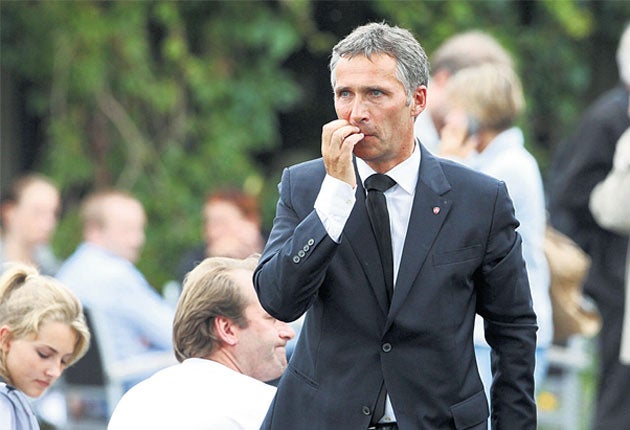
Jens Stoltenberg spoke for his shattered nation when he gave his first response to the Oslo massacres yesterday. "This is beyond comprehension," the Norwegian Prime Minister told a news conference in Oslo. "It's a nightmare."
For a country that has grown into a stable democracy over several decades, a politically motivated massacre by a fellow countryman is indeed incomprehensible. Affluent Norway, with almost no debt and buoyed by £21bn-worth of oil revenues every year, is the model of a modern social democracy. Its traditionally high standards of healthcare and education led the Organisation for Economic Co-operation and Development (OECD) to rank it as one of the 10 happiest countries in the world. Shortly before that, the charity Save the Children ranked Norway as the best place in the world to be a mother.
The political stability of the post-war period has helped. Mr Stoltenberg's Labour Party, created – like its British equivalent – as a radical alternative to the status quo, has become part of the establishment. The Labour aristocracy has been in power for 26 of the past 40 years and now rules in coalition with the Greens.
Mr Stoltenberg, a former journalist, has become part of that establishment. He came up through the party ranks, spending many summers on Utoya Island, but as a leader he has attempted to shift Labour from its traditional statist beliefs. In his first spell in power a decade ago, he angered many in his party with reforms to the welfare state, including the part-privatisation of a number of state-owned services and corporations. The electorate responded by delivering Labour only 24 per cent of the vote.
Norway, a very homogenous nation, is viewed as a welcoming destination for migrants – more than 11 per cent of the present population are classed as immigrants. The steep increase in immigrants in recent years – the majority from outside Western Europe – has given Oslo the label the "fastest growing city in Europe because of increased immigration".
The influx has not, however, resulted in the concerns over social cohesion and terror that have been expressed in other Western nations. Norway, convinced of the stability of its people, may have noticed an increase in anti-immigrant sentiment, but did not regard it as a problem.
In fact, in an annual threat assessment published in January, the Norwegian security services reported increased activity within "far-right and far-left extremist communities" during the past year – but concluded that they would not "pose a serious threat to Norwegian society in 2011".
The case of Anders Behring Breivik demands an urgent rethink. The evidence suggests he may be a deeply frustrated right-wing extremist: a fundamentalist Christian, a gun nut with a grudge against Labour, and perhaps a member of the Progress Party (FrP).
This far-right grouping, which advocates cutting migration radically, was founded in the 1970s, and has already become the second-largest party in Norway – gaining much of its support from Labour itself.
After reading Breivik's comments on Christian websites, academics suggest that he is likely to have been influenced by the rise in anti-Muslim groups, whose activity increased in Norway last year. Asbjorn Dyremdal, a professor at the Norwegian University of Science and Technology who specialises in extremist groupings, said Norway has seen a move away from neo-Nazi extremism on the ground to nationalist and anti-Islamic attacks online in recent years.
He said: "Breivik seems to have anti-racist but strongly anti-Islamic views, tied to religion, ethnicity and culture. He appears strongly anti-government, and in a way that other conspiracy groups do, he might blame the government for facilitating what he would call a 'Muslim takeover'".
It is an underworld that has been growing for several years, but Norway is only turning its eyes to it today. There is an increasing number of people who believe that rich Norway is letting too many people in to share its wealth. Their claims, however unpalatable, will have to be addressed.
And many Norwegians are already concerned that, in a country where security has always been a low priority, their long-held liberties might be the next target for politicians.
"We should not let fear paralyse our ability to think clearly and wisely," Harald Stanghelle, the political editor of the daily Aftenbladet wrote. "There is much that we should not allow to be sacrificed on the altar of fear."
The Justice Minister, Knut Storberget, conceded that the massacre "is sure to change Norway".
He added: "I hope we will come to value more highly the democratic and open work done by youth and others in political and voluntary organisations."
The implications for Britain
In the wake of the attacks in Norway, Britain has been invited to contribute to a Europe-wide police effort to investigate terrorism. Europol said the move was pertinent to the UK, where "authorities reported that the number of incidents involving right-wing extremists linked to explosives, weapons or prohibited items has increased in the last 10 years".
Europol spokesman Soeren Pedersen said right-wing groups "are getting more professional, more aggressive in the way they attract others to their cause." This was reaffirmed by online correspondence from the alleged gunman Anders Behring Breivik, which cited English Defence League demonstrations as a sign of a rising anti-Islamic mood across Europe.
The Foreign Office warned of a high threat from terrorism, and said Britons in Norway should take extra care.
Between 20,000 and 40,000 Norwegians are estimated to be either living in the UK or visiting, with the Norwegian embassy in London spending much of the weekend dealing with Britons concerned about families and loved ones who are still in Norway.
Join our commenting forum
Join thought-provoking conversations, follow other Independent readers and see their replies
Comments
Bookmark popover
Removed from bookmarks