The Sarajevo legacy
Joy at Karadzic arrest gives way to the realisation that he succeeded in ethnic carve-up of Bosnia
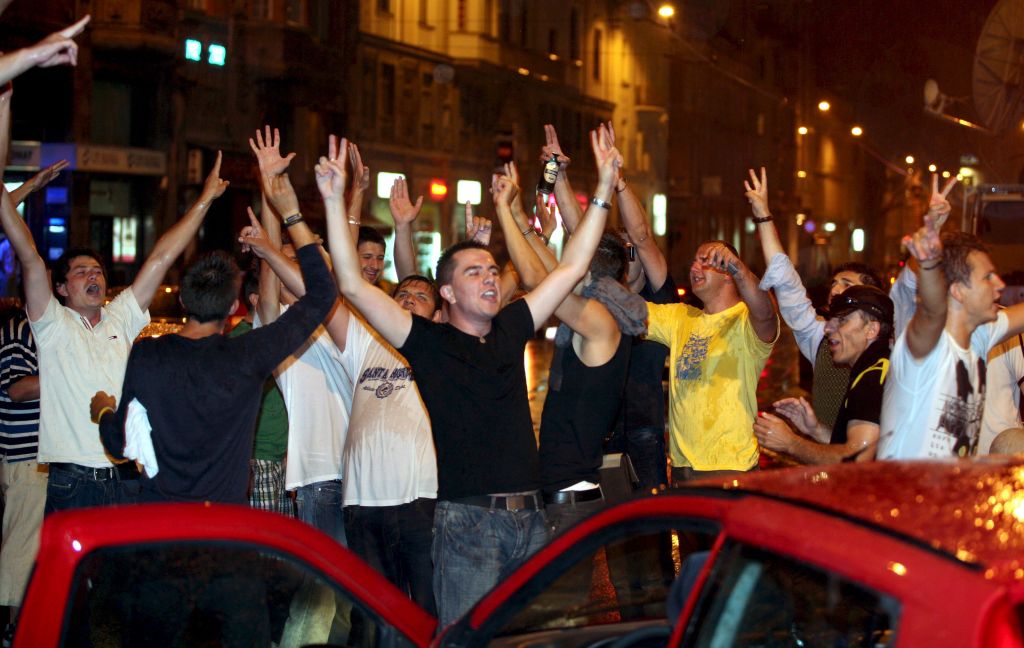
The jubilation of the people of Sarajevo at the capture of Radovan Karadzic, the man they blame for the bloody siege which pinned down their city for 44 months and cost 10,000 lives, has slowly evaporated during an extraordinary week of revelations. What was left yesterday was a coming to terms with the bitter fact that much of what the former Bosnian-Serb leader stood for has already come to pass.
"I didn't feel much jubilation," admitted Senad Slatina, a political analyst in the city. "Some of the young people say it's a good thing but for me it's so overdue that it's almost irrelevant. Karadzic is no longer on the scene, but his ideas and his life work are almost on the verge of becoming reality."
In Belgrade, Karadzic's lawyer spoke of spinning out his appeal against extradition as long as possible, but the deadline passed without any confirmation of the move. But in Sarajevo the fact is that the statelet Karadzic invented, the Republika Srpska – the Serbian entity which was meant to become part of Greater Serbia – is alive and kicking, and writing the nation's future.
It was the political fantasy that produced the siege of Sarajevo, the ethnic cleansing of communities all over Bosnia, and the prison camps for "cleansed" Bosniaks who survived these purges. Srebrenica became the ultimate symbol of this, the ugliest chapter in the disintegration of Yugoslavia. The gritty, Muslim-dominated mining town in eastern Bosnia, theoretically protected by United Nations peacekeepers, was bombarded and then invaded by Bosnian Serb forces. Muslim women and children were packed on to buses and sent to safety, but their menfolk, nearly 8,000 of them, were rounded up and shot.
The man whose ideas produced Srebrenica will soon face justice in The Hague, but on the ground in Bosnia, many fear that those ideas have triumphed.
The work of the International Commission for Missing Persons in exhuming the victims of Srebrenica, many broken by mechanical diggers and exhumed and reburied to obscure what happened to them, has given thousands of families something to bury and a name to put on a gravestone. Yet the town itself remains ethnically cleansed. The town's Mayor, Abduraham Malkic, may be a Muslim, but he lives in a Muslim enclave far away and commutes to his office.
Bosnia-Herzegovina is a multi-ethnic state in name, but in fact it is rigidly divided. And the state architecture sanctified by the Dayton Peace Agreement, which ended the war, has sanctified that reality, because the state institutions vie for power with those representing the Republika Srpska on the one hand, the ethnic Serbian entity, and the Muslim-Croat Federation on the other.
The legacy of Karadzic, right across Bosnia, is the division of everything by ethnicity: schools, police forces, district offices, work places, television stations, newspapers, practically everything. So although a few hundred Bosniaks in Sarajevo took to the rainy streets to celebrate Karadzic's arrest on Monday night, the demonstration did not last long.
"The descriptions of celebrations of his arrest were pretty manufactured," commented one foreign resident of Sarajevo. "The people who made a noise about it were out drinking anyway, and it only lasted a short while. The next day was very much business as normal. There was a sense of – at this point you expect us to care?"
The history of Bosnia since the Dayton agreement has been a constant tug-of-war between the ethnic entities – Republika Srpska in particular – and the nation-state of Bosnia-Herzegovina, supported by the international community.
"Bosnia cannot function on its own, without the international community," said Mr Slatina. "When there was a very active International High Representative – Paddy Ashdown in particular – there were a lot of reforms, things were moving forward. Now the international community is desperate to disengage from Bosnia, and we are learning how problematic Bosnia is as a country.
"There are two directly opposed political lines. One wants the country to survive and find its place in the European Union. The other is following the Karadzic line. Because, although he's gone, his policies are still very much alive. He has been delegitimised but his policies have not."
Bosnia's centrifugal tendencies have been aggravated by the rise of Milorad Dodic, the Serb political leader who opposed Karadzic during the war but who has since embraced many of his policies. When Kosovo became independent he threatened that Republika Srpska might go the same way. He fought and won battles with Lord Ashdown to prevent the control of the police shifting from the entities to the state, and has been trying to restore tax-raising powers to the entities.
"I was watching Milorad Dodic on television," said Mr Slatina, "and I said to myself, if Radovan Karadzic was sitting there would he be saying anything different? It's unfortunate that people think Karadzic's arrest has resolved the issue. Because Bosnia is still a ticking bomb."
Real Dragan Dabic 'shocked' at identity theft
The real Dragan Dabic, a 66-year construction worker, was shocked to discover his identity had apparently been stolen by one of the world's most notorious war crimes suspects. Radovan Karadzic assumed Mr Dabic's identity as a cover during the autocratic rule of his mentor, Slobodan Milosevic, officials said on Thursday as they promised to track down anyone who helped the Bosnian-Serb warlord stay on the run from genocide charges for nearly 13 years. The genuine Mr Dabic lives in Ruma, just north of Belgrade, according to Rasim Ljajic, a government official in charge of war crimes.
Join our commenting forum
Join thought-provoking conversations, follow other Independent readers and see their replies
Comments
Bookmark popover
Removed from bookmarks