Thousands of victims still to be identified 14 years after Srebrenica
Anniversary marked with burial of 500 men / Ethnic tension persists in Serb-dominated town
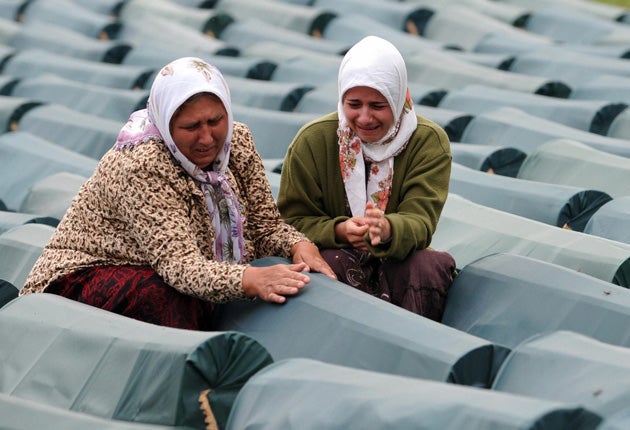
Today, fourteen years after the massacre of 8,000 Bosnian Muslims in Srebrenica – the worst atrocity in Europe since the end of the Second World War – another 500 coffins will join the thousands buried in the memorial graveyard outside the town.
The International Commission on Missing Persons has been carrying out the grim task of identifying remains using DNA and other evidence, allowing relatives to bury their dead and gain "closure". To date, it has identified 6,186 of the massacre's victims. Every year, on the anniversary, the bodies that have been identified in the previous 12 months are laid to rest in a ceremony of painful emotion. After today's funeral, groups of mourners will lay flowers in front of the barn in the nearby village of Kravica where, in the worst single incident of the massacre, more than 1,000 men were tortured and executed in a single afternoon.
But the region is still overwhelmingly inhabited by Serbs, who resent the commemorative events as an attack on their community. Last year tensions ran so high that victims' families were prevented from visiting the barn. This year Serbian residents of Kravica have asked the authorities to ban the gathering. In an open letter they claimed it would "lead to a huge deterioration of the security situation and, almost certainly, to conflicts..."
But the relatives are defiant. "We shall go, even if they kill us," said Munira Subasic, of an organisation called Mothers of Srebrenica. "Every year, they pull some stunt to divert attention from the fact that genocide was committed by the Republika Serpska army and police in Srebrenica."
Though hemmed in by Serbs, the Muslim community of the coal mining town in eastern Bosnia believed itself to be under the protection of about 600 Dutch UN peacekeepers. But when Serbian forces poured into the town in the summer of 1995, under the command of General Ratko Mladic, the Dutch failed to protect their charges. The women and children were crammed into buses and sent away to safety, but over a period of three days the unarmed men, aged from 12 to 77, were systematically murdered.
Afterwards their bodies were dumped into rivers and mass graves. When aerial photos surfaced afterwards, the Serbian army ordered the corpses to be dispersed to secondary and even tertiary grave sites, to hide the carnage. This was done by bulldozers and resulted in bodies being broken up and widely scattered. In one case, the remains of a victim were discovered in four different mass graves, two of which were about 12 miles apart.
Srebrenica is Serb-dominated now and ethnic intolerance is a steady undercurrent in the region. The nearby town of Bratunac is said to hold the highest number of unprosecuted war criminals per capita in all of Bosnia. Many of them serve in the local police force.
While more than 2,000 of the dead remain to be identified, even for those who have buried their loved ones, the pain goes on. Zlata Mujic, a smart, blue-eyed blonde now in her forties, spent her childhood ("the most beautiful part of my life") in Srebrenica and met her husband while still at school there. She was 28 when both her husband and her father were taken from her. Eleven men in total from her extended family were killed in the massacre.
For years she knew nothing of her husband's fate. "We had this false hope that he might still be alive: it was said that some of the men had escaped and were working as miners or factory workers in Serbia." But last year DNA testing confirmed his death. "They told me his body was dumped into the Drina River first," she said. "But the legs were found in one grave. The hands in another. The head was never found."
A year ago today they buried his remains alongside all the others. "Life since the fall of Srebrenica has only been a fragment of existence," she said. "I wonder every day why I am alive, and why he is not. I am just breathing, not living."
Join our commenting forum
Join thought-provoking conversations, follow other Independent readers and see their replies
Comments