Three dead in Athens riots as Greek crisis sees euro plummet
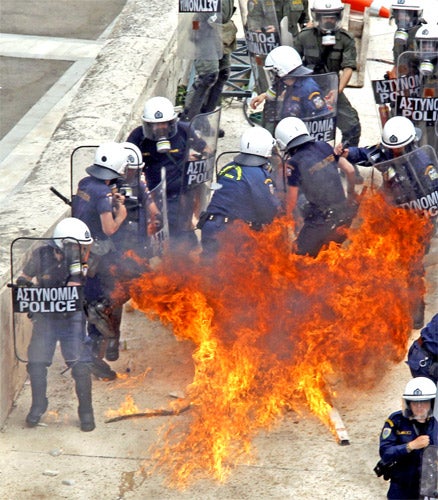
Rioters in Greece have put a torch to the European Union's hopes of containing the worst crisis in its history. As the German chancellor openly admitted that the very future of the Union is at stake, stock markets across Europe plunged and the euro fell to new lows against the dollar. Like the anarchists and communists throwing Molotov cocktails in the streets of the Greek capital, investors voted with their feet and took their own form of direct action, dumping European stocks and the single currency itself.
Three people died when a bank went up in flames from a petrol bomb thrown by protesters, as more than 100,000 Greeks took to the streets in Athens and elsewhere to protest against the savage spending cuts and tax rises that have been agreed with the IMF and eurozone states.
"Everyone has the right to protest," the prime minister, George Papandreou, told parliament. "But no one has the right to violence and especially violence that leads to the death of our compatriots."
Despite Mr Papandreou's tough words and his assurances that he can bring the Greek economy into line, it was clear yesterday that the authorities were not in control of Athens – the parliament building itself came under siege. The bodies of the three people who died were found in the wreckage of a Marfin Bank branch, on the route of the march in the city centre. Thick black smoke and shouts of "Thieves! Thieves!" filled the air.
Olli Rehn, the European Commissioner for Economic and Monetary Affairs, warned: "It's absolutely essential to contain the bushfire in Greece so that it will not become a forest fire and a threat to financial stability for the European Union and its economy as a whole."
Berlin, too, is feeling the heat. "This is about nothing less than the future of Europe – and with it the future of Germany in Europe. We are at a fork in the road," Chancellor Merkel declared in an impassioned plea to the Bundestag to approve the Greek rescue package.
The Finnish finance minister, Jyrki Katainen, spoke for many colleagues when he declared: "Our economies are so linked that a risk that problems spread from a country to another is very high." The European Commission predicts a drop of 3 per cent in Greek GDP next year, a dramatic fall.
Demonstrators attempted to break through a riot police cordon guarding parliament, and chased the ceremonial guards away from the Tomb of the Unknown Soldier in front of the building. Mr Papandreou said on Sunday that Greek public workers would have to accept cuts in salaries and pensions and that VAT would rise again.
It has enraged the population, already violently resentful. Thessaloniki and other centres also saw protests, and workers staged a 24-hour general strike that grounded all flights to and from Greece, shut down ports, schools and government services and left hospitals working with emergency staff only. The Acropolis and all other ancient sites were closed, and even journalists suspended television and radio news broadcasts.
The fear among investors is that the violence might lead to political failure and the unravelling of the financial deal to save Greece from bankruptcy. Should Greece default on her debt – inevitable unless she receives extensive funding from the IMF and Germany – the "contagion" that has so far been kept under control would engulf the other weak members of the eurozone. Portugal is widely thought to be the next candidate for speculative attack. Yesterday, Moody's credit rating agency did not help matters by putting the highly indebted country on review for a "very likely" downgrade.
When that happened, the euro promptly fell to a fresh one-year low against the American dollar and the FTSE-100 index of leading shares in London slumped by almost two per cent. Stock markets across Europe were similarly shocked at the speed with which confidence in the weaker eurozone members is evaporating. Greece alone will cost €110bn (£94bn) to support over the next three years, and Germany is expected to contribute €22.3bn and France €16.3bn.
Not even the resources of Germany, and possibly the IMF, would be able to rescue a succession of states that followed Greece towards bankruptcy, including Portugal, Ireland, Spain and Italy. And political resistance in Germany to such commitments, were they ever to be contemplated, might prevent future efforts to stabilise the eurozone. In that circumstance, the break-up of the single-currency area, barely a decade after its foundation, becomes a very real possibility.
The consequences of a widespread devaluation of European government bonds would be far-reaching, echoing the original credit crunch and the collapse of the financial system during 2007 to 2008. Such a further constriction of credit and banking failures would come at a time when few governments would be able to issue more government debt to pay for further bailouts. The parallels with the earlier subprime crisis and financial meltdown are painfully obvious to many.
Join our commenting forum
Join thought-provoking conversations, follow other Independent readers and see their replies
Comments