Tricky times for EU as Sarkozy hands presidency to Czechs
Hyperactive French leader, who took command during series of crises, passes baton to weak and divided Prague
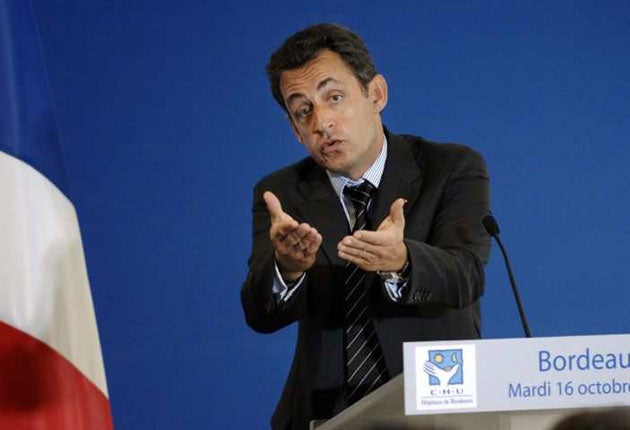
The European Union faces one of the oddest baton changes in its history next week. France, in the inexhaustible shape of Nicolas Sarkozy, will hand over the presidency of the EU to an inexperienced Czech government split between a Euro-negative President and a Euro-positive Prime Minister.
The past six months have produced a noisy collision in Brussels between M. Sarkozy's activism and vanity, and a flurry of crises, ranging from the war in Georgia to the global recession and the Irish rejection of the EU reform treaty. Cometh the hour, cometh the man. Although President Sarkozy has ruffled many feathers (especially German plumage), he has also redefined the rotating presidency of the European Union. Rarely has there been an EU president who has a) wanted to be seen to be doing so much and b) been blessed with so many problems to solve.
President Sarkozy cut short what might have been a calamitous Russia-Georgia war. He (with Gordon Brown's help) persuaded the 27 EU governments to act in unison to refloat their banks. He pushed through a somewhat depleted, but still ambitious, EU plan to curb carbon emissions. He helped to finesse a second Irish vote to rescue, late next year, the EU treaty on institutional reform.
At home, the President's popularity has been bolstered by his diplomatic hyperactivity. M. Sarkozy's approval ratings – which were languishing thanks to rising living costs in France, his penchant for confrontation and his celebrity lifestyle with his former model and singer wife Carla Bruni, have improved significantly since he took over the EU helm.
And across Europe, on the right and the left, those who are instinctively pro-Sarko and those who are anti-Sarko agree, broadly, on one thing. The French President may not have got everything right but he put himself, and therefore the EU, at the centre of the game. In the past six months, no one could accuse Europe of being invisible or – as Henry Kissinger once said – of "having no telephone number".
Such was the pace set by President Sarkozy that some European governments and bureaucrats (perhaps not a million kilometres from Berlin) might be relieved to see a transition to the lower-key Czechs. The problem is that the biggest problem of all – the global recession – is far from solved. The worst of its effects have not yet reached continental Europe or the bulk of "euroland", the 15 nations using the European single currency.
The euro itself may appear to be riding insolently high, especially for Brits contemplating a skiing holiday in the Alps or those living on the continent on a sterling salary.
But the agreement to refloat banks has not been matched by a common EU approach on how to refloat economies. Despite the European Commission's €20bn (£19bn) "stimulus plan", the British are busy feeding "demand" while the French and (reluctantly) the Germans are turning up the dial marked "offer". The prudent Germans, the only large country with money to burn, are declining ant-like, to have a bonfire of euros which would help their grasshopper neighbours. A Big Row may be waiting to happen in euroland next year and the ring-master in the next six months will be a country which is itself bitterly divided on European policy and may face a general election during its European term of office.
The President of the Czech Republic, Vaclav Klaus, is an implacable Eurosceptic. The Prime Minister, Mirek Topolanek, is a moderate anti-federalist, pro-European. The two men detest one another. The country has yet to ratify the Lisbon "reform" treaty. It does not yet belong to the euro and would find it difficult to police a euroland civil war.
For these reasons, President Sarkozy modestly put himself forward in November for a de-facto "second term" as EU president – or at least as president of euroland. He was shouted down by, among others, the Czechs, who said that they might be small, divided and inexperienced, but could still make a success of their turn at the wheel of the EU.
President Sarkozy will certainly be a difficult act to follow. After the Czechs, not many others will have a chance to try. If Irish voters do vote "yes", at the second time of asking, the whole concept of the rotating national "presidency" of the EU will be replaced (partially) from 2010 by a permanent EU council president. M. Sarkozy's energy and vanity have changed the rules of the "presidency" game just in time for the rules to change again anyway.
War over Europe President is 'against the EU'
*He steadfastly refuses to fly the European Union's blue and yellow-starred flag over Prague's Hradcany Castle; he's had a shouting match with a visiting European Parliament delegation; and he has been vociferously campaigning against the Lisbon Treaty. But the Czech President, Vaclav Klaus, will be centre-stage in Europe when his country takes over the rotating EU presidency on 1 January.
And the regional bloc could be in for some bumpy times. At a recent lunch with EU ambassadors, Mr Klaus was asked how various policies might be handled under the Czech stewardship. To each enquiry, he reportedly growled that he had no need to answer such questions because he was against the EU. The 67-year-old economist, who took over as the largely ceremonial head of state in 2003 from the playwright Vaclav Havel, has likened bank bailouts to "old socialism", branded NGOs as more dangerous than communism, thinks global warming is a myth and environmental issues a "luxury". Although he shuns the term "Eurosceptic", preferring to call himself a "Eurorealist", Mr Klaus has been actively campaigning against the Lisbon Treaty. In November, the Czech leader had dinner in Dublin with Ireland's poster-boy for the nay-sayers Declan Ganley, causing a minor diplomatic incident.
The Czech government, led by Prime Minister Mirek Topolanek, is attempting to ratify the treaty and the pair have fallen out over Europe to the extent that the President quit their Civic Democratic Party, which he himself had founded in 1991. Mr Topolanek, 52, sees the EU as vital for a country with a Soviet past. "It's by far better to kiss the German Chancellor than to hug the Russian bear," he wrote in a newspaper editorial.
Join our commenting forum
Join thought-provoking conversations, follow other Independent readers and see their replies
Comments
Bookmark popover
Removed from bookmarks